


TL;DR:
- Vegan soap is made exclusively from plant-based fats and oils, avoiding animal-derived ingredients and testing. It offers ethical benefits by reducing harm to animals and can provide skin-friendly, nourishing formulations when properly crafted. Certification programs verify its supply chain integrity, and environmental impacts depend on sourcing, packaging, and formulation choices.
Vegan soap is defined as soap made exclusively from fats and oils of vegetable origin, with no animal-derived ingredients, no animal testing, and no animal-related processes anywhere in the supply chain. That definition alone explains why it sits at the center of modern ethical beauty products. Choosing it means your daily cleansing routine no longer depends on tallow, lanolin, or gelatin. It means your skin gets plant-based nourishment from ingredients like aloe vera, coconut oil, and essential oils. And it means your purchase sends a clear signal about what you value. The importance of vegan soap spans personal health, animal welfare, and environmental responsibility, and each of those dimensions deserves a close look.
Why vegan soap matters: ingredients and what sets it apart
Vegan soap is made from vegetable fats and oils, excluding every animal-derived ingredient found in conventional bars. Traditional soap commonly contains tallow (rendered beef fat), lard (pork fat), lanolin (sheep wool grease), and gelatin (boiled animal bones and connective tissue). Vegan formulations replace all of these with plant oils such as coconut, olive, shea, palm, or castor oil, and add functional botanicals like aloe vera, pectin, or essential oils.

One confusion worth clearing up immediately: vegan and cruelty-free are not the same claim. Cruelty-free focuses on animal testing avoidance, while vegan means no animal-derived ingredients at any stage of production or the supply chain. A product can be cruelty-free but still contain beeswax or lanolin. A product can be labeled vegan but still have been tested on animals in a market that requires it. Reading both labels together gives you the full picture.
The fat source also changes how soap behaves chemically. Tallow-based bars tend to produce a dense, creamy lather because of their saturated fatty acid profile. Plant-oil-based bars can match or exceed that performance when formulated correctly, but the balance of oils matters. Coconut oil drives foam height; olive oil contributes conditioning; castor oil adds slip. Formulators who understand this chemistry produce vegan bars that clean effectively without stripping skin.
Pro Tip: When reading a vegan soap label, look for the specific oils listed rather than just the word “vegan.” Coconut oil, shea butter, and olive oil in the first three ingredients signal a well-balanced, skin-friendly formula.
| Feature | Conventional soap | Vegan soap |
|---|---|---|
| Primary fat source | Tallow, lard, lanolin | Coconut, olive, shea, castor oil |
| Animal testing | Varies by brand and market | Prohibited under vegan certification |
| Common additives | Gelatin, milk proteins | Aloe vera, essential oils, pectin |
| Certification available | Cruelty-free logos | NSF P543 vegan label, Vegetarian Society |
What makes vegan soap an ethical choice, and how is it certified?
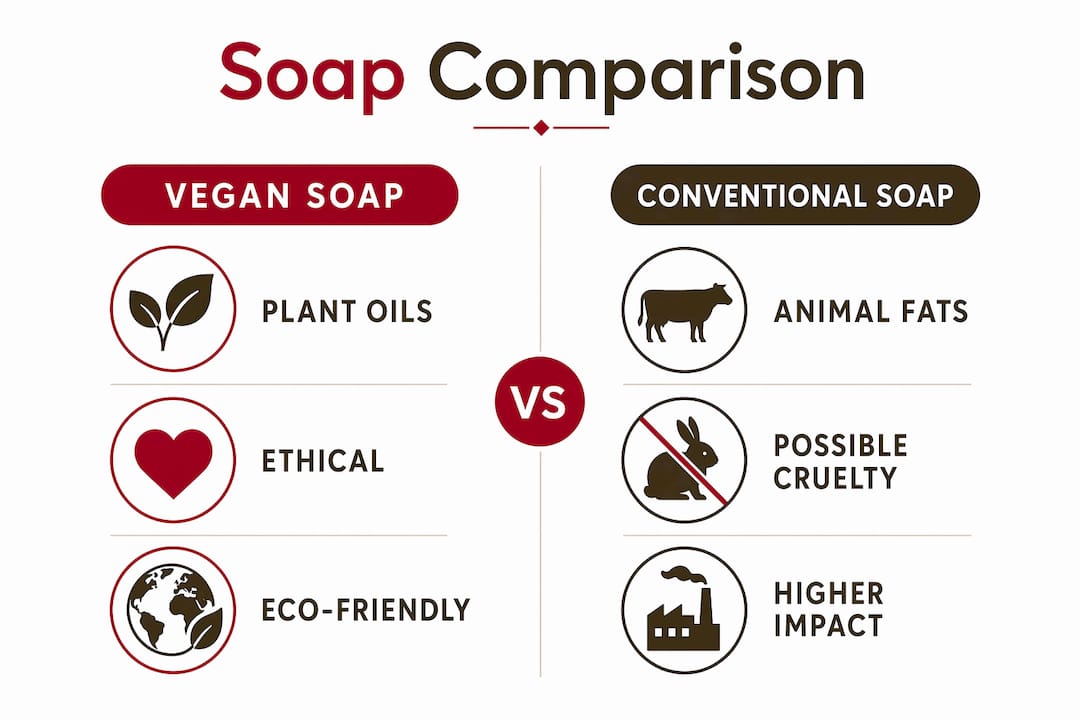
The ethical case for vegan soap rests on a straightforward principle: no animal should be harmed or exploited to clean your face. That means avoiding ingredients sourced from slaughter byproducts like tallow and gelatin, as well as ingredients that involve animal use without slaughter, like lanolin from sheep or beeswax. Veganism as a framework covers the entire production chain, not just the finished product.
Certification is where ethical claims become verifiable. NSF P543 certification requires that vegan soaps contain no animal-derived ingredients, prohibit animal testing, and mandate strict supply chain and manufacturing controls. The program covers ingredient sourcing, processing aids, packaging materials, manufacturing standard operating procedures, and annual audits. That level of scrutiny matters because supply chain variability is real. A processing aid used to clean manufacturing equipment could introduce animal-derived residues without the brand’s knowledge.
Here is what a credible vegan certification program actually evaluates:
- Ingredient review: Every raw material is screened for animal origin, including processing aids and carriers.
- Supplier documentation: Suppliers must provide declarations confirming no animal-derived inputs.
- Manufacturing controls: Shared equipment and cleaning protocols are assessed for cross-contamination risk.
- Packaging review: Even packaging materials are checked for animal-derived adhesives or coatings.
- Annual audits: Certification is not a one-time approval. Brands are re-evaluated each year.
Supply chain variability and processing aids pose real risks to vegan status without these controls. This is why a logo from NSF or the Vegetarian Society carries more weight than a brand’s self-declared “vegan” claim on the front of the package. When you see a third-party mark, someone has done the verification work for you.
What environmental benefits does vegan soap offer compared to conventional options?
The environmental case for vegan soap is real, but it requires nuance. Plant-based ingredients do not automatically mean a lower carbon footprint. Life-cycle assessments show that ingredient systems and packaging choices in personal care significantly impact environmental footprints, measured in CO2-equivalents per product unit. The ingredient source matters, but so does how it is processed, transported, and packaged.
Biosurfactants and biobased formulations can reduce climate change impact compared to petrochemical-derived surfactants used in many conventional products. However, full environmental benefits depend on performance optimization and packaging design, not just the ingredient list. A vegan soap wrapped in excessive plastic and shipped from the other side of the world may have a larger footprint than a locally produced conventional bar in minimal packaging.
| Environmental factor | What drives impact | Vegan soap advantage |
|---|---|---|
| Ingredient sourcing | Feedstock origin and farming practices | Plant oils from certified sustainable farms |
| Processing energy | Manufacturing and refining methods | Biosurfactants reduce processing burden |
| Packaging | Material type and recyclability | Brands increasingly use paper or zero-waste wraps |
| Transportation | Distance from source to consumer | Supports local and regional supply chains |
The practical takeaway is to look beyond the “plant-based” label. Seek out brands that combine vegan formulations with certified sustainable sourcing and minimal packaging. Those products deliver the environmental benefit the label implies. Didisbeautycenter’s eco-friendly skincare approach reflects exactly this thinking, pairing vegan ingredients with responsible packaging choices.
Pro Tip: Check whether a vegan soap brand discloses its palm oil sourcing. Palm oil is common in vegan formulations but carries deforestation risk unless it carries RSPO (Roundtable on Sustainable Palm Oil) certification.
How does vegan soap affect skin health and cleansing performance?
The benefits of vegan soap for skin health are grounded in formulation science, not just marketing. Soap properties like pH and foam height strongly depend on the fat base. Aloe vera gel, a common vegan additive, boosts moisturizing and foamability while helping maintain a skin-compatible pH around 9.75. That pH range is mild enough for regular use without disrupting the skin’s natural acid mantle.
Plant oils bring specific skin benefits based on their fatty acid profiles. Coconut oil contributes lauric acid, which has antimicrobial properties. Olive oil is rich in oleic acid, which mimics the skin’s own sebum and supports moisture retention. Shea butter adds stearic and oleic acids that soften and protect. When a formulator combines these thoughtfully, the result is a bar that cleans without stripping and leaves skin feeling balanced rather than tight.
That said, vegan soap is not automatically gentler for every skin type. Vegan base alone doesn’t guarantee gentleness. Surfactant chemistry and pH behavior are the key factors. A poorly formulated vegan bar with a high pH and aggressive surfactant system can irritate sensitive skin just as readily as a conventional product. Formulation expertise is what separates a genuinely skin-friendly bar from one that simply carries a vegan label.
Ingredients that consistently improve vegan soap performance for skin include:
- Aloe vera: Soothes, hydrates, and supports foam stability.
- Castor oil: Adds slip and contributes to a creamy, conditioning lather.
- Shea butter: Protects the skin barrier and reduces post-wash tightness.
- Essential oils (lavender, tea tree): Provide fragrance and functional benefits like antimicrobial action.
- Vitamin E (tocopherol): Acts as an antioxidant and extends shelf life naturally.
Pro Tip: If you have sensitive or reactive skin, choose a vegan soap with a short ingredient list and no synthetic fragrance. Fewer ingredients means fewer potential triggers, and a well-chosen plant oil base does the heavy lifting on its own.
For a deeper look at how these ingredients fit into a full routine, the step-by-step vegan skincare guide from Didisbeautycenter walks through daily application in practical terms.
Key takeaways
Vegan soap matters because it combines verified ethical sourcing, plant-based skin benefits, and a measurably lower environmental footprint when formulated and certified correctly.
| Point | Details |
|---|---|
| Vegan vs. cruelty-free | These are distinct claims; vegan covers ingredients and supply chain, cruelty-free covers testing only. |
| Certification is essential | NSF P543 and Vegetarian Society marks verify ingredient sourcing, manufacturing, and annual compliance. |
| Environmental impact needs context | Plant-based ingredients reduce footprint only when paired with sustainable sourcing and minimal packaging. |
| Formulation drives skin results | pH, surfactant choice, and oil balance determine gentleness, not the vegan label alone. |
| Key skin-boosting ingredients | Aloe vera, shea butter, castor oil, and vitamin E consistently improve vegan soap performance. |
Why I think the vegan soap conversation is still missing the point
Most articles on this topic stop at “plant-based is better.” After years of working in natural skincare and watching the vegan beauty space grow, I think that framing does more harm than good. It creates a false shortcut where consumers assume any bar labeled vegan is automatically ethical, gentle, and sustainable. The research does not support that assumption.
What I have seen work is a different approach: start with certification, then read the ingredient list, then consider the packaging. In that order. The NSF P543 vegan label tells you the supply chain has been audited. The ingredient list tells you whether the formulator actually knows what they are doing with plant oils. The packaging tells you whether the brand’s environmental commitment extends beyond the formula.
I also think the skin health angle is underappreciated. Most people switching to vegan soap are doing it for ethical reasons, which is valid. But when they find a well-formulated bar with aloe vera, shea butter, and a balanced pH, they often report that their skin feels better than it did with their previous conventional soap. That is not a coincidence. It reflects the fact that many conventional bars rely on tallow and synthetic additives that work fine but do not actively nourish. A thoughtfully made vegan bar can do both.
My honest advice: do not let the label do all the thinking for you. Look for the certification mark, check the oil base, and give your skin two to three weeks to adjust before judging. The ethical and skin benefits of vegan beauty are real, but they show up most clearly in products where the formulation matches the values on the label.
— Gloria
Explore vegan soap options at Didisbeautycenter
Didisbeautycenter offers a curated range of vegan soap formulations built on plant-based ingredients with transparent sourcing and no animal-derived additives. Every product reflects the brand’s commitment to ethical beauty products that perform as well as they promise. For entrepreneurs and small business owners, Didisbeautycenter’s private label program provides ready-to-label vegan soap options with ingredient standards and certification support built in. Whether you are building a personal skincare routine or launching your own natural beauty brand, Didisbeautycenter gives you a reliable starting point grounded in quality, transparency, and genuine sustainability.
FAQ
What is vegan soap made of?
Vegan soap is made from vegetable fats and oils such as coconut, olive, shea, and castor oil, with no animal-derived ingredients like tallow, lanolin, or gelatin. Functional botanicals like aloe vera and essential oils are commonly added for skin and performance benefits.
Is vegan soap the same as cruelty-free soap?
No. Cruelty-free means no animal testing, while vegan means no animal-derived ingredients at any stage of production. A soap can carry one label without the other, so checking for both is the most complete approach.
How do I know if a vegan soap is genuinely certified?
Look for third-party certification marks like NSF P543 or the Vegetarian Society logo. These programs audit ingredient sourcing, manufacturing practices, and supply chain controls annually, going well beyond a brand’s self-declared claim.
Does vegan soap perform as well as conventional soap?
Yes, when formulated correctly. Soap properties like foam height, pH, and moisturizing effect depend on the oil base and formulation expertise, not on whether the fat source is animal or plant. A well-made vegan bar matches conventional performance and often adds skin-conditioning benefits.
Is vegan soap always better for the environment?
Not automatically. Life-cycle assessments show that packaging design and ingredient sourcing practices drive environmental footprint as much as the ingredient type itself. A vegan soap with certified sustainable sourcing and minimal packaging delivers the strongest environmental benefit.
Discourse (0)