


TL;DR:
- Preparing private label skincare involves partnering with a manufacturer to customize formulas, enabling market readiness without building a lab. It requires a detailed brand brief, choosing between OEM and ODM manufacturing, performing thorough testing, maintaining compliance documentation, and launching with a focus on one hero SKU to validate demand. Proper preparation reduces risks, speeds up launch, and ensures product quality, compliance, and effective branding for maximum success.
Preparing private label skincare means partnering with a manufacturer to customize existing or new formulas under your own brand name, giving you a market-ready product without building a lab from scratch. The process covers five core stages: writing a formulation brief, choosing a manufacturing model, testing prototypes, meeting regulatory requirements, and building your brand identity. Each stage has real consequences for your timeline, budget, and legal standing. This guide walks you through how to prepare private label skincare step by step, so you launch with confidence rather than costly surprises.
How to prepare private label skincare: start with your brand brief
The brand and formulation brief is the single most important document you will create before contacting any manufacturer. It translates your product vision into specific, actionable requirements that a production team can quote, source, and execute without guessing.
A complete skincare brief covers these core elements:
- Product category: Face serum, body lotion, toner, cleanser, etc.
- Target customer: Age range, skin type, primary concerns (acne, hyperpigmentation, aging)
- Formula direction: Hero actives you want included (niacinamide, hyaluronic acid, vitamin C) and ingredients to exclude (fragrance, parabens, sulfates)
- Texture and sensory profile: Lightweight gel, rich cream, fast-absorbing, no residue
- Packaging format: Airless pump, glass dropper, squeeze tube, recyclable materials
- MOQ and budget: Minimum order quantity you can commit to and your per-unit cost ceiling
- Target market and sales channel: US DTC, EU retail, Amazon, specialty boutiques
- Timeline: Your target launch date and any seasonal deadlines
A formulation brief aligns your brand vision with manufacturing execution, cutting down on back-and-forth and reducing the risk of receiving a product that misses your expectations entirely.
Pro Tip: Never submit a brief that says “something like Brand X’s serum.” Name the specific texture, finish, and actives you want. Vague briefs produce vague samples and add weeks to your timeline.

OEM vs. ODM: which manufacturing model fits your plan?
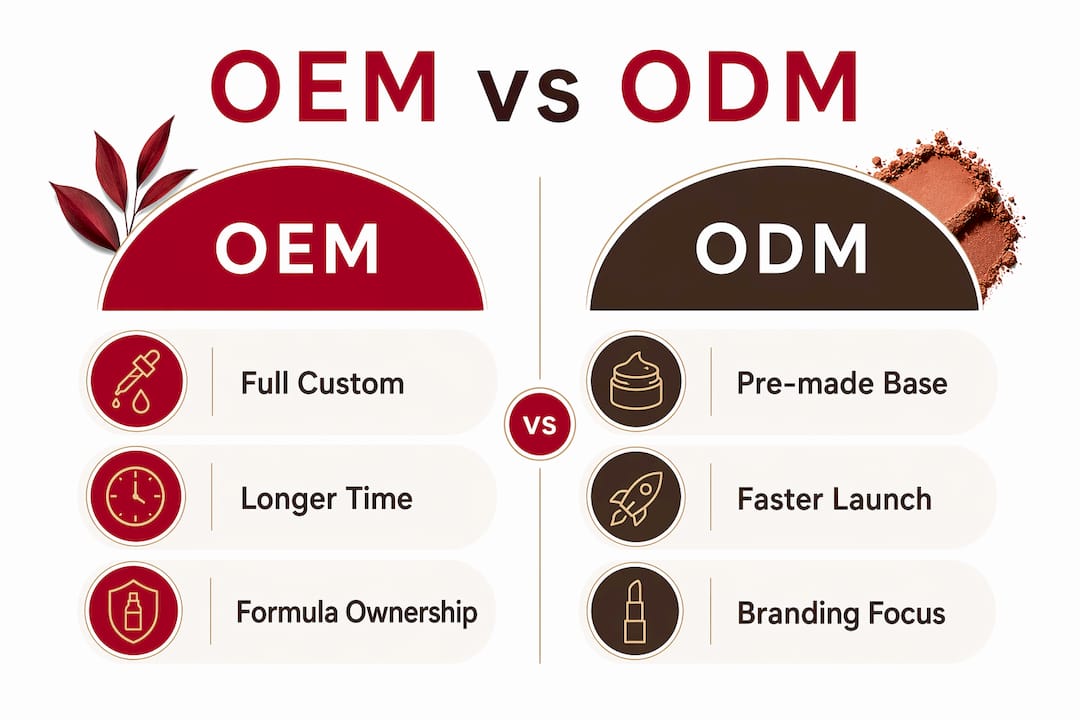
The two primary paths in the private label skincare process are OEM (Original Equipment Manufacturing) and ODM (Original Design Manufacturing). Choosing the right one depends on your budget, timeline, and how differentiated your formula needs to be.
OEM means fully custom product development. A manufacturer builds your formula from scratch based on your brief. This path takes 3–6 months or longer and suits founders who need a proprietary formula as a core brand asset.
ODM means selecting from a manufacturer’s existing, stability-tested base formulas and applying your branding, label, and minor tweaks. Private label manufacturing provides turnkey access to these tested bases, enabling market entry in 4–8 weeks. That speed advantage is significant for first-time founders validating demand.
| Factor | OEM (Custom) | ODM (Private Label) |
|---|---|---|
| Customization | Full formula control | Limited to label and minor tweaks |
| Timeline | 3–6+ months | 4–8 weeks |
| Cost | Higher per unit | Lower per unit |
| MOQ | Often 5,000+ units | Often 500–2,500 units |
| Market risk | Higher (unproven formula) | Lower (tested base) |
Here is a practical decision sequence for new founders:
- Define your budget ceiling and launch date first.
- If you need to launch within 3 months, ODM is your only realistic path.
- If your brand story depends on a unique, proprietary formula, plan for OEM and budget 6+ months.
- Consider starting with ODM to validate your niche, then transitioning to OEM once you have sales data.
For OEM projects, expect 2–5 iterative sample rounds before formula lock. Each round tests texture, scent, absorption, and stability. Skipping rounds to save time is the fastest way to end up with a product that generates returns.
Pro Tip: Launch your first SKU as an ODM product. Use real customer feedback to define your OEM brief. You will write a far better brief after 500 sales than before your first one.
What testing and regulatory steps are non-negotiable?
Testing is where most first-time founders underestimate both the time and the cost. Skipping or shortcutting this stage creates legal exposure and product quality problems that are far more expensive to fix after launch.
Prototype testing
Prototype iteration typically involves 2–5 sample rounds, with each round evaluated for absorption, scent, residue, and sensory performance. Experts recommend testing multiple texture variants with 10–20 real users over approximately 72 hours. The failure modes to watch for are pilling on the skin, greasy residue, and poor absorption. These are the exact issues that drive negative reviews and returns.
Stability testing
Accelerated stability testing runs at approximately 40°C with 75% relative humidity for 4–12 weeks. Real-time confirmation testing runs up to 24 months. Both are required to establish a defensible shelf life claim on your label. A product that separates, discolors, or grows microbial contamination within its stated shelf life is a regulatory and reputational liability.
Regulatory documentation
Your compliance requirements depend on where you sell:
- United States (FDA): Cosmetic labeling rules require ingredient lists in INCI names, descending by predominance, with a minimum font size of 1/16 inch. The responsible party’s name and address must appear on the label.
- European Union: Every cosmetic product requires a Product Information File (PIF) kept for 10 years at the Responsible Person’s address. The PIF contains safety reports, manufacturing data, full composition, and testing evidence.
Strong cosmetic product safety reports depend on thorough, scientifically coherent documentation and testing rather than on branding alone.
Pro Tip: Create a documentation folder for each SKU before artwork freeze. Map every label claim to a substantiation document, stability result, and quality record. PIF documentation must be updated any time you change the formula or packaging, so build the habit early.
How do you build a brand and launch strategy that sells?
A great formula in generic packaging with no clear story will not sell. Branding is not decoration. It is the reason a customer picks your product over the 40 others in the same category.
Start with a brand story that connects your product to a specific customer problem. A brightening serum for melanin-rich skin is a clearer proposition than “a serum for all skin types.” Specificity builds trust and makes your marketing copy write itself.
Packaging choices carry functional weight too. Airless pumps protect oxidation-sensitive actives like vitamin C and retinol. Recyclable materials signal values alignment to eco-conscious buyers. Glass droppers communicate clinical credibility. Your packaging format should match both your formula requirements and your customer’s expectations. Learn more about ethical skincare branding to align your visual identity with your brand values from day one.
For your launch, starting with a single hero SKU at a low MOQ of 2,000–2,500 units is the most capital-efficient way to validate demand. That scale is small enough to limit your downside and large enough to run a real market test.
Key launch tactics that work for early-stage founders:
- Build a landing page waitlist before production starts to gauge real demand
- Send samples to 20–50 creators in your niche for authentic content
- Focus on one sales channel first (DTC website or Amazon, not both simultaneously)
- Use clean, professional label design to build credibility with first-time buyers
Branding inconsistency is one of the top reasons beauty brands lose customers early. Your logo, label typography, social media visuals, and packaging must tell the same story.
Pro Tip: Use a landing page waitlist to validate demand before placing your production order. Two hundred signups with email addresses is real market signal. Zero signups is equally valuable information.
What are the most common private label skincare mistakes?
Most preparation failures trace back to a small set of avoidable errors. Knowing them in advance is the cheapest form of risk management available to you.
- Vague formulation briefs produce misaligned samples and add weeks of revision cycles to your timeline.
- Unverified manufacturers without FDA registration or GMP certification create legal exposure that can shut down your sales channel.
- Skipping user testing on texture and absorption leads to returns and negative reviews that damage your brand before it has traction.
- Outdated documentation after formula or packaging changes puts your EU PIF compliance at risk and can trigger product recalls.
- Scaling too fast before demand validation ties up cash in inventory that may not move.
Organized claims and documentation folders per SKU, built before artwork freeze, prevent the last-minute reformulations that delay production and inflate costs.
Pro Tip: Assign one internal point of contact for all manufacturer communications. Structured communication protocols with a single contact reduce sample iteration time and prevent conflicting instructions from reaching your production team.
Key takeaways
Preparing a private label skincare line requires a detailed brief, the right manufacturing model, rigorous testing, compliant documentation, and a focused launch strategy built around one hero product.
| Point | Details |
|---|---|
| Write a detailed brief first | Include formula direction, packaging, MOQ, target market, and timeline before contacting any manufacturer. |
| Choose ODM for speed | ODM launches in 4–8 weeks vs. 3–6 months for OEM, making it the right starting point for most founders. |
| Test prototypes with real users | Run 2–5 sample rounds with 10–20 users to catch pilling, residue, and absorption failures before production. |
| Build compliance documentation early | Maintain a PIF for EU sales and meet FDA labeling rules before artwork is finalized. |
| Launch with one SKU at low MOQ | Start with 2,000–2,500 units to validate demand before committing to larger production runs. |
What i have learned after watching founders launch skincare brands
The founders who struggle most are not the ones with the smallest budgets. They are the ones who skip the brief and go straight to sampling. I have seen entrepreneurs spend three months and thousands of dollars on sample revisions that a two-page brief would have prevented entirely.
The ODM-first strategy is genuinely underrated. There is a persistent belief that a “real” brand needs a custom formula. That belief costs founders time and money they cannot recover. Your formula is not your brand. Your positioning, your story, and your customer relationship are your brand. A well-chosen ODM base with a sharp brand identity will outsell a custom formula with weak marketing every time.
The documentation piece is where I see the most costly surprises. Founders who sell into the EU without a current PIF face enforcement risk that can pull their products from shelves. Updating that file every time you change a supplier or tweak a formula is not optional. Build the habit before you need it.
My honest recommendation for founders with limited cash: spend more on your brief, your testing, and your label design than on your first production run. A smaller, better-prepared batch beats a large, poorly tested one. Speed to market matters, but speed to a product that works and complies matters more.
— Gloria
Launch your private label skincare line with Didisbeautycenter
Didisbeautycenter specializes in exactly the kind of support new founders need most: pre-tested, natural and vegan base formulas, flexible MOQ options, and expert guidance through formulation briefing, packaging selection, and compliance documentation.
Whether you are building your first hero SKU or scaling an existing line, Didisbeautycenter’s private label services cover the full process from brief to shelf-ready product. The platform’s ready-to-label packs and eco-conscious packaging options make it straightforward to launch a credible, compliant brand without a large upfront investment. Explore Didisbeautycenter’s private label program to get a personalized consultation and find the right formula and packaging combination for your brand.
FAQ
What is the first step in the private label skincare process?
The first step is writing a detailed brand and formulation brief. It should cover product category, target customer, hero actives, texture preferences, packaging format, MOQ, target market, and timeline before you contact any manufacturer.
How long does it take to launch a private label skincare product?
ODM private label products can reach market in 4–8 weeks. Custom OEM formulations typically take 3–6 months or longer, depending on the complexity of the formula and the number of sample rounds required.
What stability testing does a skincare product need?
Accelerated stability testing runs at approximately 40°C and 75% relative humidity for 4–12 weeks. Real-time shelf-life confirmation testing runs up to 24 months and is required to support your stated expiration date.
Do i need a product information file to sell in the US?
The PIF is an EU requirement under Regulation (EC) No 1223/2009, not a US requirement. For US sales, FDA cosmetic labeling rules apply, including INCI ingredient listing in descending order and minimum font size of 1/16 inch.
How many units should i order for my first launch?
Starting with 2,000–2,500 units of a single hero SKU is the most practical approach for demand validation. That quantity limits your financial exposure while giving you enough inventory to run a real market test with creator samples and a DTC campaign.
Discourse (0)