


TL;DR:
- Minimalist skincare focuses on three essential steps: cleanse treat and moisturize.
- Fewer products reduce the risk of irritation and improve long-term results.
- Natural vegan formulations offer effective, eco-friendly options that support skin barrier health.
Most people believe that a longer skincare routine means better skin. More serums, more masks, more steps. But that belief is quietly costing you time, money, and sometimes your skin’s health. Minimalist skincare flips that idea on its head. The core methodology is straightforward: prep with a cleanser, treat with targeted actives, and seal with a moisturizer, prioritizing multi-functional products that do more with less. Natural and vegan formulations fit perfectly into this approach, delivering real results without unnecessary fillers, animal-derived ingredients, or a bathroom shelf that looks like a chemistry lab.
Table of Contents
- Minimalist skincare defined: The essentials explained
- The science of simplicity: How quality trumps quantity
- Building your minimalist routine: Natural and vegan essentials
- Sustainable beauty: Fewer products, better results
- Why perfect skin isn’t about more products
- Explore minimalist, natural skincare with Didis Beauty Center
- Frequently asked questions
Key Takeaways
| Point | Details |
|---|---|
| Less is more | Minimalist skincare focuses on just a few high-quality steps for best results. |
| Choose multi-taskers | Products that serve multiple purposes simplify routines and prevent irritation. |
| Consistency matters | Daily use of minimalist essentials shows skin barrier improvement in 4-12 weeks. |
| Eco-friendly benefits | Fewer products mean less waste and a more sustainable beauty routine. |
Minimalist skincare defined: The essentials explained
Minimalist skincare is not about doing the bare minimum for your skin. It is about doing the right minimum. The idea is to strip away everything non-essential and focus only on products that serve a clear, proven purpose. No redundant steps. No trendy ingredients added just because they are popular this season.
At its core, a minimalist routine follows three foundational steps: cleanse, treat, and moisturize. In the morning, you add SPF as a fourth layer. At night, the focus shifts to repair and recovery, which is when ingredients like retinol or barrier-supporting ceramides work best. This structure is exactly what dermatologists recommend: a gentle cleanser, a multitasking serum, a moisturizer, and SPF, with a strong warning against over-exfoliation.
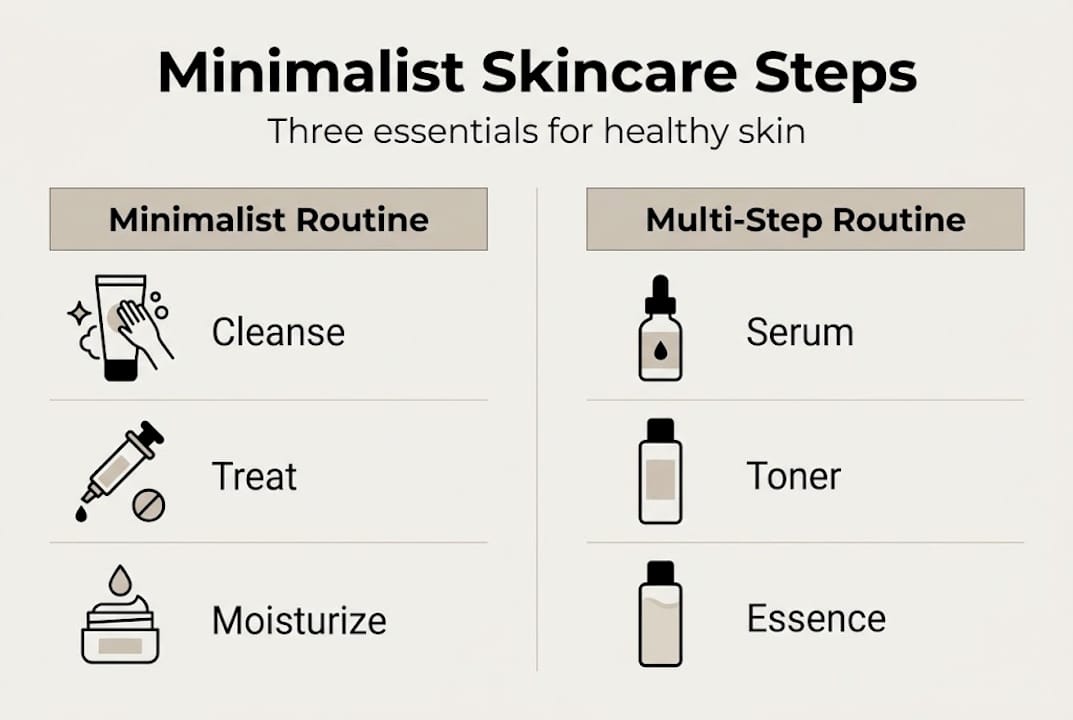
Here is a quick look at how a minimalist routine compares to a typical multi-step one:
| Feature | Minimalist routine | Multi-step routine |
|---|---|---|
| Number of products | 3 to 5 | 8 to 12+ |
| Risk of product conflicts | Low | High |
| Time per session | 3 to 5 minutes | 15 to 30 minutes |
| Cost over time | Lower | Higher |
| Skin adjustment period | Shorter | Longer |
One of the biggest hidden benefits of keeping your routine short is that you reduce the chance of product conflicts. Layering too many actives, like vitamin C with AHAs or retinol with strong exfoliants, can actually damage your skin barrier rather than help it. Fewer products mean fewer chances for irritation.
Here is what a solid minimalist routine actually looks like:
- AM: Gentle cleanser, antioxidant or hydrating serum, moisturizer with ceramides, SPF 30+
- PM: Gentle cleanser, treatment serum (retinol or niacinamide), barrier-repair moisturizer
“Simplicity in skincare is not laziness. It is strategy. The fewer variables you introduce, the easier it is to understand what is actually working for your skin.”
If you want a deeper breakdown of what this approach really involves, minimal skincare explained is a great place to start.
The science of simplicity: How quality trumps quantity
Here is the part most skincare marketing does not want you to hear: adding more products rarely improves your results. What actually moves the needle is consistency with the right ingredients.
Science backs this up clearly. Barrier repair studies confirm that the skin responds better to steady, repeated exposure to proven ingredients than to a rotating cast of new formulas. When you keep switching products, your skin never gets the chance to adapt and improve.
Two ingredients stand out in the research: ceramides and niacinamide. Ceramides are lipids (fats) that naturally exist in your skin barrier. When that barrier is compromised, skin becomes dry, reactive, and prone to breakouts. Niacinamide is a form of vitamin B3 that reduces inflammation, minimizes pores, and supports barrier function. Together, they are a powerhouse pairing. Barrier repair with ceramides and niacinamide typically shows measurable improvement in 4 to 12 weeks of consistent use.
That timeline matters. Four to twelve weeks is not a long time, but it requires patience and commitment to the same routine. Most people quit before they ever see results because they keep chasing something newer.
| Ingredient | Key benefit | Found in |
|---|---|---|
| Ceramides | Barrier repair, moisture retention | Moisturizers, serums |
| Niacinamide | Inflammation reduction, pore minimizing | Serums, toners |
| Hyaluronic acid | Deep hydration | Serums, essences |
| Squalane | Lightweight moisture, barrier support | Oils, moisturizers |
Multi-functional products shine here because they combine several of these ingredients into one formula, cutting down the number of steps without sacrificing efficacy. A serum that contains both niacinamide and hyaluronic acid does the work of two separate products.
Pro Tip: If you want to test whether your current routine is working, commit to the same three to four products for a full eight weeks before making any changes. Take weekly photos in the same lighting. The results will surprise you.
For a practical guide on how layering vegan products affects your results, the vegan layering results guide walks through a four-week experiment worth reading.
Building your minimalist routine: Natural and vegan essentials
Now that you understand why simplicity works, building your own routine becomes much easier. The goal is to find products that do multiple jobs well, especially if you are committed to vegan and natural formulations.
Multi-taskers are essential for anyone seeking natural efficacy without animal-derived ingredients. Plant-based formulas have come a long way, and today you can find vegan alternatives that match or outperform conventional products in every category.
Here is a step-by-step approach to building your AM and PM regimen:
- Choose a gentle cleanser. Look for sulfate-free, pH-balanced formulas with plant-derived surfactants. Avoid anything that leaves your skin feeling tight after washing.
- Pick one treatment serum. For mornings, an antioxidant serum with vitamin C or green tea extract works well. For evenings, a niacinamide or bakuchiol serum (a vegan alternative to retinol) is ideal.
- Add a ceramide-rich moisturizer. Look for plant-derived ceramides or phytosphingosine, which mimics the function of ceramides without animal sourcing.
- Apply SPF every morning. Mineral sunscreens with zinc oxide are vegan-friendly and reef-safe. This step is non-negotiable.
- Reassess every eight weeks. Once you have a baseline, you can adjust one product at a time if needed.
What to look for on ingredient labels when shopping vegan:
- No beeswax, lanolin, collagen, or carmine
- Plant-based emollients like shea butter, jojoba oil, or squalane
- Certified vegan or cruelty-free logos from recognized bodies
Pro Tip: When switching to a minimalist vegan routine, introduce one new product every two weeks. This way, if a reaction occurs, you know exactly which product caused it.
For more guidance on building vegan eco-friendly routines, or to explore the principles behind eco-conscious skincare, both resources offer practical next steps.
Sustainable beauty: Fewer products, better results
A minimalist skincare routine does more than simplify your morning. It also reduces your environmental footprint in ways that add up fast.

Simplifying your routine suits busy lives and reduces waste at the same time. When you buy fewer products, you generate less packaging waste, use fewer resources in production, and spend less money overall. It is one of those rare situations where the choice that is good for your skin is also good for the planet.
Consider the numbers. The average person using a ten-step routine goes through roughly 10 to 15 product containers every three to four months. A minimalist with four products might replace one or two items in that same period. That is a significant reduction in plastic, cardboard, and shipping emissions over a year.
Here are some practical habits that support sustainable minimalist beauty:
- Buy products in larger sizes when possible to reduce packaging per use
- Choose brands that use recyclable or refillable containers
- Avoid single-use sheet masks and disposable applicators
- Opt for concentrated formulas that last longer
- Store products properly to extend their shelf life and reduce waste
“Every product you skip is a container that never gets made, a formula that never gets shipped, and a chemical that never gets washed down your drain.”
Beyond the environmental angle, there is a real financial argument here too. Premium skincare products are expensive. Buying three or four high-quality items is far more affordable than buying twelve average ones. And because you are using fewer products, each one lasts longer.
Your time is also worth something. A three-minute routine done consistently every morning beats a twenty-minute routine that you skip half the time because it feels like too much effort. Consistency, not complexity, is what actually changes your skin.
For more ideas on reducing your beauty footprint, eco-friendly beauty tips covers practical strategies that align with a minimalist mindset.
Why perfect skin isn’t about more products
Here is something most beauty content will not tell you directly: the skincare industry profits from your insecurity. Every new launch, every “revolutionary” ingredient, every ten-step routine is designed to make you feel like you are not doing enough. But the evidence points in the opposite direction.
We have seen it repeatedly. People who strip their routines down to three or four well-chosen products often report better skin than they had when using ten or twelve. Why? Because they stopped irritating their barrier with competing actives, stopped confusing their skin with constant change, and started giving their skin the consistency it actually needs to heal.
The real challenge is not finding the right serum. It is resisting the urge to keep looking for one. Product-hopping is the single biggest obstacle to good skin. Your skin does not need novelty. It needs reliability.
If you are ready to rethink your approach, minimal skincare wisdom offers a grounded perspective on what actually matters. Less really is more, and your skin will thank you for it.
Explore minimalist, natural skincare with Didis Beauty Center
Simplifying your routine is a smart move, and finding the right products to support it should be just as easy.
At Didis Beauty Center, every product is formulated with natural, vegan ingredients that are designed to do more with less. Whether you are building your first minimalist routine or looking to upgrade your current one, the curated selection makes it simple to find exactly what your skin needs. And if you are an entrepreneur interested in launching your own simplified skincare line, the private label skincare program offers ready-to-label options that align perfectly with clean, minimalist beauty values. Start with what matters most, and let quality do the rest.
Frequently asked questions
How many steps should a minimalist skincare routine include?
Most minimalist routines follow three core steps: cleanse, treat, and moisturize, with SPF added every morning as a fourth essential layer.
Are minimalist routines better for sensitive skin?
Yes. Fewer products mean fewer potential irritants, and focusing on gentle formulas with ceramides and niacinamide supports barrier repair in weeks rather than months.
Can minimalist skincare be vegan and natural?
Absolutely. Multi-taskers for vegans with plant-derived, certified vegan ingredients deliver the same efficacy as conventional products without any animal-derived components.
How quickly can I expect results from a minimalist routine?
With consistent use of barrier-supporting ingredients, skin improvement in 4-12 weeks is a realistic and well-supported benchmark based on clinical research.
Discourse (0)