


TL;DR:
- “Natural” in skincare has no legal U.S. definition, and the term often lacks standardized standards. Synthetic ingredients can be chemically identical to natural ones, making origin alone an unreliable safety indicator. Certification labels like COSMOS and USDA Organic provide genuine assurance, while reading ingredient lists ensures transparency and helps avoid greenwashing.
You’ve probably grabbed a bottle off a shelf because the word “natural” caught your eye. Most of us have. But what are natural ingredients, really? 86% of consumers believe “natural” means no artificial ingredients, yet no U.S. law enforces that belief. The term is not standardized, not policed, and not guaranteed to mean what you think it does. This article breaks down what natural ingredients actually are, how they compare to synthetic alternatives, what real benefits they offer, and how to tell the difference between genuine transparency and clever marketing.
Table of Contents
- Key Takeaways
- What are natural ingredients: sources, definitions, and regulations
- Natural vs synthetic ingredients: what the science actually says
- Benefits and real limitations of natural ingredients
- How to identify natural ingredients on product labels
- My honest take on the natural ingredients conversation
- Explore natural skincare you can actually trust
- FAQ
Key Takeaways
| Point | Details |
|---|---|
| “Natural” has no legal U.S. definition | No federal law defines “natural” on beauty labels, so the term alone tells you very little. |
| Synthetic can equal natural chemically | Some synthetic ingredients are molecularly identical to natural ones, meaning origin does not determine safety. |
| Certifications offer real assurance | Labels like COSMOS and USDA Organic carry enforceable standards that generic “natural” claims do not. |
| Label reading beats front claims | The ingredient list on the back of a product is always more reliable than marketing language on the front. |
| Natural does not mean allergen-free | Botanical extracts and plant-based ingredients can trigger reactions just as readily as synthetic compounds. |
What are natural ingredients: sources, definitions, and regulations
Natural ingredients are substances derived from plant, animal, mineral, or microbial sources. Think shea butter pressed from a tree nut, kaolin clay pulled from the earth, or hyaluronic acid originally derived from rooster combs before lab synthesis became standard. The source is biological or geological, not manufactured from petroleum or coal-based chemistry.
But here is where it gets complicated. Natural often refers to source material, not to how much processing happened afterward. A botanical extract pulled from chamomile flowers may go through solvent extraction, purification, enzymatic treatment, and stabilization before it ever reaches your moisturizer. At that point, calling it “natural” describes where it started, not what it became.
Regulatory agencies treat this differently depending on where you live:
- United States: The FDA has no formal definition of “natural” for cosmetics. The USDA’s organic certification requires at least 95% organic ingredients for an “Organic” seal, but “natural” carries no such threshold.
- European Union: Starting September 2026, the EU bans standalone use of “natural” as a wellness claim unless a recognized third party like COSMOS or NATRUE certifies it.
- Global gap: Terms like “natural origin,” “plant-derived,” and “nature-identical” are used loosely across markets, often without enforceable standards behind them.
Understanding what are organic ingredients is slightly easier. Organic refers to how a crop was grown, specifically without synthetic pesticides or fertilizers, and the certification process is more rigorous. “Natural” and “organic” sound interchangeable but they are not the same thing.
Natural vs synthetic ingredients: what the science actually says
This is the section where the biggest misconceptions live. Many consumers assume natural is automatically safer or more effective. The science does not support that view.
Synthetic ingredients can be chemically identical to their natural counterparts at the molecular level. Vitamin C synthesized in a lab and vitamin C extracted from acerola berries are the same molecule: ascorbic acid. Your skin cells cannot tell the difference. The only distinction is origin, and origin alone does not determine how a compound behaves in your body or on your skin.
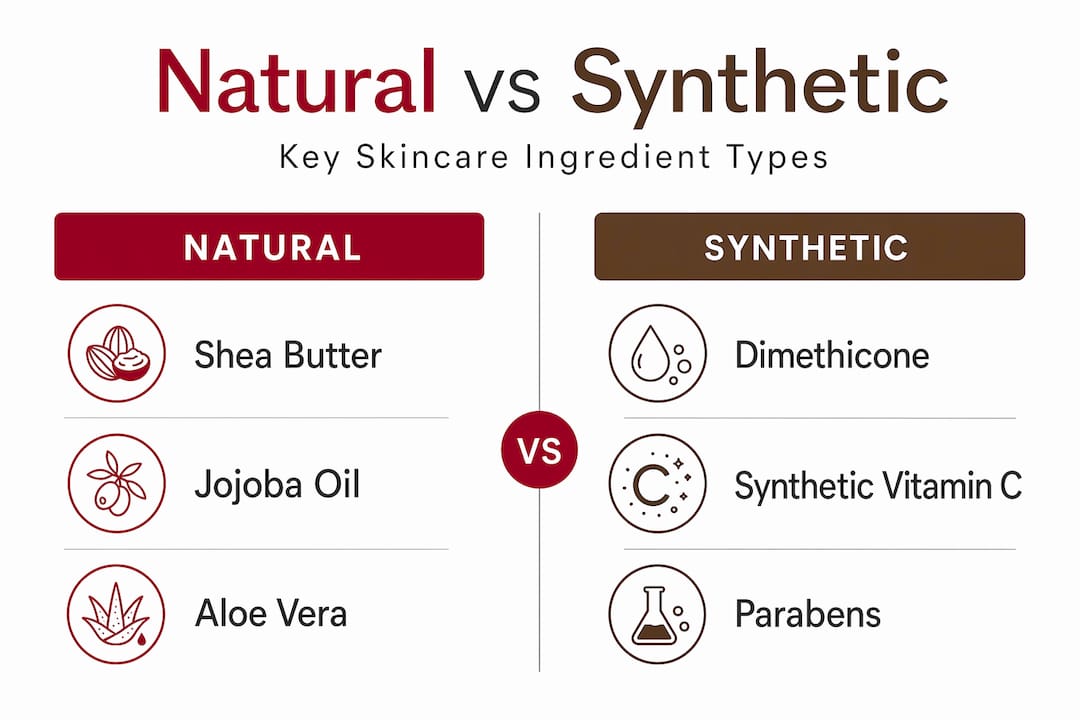
Here is a quick comparison of common natural and synthetic ingredient equivalents:
| Natural ingredient | Synthetic equivalent | Key difference |
|---|---|---|
| Shea butter (plant fat) | Dimethicone (silicone) | Origin differs; both provide moisturization |
| Vitamin E from wheat germ | Tocopherol acetate (lab-made) | Chemically similar; synthetic version is more stable |
| Lactic acid from fermented beets | Synthetic lactic acid | Identical molecule; synthetically produced is more consistent |
| Benzyl alcohol (jasmine extract) | Synthetic benzyl alcohol | Same compound; origin varies by manufacturer |
Cosmetic safety is risk-based, not origin-based. Regulatory agencies evaluate whether an ingredient poses a health risk at the concentration used in a product. A botanical extract used at 10% concentration can be more irritating than a synthetic compound used at 0.5%. Concentration and formulation context matter far more than the “natural” or “synthetic” label.
Pro Tip: When comparing products, look at the concentration and position of an ingredient in the list rather than whether it sounds natural. Ingredients are listed by descending concentration, so an ingredient in the top five has real presence in the formula.
The FTC adds another layer here. Scientific substantiation is required for any health or performance claim tied to an ingredient, natural or otherwise. Brands carry the burden of proof, which means “our natural extract cures acne” is a claim that needs clinical backing, not just a good story.
Benefits and real limitations of natural ingredients
So why do so many people actively seek out natural ingredient benefits? There are legitimate reasons, alongside some important caveats worth knowing.
The genuine benefits include:
- Lower environmental impact: Many plant-derived ingredients are biodegradable and sourced through more sustainable farming practices compared to petrochemical manufacturing.
- Skin compatibility: Some botanical ingredients, like aloe vera, oat extract, and calendula, have extensive track records for tolerability in sensitive skin formulations.
- Consumer preference: Brands using natural colors sourced from ingredients like beetroot red or spirulina extract align with a growing demand for products free of petroleum-based dyes, a trend the FDA formally recognized in early 2026.
- Fragrance transparency: Natural scents derived from essential oils or plant extracts often carry a cleaner ingredient story than synthetic fragrance blends, which can mask dozens of undisclosed chemicals under a single word.
The limitations are equally real. Natural extracts are notoriously variable. The potency of lavender oil shifts based on where it was grown, what season it was harvested, and how it was stored. Synthetic ingredients do not have that problem. A lab-produced compound is the same batch to batch, year to year.
Stability is another challenge. Many natural ingredients undergo significant processing specifically to improve shelf life and prevent microbial contamination. Ironically, this processing sometimes introduces the preservatives and stabilizers that “natural” shoppers are trying to avoid.

Allergenicity is an underappreciated risk. Poison ivy is entirely natural. So is latex. Botanical extracts in skincare, including tea tree oil, citrus extracts, and certain nut butters, are among the most common triggers for contact dermatitis. Natural does not mean hypoallergenic, and for people with sensitive skin, a well-formulated synthetic product may actually be the gentler choice.
How to identify natural ingredients on product labels
Knowing how to identify natural ingredients on a label is a skill worth building. Most of the clarity you need is already on the packaging. You just need to know where to look.
-
Start with the INCI name. Every cosmetic ingredient has an International Nomenclature of Cosmetic Ingredients name. Plant-derived ingredients typically include the Latin species name in parentheses, like Butyrospermum parkii (shea butter) or Aloe barbadensis leaf juice. This naming convention is your clearest signal of natural origin.
-
Read the full list, not just the front label. Short, recognizable ingredient lists are stronger quality signals than any marketing claim on the front of a bottle. A product labeled “pure and natural” with 30 unrecognizable compounds in the ingredient list deserves a second look.
-
Look for certifications, not just claims. COSMOS-certified products meet specific standards for the percentage of natural and organic content, how ingredients were processed, and what preservatives are allowed. NATRUE certification operates similarly. These certifications offer meaningful assurance that generic “natural” wording simply cannot provide.
-
Watch for greenwashing signals. Vague terms like “infused with botanicals,” “inspired by nature,” or “with natural extracts” rarely indicate meaningful natural content. If the natural ingredient appears near the bottom of the list, its concentration is likely cosmetically insignificant.
-
Cross-check ingredients with a trusted database. Tools like the Environmental Working Group’s Skin Deep database let you look up individual ingredients to understand their source, safety rating, and known concerns. This removes the guesswork entirely.
Pro Tip: When in doubt, check how to read skincare labels before purchasing. Understanding label structure makes greenwashing much harder to miss.
Look for brands that list ingredient percentages or explain sourcing on their website. That level of transparency in natural skincare is a far better trust signal than any buzzword on the packaging.
My honest take on the natural ingredients conversation
I have worked in and around beauty formulations long enough to know that “natural” has become one of the most overworked and under-scrutinized words in the industry. My take is direct: the word alone should not influence your purchasing decision.
What I find genuinely frustrating is that consumers are doing the right thing by caring about what goes on their skin. The instinct is correct. The execution is being exploited. Brands know that “natural” sells, and without a legal definition to hold them to, many are using it as decoration rather than description.
What I have actually learned from paying attention to formulations is this: the brands worth trusting are the ones that do not lean heavily on the word “natural” at all. They list ingredients clearly. They explain why each one is there. They hold certifications that have real standards behind them. They talk about signs of high-quality skincare in terms of formulation and testing, not just origin stories.
The evolving regulatory picture also matters here. With the EU moving to ban unsubstantiated natural claims and the FDA tightening language around color additives, the era of free-for-all “natural” marketing is genuinely starting to close. That is good news for consumers. But in the meantime, your best protection is education. Read the label, check the certification, and be skeptical of any brand that leads with the word “natural” and offers nothing else to back it up.
— Gloria
Explore natural skincare you can actually trust
At Didisbeautycenter, the approach to natural and vegan formulations goes beyond labeling. Every product is built around ingredient transparency, safety-focused formulation, and honest communication about what is actually inside.
Whether you are shopping for yourself or looking to build your own skincare brand, Didisbeautycenter offers something most retailers do not: the ability to see the reasoning behind the formulas. For entrepreneurs ready to create a natural skincare line with real standards, the private label program gives you access to professionally formulated, natural-based products you can brand and sell with confidence. Explore the full range at Didisbeautycenter and find skincare that earns the word “natural” rather than just wearing it.
FAQ
What are natural ingredients in skincare?
Natural ingredients in skincare are substances derived from plant, animal, mineral, or microbial sources. Common examples include shea butter, aloe vera, kaolin clay, and plant-based essential oils.
Are natural ingredients always safer than synthetic ones?
No. Cosmetic safety depends on formulation and concentration, not ingredient origin. Some botanical extracts cause allergic reactions, while well-formulated synthetic ingredients can be completely safe.
What is the difference between natural and organic ingredients?
“Natural” refers to the biological or geological origin of an ingredient. “Organic” is a certified standard based on how a crop was grown, requiring the absence of synthetic pesticides and fertilizers. Organic certification carries enforced standards that “natural” does not.
How can I tell if a product actually uses natural ingredients?
Read the full ingredient list and look for INCI names with Latin plant species in parentheses. Prioritize products with third-party certifications like COSMOS or USDA Organic over front-label claims. Short, recognizable ingredient lists are typically stronger indicators of genuine natural content.
Does “natural” on a label have a legal meaning in the U.S.?
No. The FDA does not legally define “natural” for cosmetics or skincare products. No strict standard enforces what the term means, which is why certifications and full ingredient lists are more reliable guides than the word itself.
Discourse (0)