


TL;DR:
- Natural ingredients vary in effectiveness; clinical evidence and proper formulation are essential.
- Some natural oils, like coconut oil, are highly comedogenic and can cause skin issues.
- Efficacy relies on scientific testing, transparency, and understanding ingredient stability and proper use.
If you believe “natural” automatically means safe, effective, and gentle on your skin, you are not alone — but you are working with an incomplete picture. The natural beauty market has grown massively, fueled by genuine consumer demand for cleaner, kinder formulations. Yet the science tells a more layered story: some plant-derived ingredients deliver measurable, clinically proven results, while others can clog pores, trigger allergies, or degrade before they even reach your skin. This guide unpacks what the research actually says, so you can shop smarter, formulate better, and stop relying on labels alone.
Table of Contents
- Why natural ingredients matter in beauty products
- How science tests and proves natural ingredient claims
- Risks, edge cases, and comedogenic ingredients
- How to choose and use natural ingredients wisely
- Industry perspective: Why passion needs evidence in the age of natural beauty
- Ready to harness the power of naturals for your brand?
- Frequently asked questions
Key Takeaways
| Point | Details |
|---|---|
| Science over hype | Efficacy of natural ingredients depends on clinical evidence, not just labels or trends. |
| Check ingredient ratings | Always review comedogenic and allergenicity ratings, especially for sensitive or acne-prone skin. |
| Demand clinical results | Look for measurable improvements in trials, such as over 10% gains in skin hydration or elasticity. |
| Personalization matters | Tailor ingredient choices to your unique skin needs and business goals for the best outcomes. |
| Mind formulation risks | Natural ingredients may oxidize or spoil faster, so proper testing and storage are important. |
Why natural ingredients matter in beauty products
Consumer interest in natural skincare benefits has shifted from a niche preference to a mainstream movement. Shoppers today are reading labels, researching origins, and choosing brands that align with their vegan and cruelty-free values. That shift is real and meaningful. But passion alone does not make an ingredient effective.
So what separates a truly valuable natural ingredient from a trendy one with no real results? The answer comes down to bioactive compounds. These are naturally occurring molecules that interact with your skin at a cellular level, triggering measurable changes.
Here is why this matters:
- Bioactivity is specific. A plant extract is not beneficial just because it comes from a plant. The individual compounds within it need to be identified and studied.
- Concentration is everything. A product might list a botanical ingredient but contain so little of it that the effect is negligible.
- Delivery method matters. Even a potent compound does nothing if the formula cannot carry it to the right skin layer.
- Not all clinical evidence is equal. Anecdotal reviews and brand claims are not the same as peer-reviewed trials.
“The best natural skincare products are the ones that have been put through rigorous testing — not just ones that sound clean on the label.”
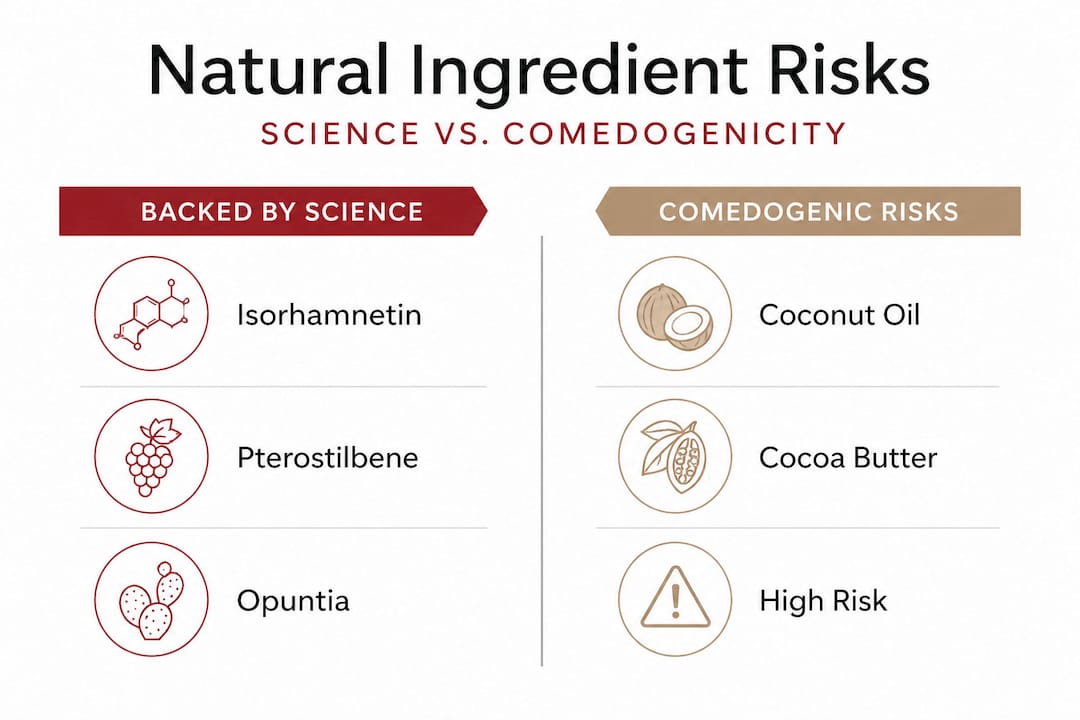
Some of the most compelling evidence comes from studies on lesser-known plant compounds. Isorhamnetin and pterostilbene are two standout examples: isorhamnetin from Opuntia ficus-indica (prickly pear) reduced sebum production by 21.1%, shrunk pore appearance by 9.6%, and lowered inflammatory marker TNF-α by 7.4% in just 28 days. Pterostilbene at 0.1% concentration improved skin elasticity by 32.6% and reduced the appearance of wrinkles by 7 to 15% in the same time frame. Those are not marketing claims — those are randomized clinical outcomes.
Pro Tip: When evaluating any natural skincare product, look specifically for language referencing randomized controlled trials or peer-reviewed journals. If a brand only cites “customer results” or vague studies, treat that as a yellow flag.
How science tests and proves natural ingredient claims
Knowing why certain ingredients work is one thing. Knowing how to verify those claims as a consumer or formulator is another skill entirely.
The gold standard in ingredient testing is the randomized controlled trial, or RCT. In an RCT, participants are divided into groups, one using the active ingredient and one using a placebo, without knowing which they received. Results are then measured objectively using instruments like corneometers (for hydration), cutometers (for elasticity), and sebummeters (for oil production). This removes bias and makes the results reproducible.
Here is a step-by-step approach to interpreting clinical outcomes when you are shopping or sourcing:
- Find the study type. Is it an RCT, an open-label trial, or just a consumer survey? An RCT carries the most weight.
- Check the sample size. Trials with fewer than 20 participants are often too small to be conclusive.
- Look at the percentage improvement. RCTs showing >10% improvement in hydration, elasticity, or sebum reduction are generally considered clinically meaningful benchmarks.
- Check the timeframe. Results achieved in 28 days are significant; results that take 6 months with small changes may not justify the cost.
- Identify the active compound and percentage. “Contains botanical extract” is meaningless without knowing the exact compound and its concentration.
Here is a look at the clinical data from two well-studied natural compounds:
| Ingredient | Source | Key Metric | Result | Trial Duration |
|---|---|---|---|---|
| Isorhamnetin | Opuntia ficus-indica | Sebum reduction | 21.1% | 28 days |
| Isorhamnetin | Opuntia ficus-indica | Pore appearance | 9.6% reduction | 28 days |
| Isorhamnetin | Opuntia ficus-indica | TNF-α (inflammation) | 7.4% reduction | 28 days |
| Pterostilbene (0.1%) | Blueberries/grapes | Skin elasticity | 32.6% improvement | 28 days |
| Pterostilbene (0.1%) | Blueberries/grapes | Wrinkle reduction | 7 to 15% | 28 days |
Those numbers from peer-reviewed cosmetics research show what is actually possible when science backs up a natural claim. Understanding skincare hydration facts can also help you set realistic expectations for what a single product can accomplish.
Risks, edge cases, and comedogenic ingredients
Scientific evidence is essential, but understanding potential risks is equally critical for savvy consumers. Here is the part of the natural beauty conversation that does not get enough attention: natural ingredients can cause real harm if used without awareness.

The biggest hidden risk? Comedogenicity. A comedogenic ingredient is one that clogs pores, leading to blackheads, whiteheads, or acne breakouts. The scale runs from 0 (non-comedogenic) to 5 (highly comedogenic), and some of the most popular natural ingredients sit near the top.
| Natural ingredient | Comedogenic rating | Skin type risk |
|---|---|---|
| Coconut oil | 4 (high) | Oily, acne-prone |
| Cocoa butter | 4 (high) | Oily, combination |
| Wheat germ oil | 5 (very high) | Most skin types |
| Jojoba oil | 2 (low) | Generally safe |
| Argan oil | 0 to 1 (very low) | Most skin types |
| Hemp seed oil | 0 (non-comedogenic) | All skin types |
| Rosehip oil | 1 (very low) | Most skin types |
Coconut oil and cocoa butter both rate a grade 4, driven by their medium-chain fatty acid profiles (C10 to C16), which show high pore-clogging activity. Refined versions of these oils carry slightly lower risk than unrefined ones, but neither is ideal for acne-prone skin.
For consumers exploring natural skincare for sensitive skin, comedogenicity is only part of the picture. Allergen risk is another layer entirely. Common allergens found in otherwise gentle-sounding natural products include:
- Essential oils (lavender, tea tree, citrus-based oils) that can trigger contact dermatitis
- Nut-derived butters (shea, almond) that may affect those with tree nut sensitivities
- Fragrant plant extracts like chamomile, which belongs to the ragweed family
- Preservative-adjacent botanical ingredients that some formulas rely on for shelf stability but that can irritate reactive skin
- Unrefined waxes and resins that contain pollen proteins
There is also a stability concern that many brands quietly sidestep. Natural formulations oxidize faster than synthetic ones because plant-derived oils and extracts lack the built-in antioxidant protection that synthetic stabilizers provide. An oil that smells slightly off has likely begun to degrade, and applying oxidized product to your skin can worsen inflammation rather than calm it.
Pro Tip: Patch test every new natural product on the inside of your wrist or behind your ear for 48 hours before applying it to your face. This is especially important if you have recently changed suppliers or switched to a product with a new botanical ingredient list.
How to choose and use natural ingredients wisely
Armed with both the science and the possible pitfalls, it is time to apply this knowledge to your next purchase or your own creations. Whether you are a committed skincare enthusiast building a personal routine or a small business owner developing a line of vegan products, the same core principles apply.
Here is a practical numbered approach to evaluating products and ingredients:
- Read past the front label. Terms like “natural,” “clean,” and “plant-based” are marketing language, not regulated definitions. Flip the product over and read the INCI (International Nomenclature of Cosmetic Ingredients) list.
- Identify the key actives. Ingredients are listed in order of concentration. If your “vitamin C serum” lists ascorbic acid tenth or lower, it probably contains too little to be effective.
- Cross-reference comedogenicity ratings. Use a reliable comedogenicity database before adding any oil or butter to your routine, especially if you are oily or acne-prone.
- Look for clinical backing. RCTs with >10% improvements in measurable skin metrics are meaningful; vague claims about “youthful-looking skin” are not.
- Check the expiration date and packaging. Natural formulas in clear or wide-mouth jars degrade faster than airless pumps or opaque containers. Packaging is part of efficacy.
- For small business owners: request a Certificate of Analysis (COA). A COA from your raw material supplier confirms purity, potency, and absence of contaminants. No COA, no order.
- Run stability testing. Before launching a product, expose it to temperature cycling (heat and cold) to confirm it does not separate, discolor, or smell off.
- Document feedback systematically. Whether you are testing personally or gathering early customer data, track skin responses by skin type, climate, and routine. Patterns will tell you what the lab cannot.
Consulting a solid skincare formulation guide can help you bridge the gap between choosing ingredients and actually building a stable, effective product.
Pro Tip: Document every formulation change you make, even small adjustments to preservative percentages or fragrance levels. If a skin reaction occurs in a customer, you need that paper trail to identify the culprit quickly and iterate responsibly.
Industry perspective: Why passion needs evidence in the age of natural beauty
Reflecting on these practical strategies, let us consider the deeper forces shaping where natural beauty is headed and what that means for honest brands and informed consumers.
Here is something we see repeatedly in this space: founders and formulators who start their journey with genuine love for botanicals, earth-friendly sourcing, and cruelty-free values. That passion is not the problem. It is actually one of the most powerful drivers of innovation in the beauty industry. But passion without accountability can quietly become its own kind of marketing hype.
When a brand says “our formula is all-natural,” that statement is not automatically false. But it is also not automatically meaningful. It says nothing about whether the formula actually works, whether the concentrations are effective, or whether the sourcing is verified. The uncomfortable truth that most brands will not say out loud: some synthetic compounds outperform their natural equivalents. Hyaluronic acid produced through fermentation is molecularly identical to naturally derived versions and is more stable. Certain lab-produced retinoids are more effective than plant-based retinol alternatives, with more predictable results.
Honest brands — the ones worth rewarding with your loyalty and your dollars — acknowledge this complexity rather than hiding from it. They say things like “our vitamin C is stabilized for maximum absorption” or “we chose jojoba over coconut oil specifically because of its non-comedogenic profile.” They back claims with references. They disclose limitations.
Consumer passion drives the market, but science is what validates it over time. A product that rides a “natural” trend without clinical grounding will eventually lose customers the moment they stop seeing results. Meanwhile, a product built on honest formulation and transparent evidence builds loyalty that compounds year after year.
We believe the future of natural beauty belongs to brands that blend both: the integrity of botanical sourcing and vegan values with the intellectual honesty to say “here is what works, here is what does not, and here is the data.” That blend is harder to market in a single tagline. But it is the only thing that actually holds up. You can explore more on lasting skincare benefits and what separates trend-driven formulas from ones that stand the test of time.
Ready to harness the power of naturals for your brand?
If this guide has shown you anything, it is that natural skincare done right is both an art and a science. And that is exactly what we have built at Didis Beauty Center.
Whether you are a passionate consumer who wants products with real ingredient transparency, or a small business owner ready to launch your own vegan line, we offer private label skincare solutions built on high-quality, cruelty-free, natural formulations. Our team understands both the science and the sourcing. We help you skip the guesswork with ready-to-brand products that meet real efficacy and safety standards. Check out our private label options and take the next step toward a brand you can stand behind, ingredient by ingredient.
Frequently asked questions
Are natural skincare ingredients safer than synthetic ones?
Natural ingredients are not always safer; some, like coconut oil and cocoa butter, rate a grade 4 on the comedogenic scale and can trigger breakouts, while others may cause allergic reactions, so evidence and personal patch testing always matter.
What clinical results should I look for in natural skincare?
Look for products backed by randomized controlled trials showing >10% improvements in hydration, elasticity, or sebum reduction, as these are the benchmarks that separate meaningful clinical results from marketing language.
How do I avoid comedogenic natural oils?
Check comedogenicity ratings before introducing any oil into your routine; coconut oil rates grade 4 and is a common hidden trigger for breakouts, while oils like hemp seed and argan rate 0 to 1 and are far safer for oily or acne-prone skin.
Why do some natural products oxidize or spoil faster?
Natural formulations often lack the synthetic stabilizers that extend shelf life, making them more prone to oxidation and spoilage, which is why proper packaging, storage, and expiration date awareness matter far more with naturals than with conventional products.
Can I use the same natural skincare products for my small business and personal routine?
Personal-use products might work beautifully for your own skin, but a business line must meet documented safety testing, efficacy standards, and regulatory labeling requirements that go well beyond what a personal routine demands.
Discourse (0)