


TL;DR:
- Most sustainable skincare packaging emphasizes designing for reuse, recyclability, and considering the entire product life cycle.
- Material choice alone is insufficient; effective systems for collection, refilling, and consumer education are essential to truly reduce waste.
Over 120 billion units of cosmetics packaging are produced globally each year, and the vast majority ends up in landfills. For eco-conscious consumers trying to make better choices and small brand owners hoping to build something meaningful, this number is both alarming and motivating. The challenge isn’t a lack of good intentions. It’s the absence of a clear, practical roadmap. This guide walks you through exactly what sustainable skincare packaging means, what materials and tools you’ll need, a step-by-step process to implement it, and how to verify that your efforts are actually working.
Table of Contents
- Understanding sustainable packaging in skincare
- What you need: Materials, tools, and considerations
- Step-by-step: Packaging skincare products sustainably
- Mistakes to avoid and how to verify sustainability
- The uncomfortable truth about sustainable skincare packaging
- Bringing sustainability to your brand with expert help
- Frequently asked questions
Key Takeaways
| Point | Details |
|---|---|
| Go beyond materials | True sustainability measures the whole system, not just what your container is made of. |
| Use closed-loop solutions | Mail-back and drop-off programs help ensure even hard-to-recycle beauty packaging gets reused or recycled. |
| Educate customers | Clear instructions and takeback options drive the success of refill and sustainable packaging initiatives. |
| Verify your choices | Ask for certifications, check supplier data, and monitor real-world usage, not just marketing claims. |
Understanding sustainable packaging in skincare
With the problem introduced, let’s clarify what actually makes packaging sustainable in the skincare world.
Sustainable packaging isn’t just about swapping plastic for glass. At its core, it means designing packaging with its entire life cycle in mind, from the raw materials used to make it all the way through to what happens after the product inside runs out. In the skincare industry, this is especially tricky because products often require airtight, contamination-resistant containers, which limits the materials you can use. A truly sustainable beauty approach considers the packaging, the formula, the sourcing, and the disposal method as one connected system.
Common materials that are generally considered eco-friendly in skincare include:
- Glass: Infinitely recyclable, chemically inert, and premium-feeling. Works great for serums and toners, though it’s heavier and more fragile during shipping.
- Aluminum: Highly recyclable and lightweight once production emissions are offset. Ideal for balms, creams, and even pump dispensers.
- Bioplastics: Made from plant-based sources like sugarcane or cornstarch. They sound great in theory, but many require industrial composting facilities that most consumers don’t have access to.
- Post-consumer recycled (PCR) plastics: Made from previously used plastic, reducing demand for virgin materials. A practical choice for brands that need flexible, lightweight packaging.
- Refill pouches: Thin, low-material-weight options designed to refill a durable primary container. They generate less waste per use but require a well-designed refill system to work.
One major reason skincare packaging ends up in landfills, even when it’s technically recyclable, is that many containers are small and made from multiple fused materials. A pump bottle, for example, may combine polypropylene, stainless steel, and a glass ball. Your curbside recycling bin can’t sort that. This is where takeback and collection programs step in. Pact Collective is a nonprofit that offers beauty-specific mail-back and drop-off collection models to recover hard-to-recycle beauty packaging and give it a second life.
For a deeper look at how eco-conscious choices connect across your whole routine, the eco-friendly skincare guide at Didis Beauty Center covers ingredients, formulas, and packaging together.
Pro Tip: When choosing packaging, avoid designs that fuse two different materials permanently, like metal springs inside plastic pumps. Single-material construction makes recycling dramatically easier and less costly for everyone in the chain.
What you need: Materials, tools, and considerations
Now that you know what sustainable packaging involves, here’s what you’ll need to do it right.
Choosing a sustainable material is step one, but it’s not enough on its own. You also need the right tools, closure types, and labeling methods to make sure your packaging performs well throughout its shelf life and afterward. Here’s a breakdown of the primary packaging materials and what they work best for:

| Material | Best use case | Key limitation |
|---|---|---|
| Glass | Serums, toners, facial oils | Heavy; higher shipping emissions |
| Aluminum | Balms, creams, spray bottles | Higher upfront production cost |
| Recycled paper/cardboard | Outer boxes, powder packaging | Not waterproof; limited for liquids |
| PCR plastic | Pump bottles, squeeze tubes | Consumer perception; quality varies |
| Refill pouches | Secondary packaging for refills | Requires consumer buy-in and infrastructure |
Beyond the container itself, you’ll need to think about:
- Sanitization tools: Filling stations, clean funnels, and sanitizing sprays to keep products safe during packaging.
- Closure types: Opt for closures made from the same material as the container to keep it single-stream recyclable. Avoid metal lids on plastic jars when possible.
- Labels: Water-based adhesive labels printed on recycled paper are far preferable to foil or plastic laminated labels, which contaminate the recycling stream.
- Shrink wraps and seals: Wherever possible, skip them entirely or use perforated paper-based tamper seals instead of plastic wraps.
Cost and accessibility are real barriers, especially for small brands just starting out. Glass and aluminum often cost more per unit than conventional plastic, and minimum order quantities from sustainable suppliers can be high. That’s why sourcing locally is a smart move. You’ll find inspiration for practical approaches in this resource on natural packaging for beauty products that balance cost and sustainability.
It’s also worth noting that refill initiatives as a system require full infrastructure planning to succeed. You can’t simply offer a refill option without thinking through logistics, consumer education, and the mechanics of how used containers return to you.
Pro Tip: Source your packaging suppliers locally whenever you can. Shipping lightweight refill pouches across a continent can generate more emissions than using a heavier material made nearby. Life cycle thinking applies to logistics too, not just materials.
Step-by-step: Packaging skincare products sustainably
Ready with the right materials and mindset, here’s the hands-on process for packaging skincare more sustainably.
Switching to sustainable packaging isn’t a single decision. It’s a sequence of connected choices, and getting the order right matters. Follow these steps whether you’re a solo consumer refilling products at home or a brand owner redesigning your entire product line:
-
Assess your product’s needs first. Look at your formula. Is it water-based? Does it require an airless pump to prevent oxidation? Does it need UV protection? These functional requirements will narrow your material options before you even start shopping for eco-friendly alternatives.
-
Select the most appropriate sustainable material. Based on your product needs, choose from the material table above. A vitamin C serum that oxidizes easily still needs UV-blocking packaging, which is why dark glass remains a strong choice even though it’s heavier.
-
Design for reuse or refill from day one. Don’t design a beautiful glass bottle and add refill as an afterthought. Refill openings need to be wide enough to fill easily. Labels need to survive multiple washes. Pumps need to be removable so consumers can actually clean the container between refills.
-
Label responsibly. Use water-activated or plant-based adhesive labels on recycled stock. Make sure your label clearly communicates how to clean, reuse, or return the container. This is an often-overlooked step in your eco-friendly packaging steps that directly affects whether your customer participates in your return program.
-
Partner with or create a collection or takeback program. Mail-back programs exist specifically because beauty packaging doesn’t survive the conventional recycling process. Even if you’re a tiny brand, you can join an existing collection network rather than building one from scratch.
Here’s a quick summary of the full process:
| Step | Purpose | Best practice | Common pitfall |
|---|---|---|---|
| Assess product needs | Align packaging with formula | Test for contamination and oxidation | Choosing materials before knowing the formula |
| Select material | Reduce environmental footprint | Prioritize mono-materials | Picking “eco” aesthetics over function |
| Design for reuse | Extend packaging life cycle | Wide openings, removable pumps | Treating refill as optional add-on |
| Label responsibly | Enable customer action | Clear return/recycle instructions | Using laminated or foil labels |
| Implement collection | Close the loop | Join established networks | Assuming customers know what to do |
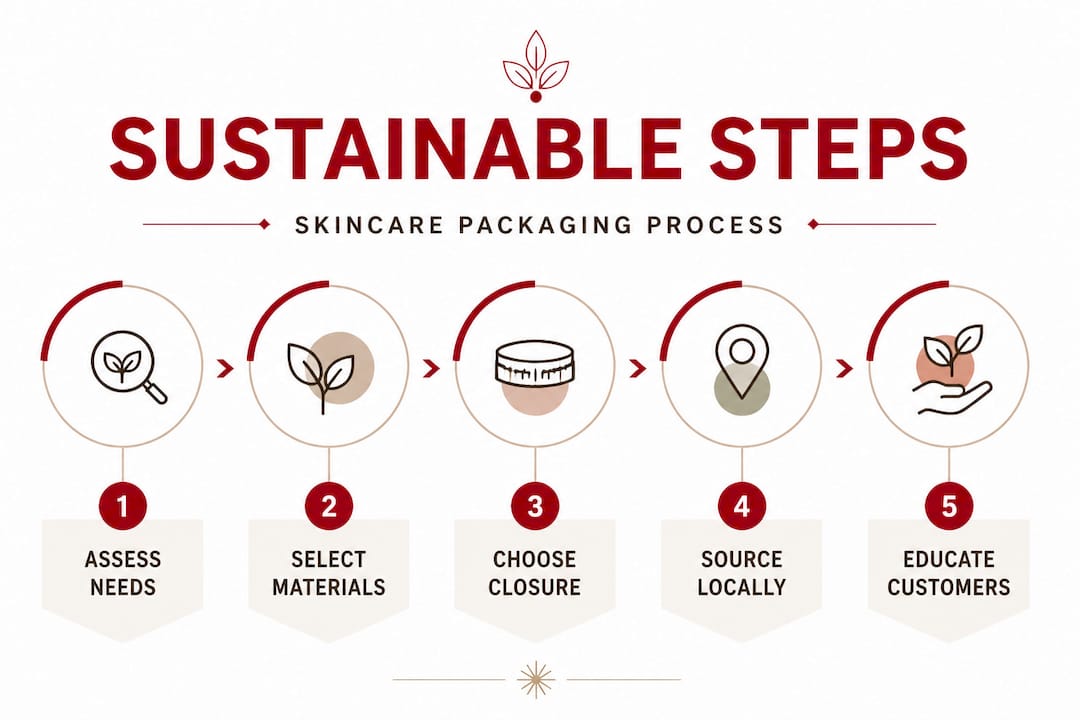
Customer education is the piece most brands skip entirely. If your customer doesn’t know they can mail back their empty jar, they’ll toss it. A small insert card explaining the return process, or a QR code on the label linking to instructions, can dramatically improve actual return rates. Refill systems work best when they are designed around real user behavior, not ideal-world assumptions.
Mistakes to avoid and how to verify sustainability
Even with a solid step list, it’s easy to slip up. Avoid these common mistakes and verify your impact for lasting results.
The sustainable packaging space is full of well-meaning mistakes that cancel out good intentions. Here are the ones we see most often:
- Greenwashing through material optics: Putting a product in green-colored packaging or adding a leaf logo doesn’t make it sustainable. Consumers and regulators are increasingly savvy about this, and it erodes trust fast.
- Ignoring end-of-life realities: A “recyclable” label is only meaningful if the consumer has access to a recycling facility that actually accepts that material. Many bioplastics, for example, require industrial composting that doesn’t exist in most neighborhoods.
- Prioritizing aesthetics over function: A beautiful matte paper label looks great in a product shoot but turns into a soggy mess in a humid bathroom. Packaging has to survive real conditions or it gets replaced faster, which creates more waste.
- Skipping customer education entirely: This is the single most common failure point in refill and takeback programs.
“Choosing a sustainable material is meaningful only when the entire system, from logistics to consumer behavior, is designed to support it. A refill pouch sitting in a landfill is no better than a plastic bottle that was never offered a second life.”
To verify that your packaging is genuinely sustainable, look for third-party certifications like FSC (Forest Stewardship Council) for paper, or GRS (Global Recycled Standard) for PCR plastics. Ask your suppliers directly for Life Cycle Assessment (LCA) data, which quantifies the actual environmental impact of a material from production through disposal. Monitor your own return rates if you run a takeback program. A low return rate isn’t just a logistics problem. It’s a communication and design problem.
If refill or closed-loop programs aren’t designed as a system, they may actually underperform for both sustainability and customer experience. That’s a finding worth taking seriously before you invest in building a program that looks good on paper but doesn’t move the needle in practice.
Understanding why sustainable skincare matters at a deeper level will help you make decisions rooted in outcome rather than appearance.
Pro Tip: Before you launch new packaging across your entire product line, test it with a small batch in real-world conditions. Ship it to yourself. Leave it in a bathroom for a week. Fill and refill it three times. What breaks down first? Fix that before you scale.
The uncomfortable truth about sustainable skincare packaging
Here’s where we need to be honest with you, even if it’s a little uncomfortable.
Most “sustainable packaging” that’s on the market right now is still missing the point. Brands celebrate switching from virgin plastic to PCR plastic, or from conventional packaging to glass, and call it a win. And to be fair, material choice does matter. But if no one returns the glass bottle, if no one refills the beautiful aluminum tin, if the takeback program on the website gets one return per month, the material swap is largely cosmetic.
The real metric of sustainable packaging isn’t what it’s made of. It’s how many times it actually cycles through before it becomes waste. A glass bottle that gets used once and thrown away has a higher carbon footprint than a lightweight plastic container that gets refilled ten times. That’s a counterintuitive but well-documented reality.
What the industry needs, and what brands at every size can actually deliver, is investment in experience and outcome rather than materials and marketing. That means making refill easy enough that a tired parent can do it with one hand. It means making your step towards sustainability clear, practical, and rewarding for the customer. It means measuring your return rate every quarter and treating it as seriously as you treat your conversion rate.
We believe the brands that will define sustainable beauty in the next decade are not the ones with the most impressive packaging copy. They’re the ones building systems their customers actually use.
Bringing sustainability to your brand with expert help
Making the shift to sustainable packaging is a real commitment, and you don’t have to figure it out alone.
At Didis Beauty Center, we work with small brand owners and eco-conscious consumers who want to do this the right way. Our private label skincare solutions are designed with natural, vegan formulations and eco-conscious packaging options built in, so you’re not starting from scratch. Whether you’re building your first product line or rethinking your current packaging strategy, our team can help you find options that align with your values and your budget. Explore our resources, guides, and ready-to-label packs to take the next step in your sustainable beauty journey without the guesswork.
Frequently asked questions
What is the most sustainable packaging for skincare products?
Packaging made from glass, aluminum, or easily recyclable mono-materials is often the most sustainable because of high recyclability and closed-loop potential. Industry collection programs also significantly improve outcomes for containers that are difficult to recycle through conventional channels.
How can small skincare brands implement closed-loop packaging?
Integrate refillable designs and partner with existing collection programs to recover used containers for reuse or recycling. Refill initiatives require a well-structured system covering education, logistics, and return rates to be effective.
Why isn’t all “recyclable” packaging actually recycled?
Many skincare packages are too small or made of mixed materials, making them hard for standard recycling systems to process. Mail-back programs exist precisely because regular recycling infrastructure struggles with small and multi-material beauty items.
What’s the key mistake brands make with sustainable packaging?
Focusing only on material choice while ignoring the full reuse and return system leads to poor real-world sustainability performance. Refill systems must be system-oriented or they risk underperforming on both environmental impact and customer experience.
Recommended
- How to Package Beauty Products Naturally for Your Brand – Didis Beauty Center
- How to design skincare branding that sells naturally & ethically – Didis Beauty Center
- Step-by-step sustainable beauty: your actionable guide – Didis Beauty Center
- Wholesale packaging guide: cut costs and impress customers – SubliBlanks Ltd
Discourse (0)