


TL;DR:
- Building a successful vegan skincare brand requires rigorous supply-chain documentation and independent certification verification. Aspiring founders must identify a niche, build compliant formulations, choose ethical manufacturing partners, and develop transparent marketing strategies. Prioritizing compliance infrastructure ensures long-term trust and smooth certification processes, avoiding costly delays.
Turning a passion for clean beauty into a verified vegan skincare brand sounds exciting until you hit the reality of ingredient traceability, certification paperwork, and supply-chain negotiations. Many aspiring founders spend months perfecting a formula only to discover their supplier uses animal-derived processing aids, or that “cruelty-free” and “vegan” require completely separate documentation. This guide walks you through every critical stage, from carving out your niche and building a compliant formulation strategy to choosing manufacturing partners, budgeting realistically, and marketing with the kind of transparency that earns long-term customer loyalty.
Table of Contents
- Identify your target niche and core audience
- Build your vegan formulation and compliance strategy
- Choose manufacturing partners and testing protocols
- Prepare for certification, labeling, and launch budgeting
- Create a transparent brand, marketing, and retail strategy
- What founders miss about vegan skincare launches
- Partner with experts for your vegan skincare launch
- Frequently asked questions
Key Takeaways
| Point | Details |
|---|---|
| Niche is everything | Defining a clear target audience and skin concern streamlines product development and certification. |
| Certify both vegan and cruelty-free | Brands must separately document vegan ingredients and no animal testing across the supply chain. |
| Document supply-chain thoroughly | Ingredient traceability and prevention of cross-contamination are key for certification readiness. |
| Budget for testing and launch | Expect startup costs from $10,000 to $50,000 for small batches and up to $250,000+ for broader launches. |
| Build trust with verified credentials | Transparent, independently verified certifications and clear messaging increase consumer confidence and retail readiness. |
Identify your target niche and core audience
Before you buy a single ingredient, you need to know exactly who you are selling to and what skin problem you are solving. Vague positioning like “natural skincare for everyone” rarely converts because it speaks to no one specifically. The market rewards founders who go narrow first and expand later.
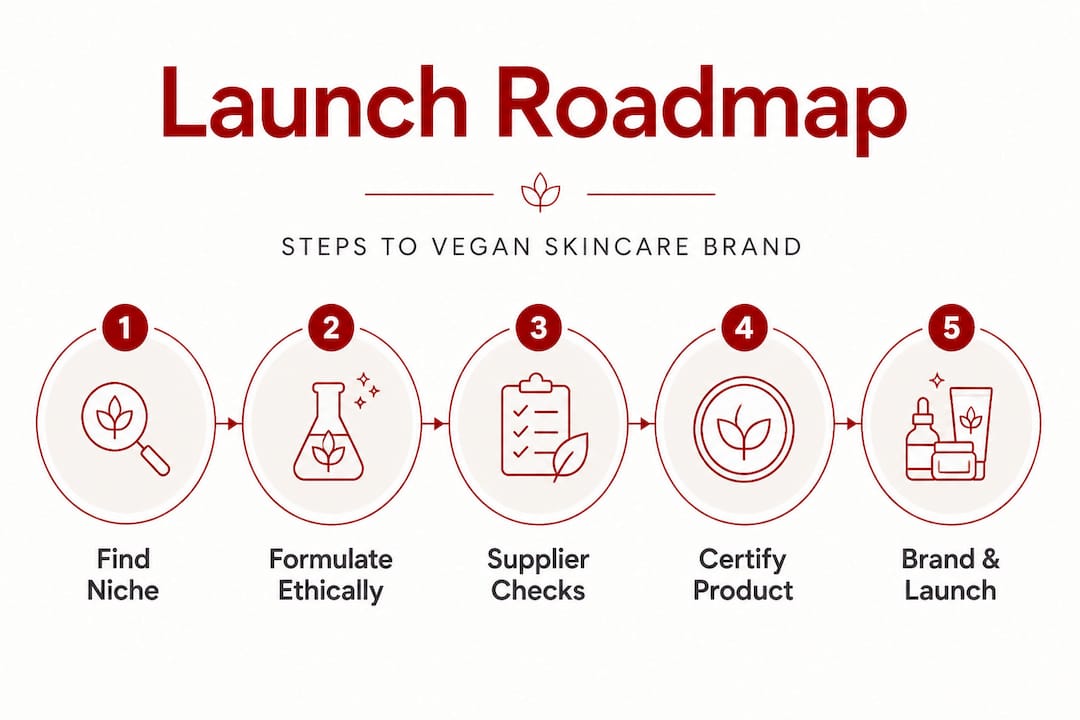
Shopify’s 2026 guide on starting a skincare line confirms that step-by-step execution for aspiring founders begins with picking a narrow skin problem plus a defined audience. That single decision shapes everything downstream, from the active ingredients you choose to the certifications you pursue and the price point your customer will accept.
Here are the most productive ways to validate your niche before committing:
- Search volume and trend data. Use Google Trends to compare terms like “vegan toner for acne” versus “vegan brightening serum.” Rising search volume signals unmet demand.
- Community listening. Spend time in Reddit skincare communities, TikTok comment sections, and Facebook groups. What frustrations come up repeatedly?
- Competitor gap analysis. If five brands already own “vegan anti-aging for 50+,” find the adjacent gap they are ignoring, perhaps vegan barrier repair for eczema-prone skin.
- Your own lived experience. Founders who have personally struggled with a skin concern often build the most authentic brands because they understand the customer journey from the inside.
Niche selection also shapes your certification needs. A brand targeting hyperpigmentation in deeper skin tones has different ingredient requirements than one focused on sensitive, redness-prone skin. Understanding vegan beauty practices in depth will help you map those requirements early.
| Niche | Core concern | Certification priority | Avg. price sensitivity |
|---|---|---|---|
| Acne-prone, oily skin | Oil control, non-comedogenic | Vegan + dermatologist tested | Medium |
| Hyperpigmentation | Brightening, even tone | Vegan + cruelty-free | Medium-high |
| Sensitive or reactive skin | Fragrance-free, barrier support | Vegan + hypoallergenic | High |
| Mature or aging skin | Firmness, hydration | Vegan + clinically tested | High |
| Eco-minimalist | Multi-use, low waste | Vegan + sustainable packaging | Medium |
Use this table as a starting framework, not a final decision. Real differentiation comes from layering your niche with a specific audience identity, a clear price tier, and a formulation philosophy that you can defend with documentation.
Build your vegan formulation and compliance strategy
With your niche selected, it is time to build rigor into your formulation and compliance strategy. This is where most early-stage founders lose months of progress because they treat “vegan” as a marketing label rather than a documented supply-chain standard.
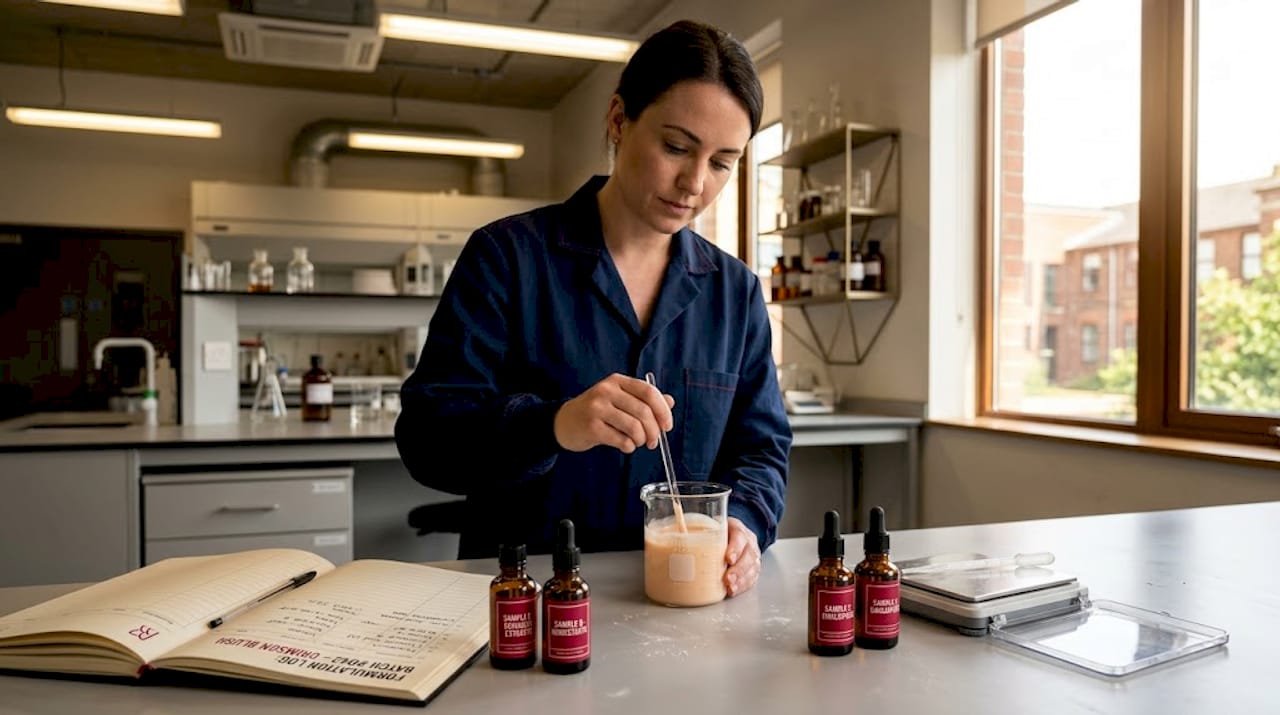
Vivify states it directly: treat “vegan” and “cruelty-free” as separate requirements that must be independently substantiated. A product can be vegan (no animal-derived ingredients) and still fail cruelty-free requirements if any ingredient was tested on animals at any point in the supply chain. You need documentation for both, and you need it from every supplier, not just your final manufacturer.
The V-Label certification guide makes clear that vegan certification readiness requires documentation and traceability, proof of no animal testing, and ingredient verification that goes beyond the final INCI list to include processing aids and additives.
Here is a practical compliance workflow for new founders:
- Build your ingredient master list. Every raw material gets its own entry, including the INCI name, supplier name, country of origin, and current vegan status documentation.
- Request supplier declarations. Ask each supplier for a signed statement confirming no animal-derived ingredients, no animal testing, and no cross-contamination risk with non-vegan runs.
- Audit processing aids. This is the step most founders skip. Ingredients like gelatin, beeswax derivatives, or carmine can enter a formula through processing aids that never appear on the INCI list.
- Document your production controls. If you ever share equipment with non-vegan products, your certification body will need to see your cleaning validation procedures.
- Create a version-controlled compliance file. Every time a supplier changes their own sourcing, your documentation needs updating.
“Vegan compliance is not a one-time checklist. It is an ongoing supply-chain discipline that requires active management at every production cycle.”
You can learn more about building an ethical sourcing approach and explore which vegan ingredients offer the best performance for different skin concerns.
Pro Tip: When onboarding a new supplier, ask specifically for vegan certification documents, not just a verbal assurance. A supplier who cannot provide paperwork is a liability risk when your own certification audit arrives.
Choose manufacturing partners and testing protocols
With compliance plans in place, it is critical to choose the right manufacturing strategy and robust testing that aligns with vegan standards. This decision is one of the highest-leverage choices you will make as a founder because it directly affects your cost structure, speed to market, and your ability to control quality.
Shopify’s 2026 guide frames this as getting hands-on with formulation and manufacturing before running testing and labeling compliance. In practice, that means understanding the three main pathways available to you.
| Manufacturing approach | Speed to market | Vegan-compliance risk | Minimum order quantity | Best for |
|---|---|---|---|---|
| Private label (ready formulas) | Fast (4-12 weeks) | Low if partner is certified | Low (50-200 units) | First-time founders |
| Co-manufacturing (custom formula) | Medium (3-6 months) | Medium (requires audit) | Medium (500-1,000 units) | Brands with unique formulas |
| In-house production | Slow (6-18 months) | High (full control required) | No minimum | Experienced chemists |
Testing is non-negotiable regardless of manufacturing pathway. A complete testing program for a vegan skincare product should include:
- Stability testing. Confirms your formula holds up across temperature, light, and time. Plan for at least 12 weeks of accelerated stability data before launch.
- Safety assessment. Required in most markets. A qualified safety assessor reviews your formula and generates a Product Information File (PIF).
- Preservative efficacy testing. Verifies that your preservative system actually protects the product against microbial contamination.
- Consumer perception testing. Real-world feedback from your target audience validates claims like “non-greasy” or “absorbs quickly.”
- Compatibility testing. Confirms your formula does not react with your packaging, especially important for water-based formulas in recycled packaging.
Pro Tip: Before finalizing any manufacturing contract, ask the facility for their current vegan and cruelty-free certification documents. If they cannot produce them, you will inherit their compliance gaps as your own problem at audit time.
Explore private label options designed for founders who want verified vegan formulas without the complexity of building production from scratch. You can also review types of vegan skincare products to decide which product categories fit your brand direction.
Prepare for certification, labeling, and launch budgeting
After locking in manufacturing and testing, prepare for the critical steps of documentation, labeling, and budgeting for launch. These three areas are where founders most commonly underestimate both the time and the money required.
The V-Label guide specifies that vegan certification readiness requires documented traceability, proof of no animal testing, and ingredient verification that extends to processing aids and additives, not just the finished formula. Start compiling that documentation from day one, not after you have already paid for a production run.
Your certification and labeling documentation checklist should include:
- Full ingredient traceability records for every raw material
- Signed supplier declarations confirming vegan and cruelty-free status
- Processing aid disclosures from each contract manufacturer
- Safety assessment and Product Information File
- Stability and preservative efficacy test results
- Label compliance review for your target markets (INCI listing, country of origin, allergen disclosure)
- Proof of no animal testing at every point in the supply chain
On the financial side, realistic budgeting prevents the most common startup failure mode: running out of cash before reaching the market. According to FinancialModelNet, startup costs for small-batch DTC vegan operations typically range from $10,000 to $50,000, while broader multi-channel launches can run $100,000 to $250,000 or more. A single custom formula development can cost anywhere from a few hundred to several thousand dollars before you have manufactured a single unit.
The major cost drivers to budget for include:
- Formula development and stability testing. Often $2,000 to $10,000 depending on complexity and number of iterations.
- Safety assessment and regulatory filing. Varies by market, but budget $500 to $3,000 per product.
- Certification fees. Annual fees for recognized vegan certifications typically range from $200 to $2,000+ depending on the certifying body and your revenue.
- Packaging design and procurement. Minimum order quantities on eco-conscious packaging can be a significant upfront cost.
- Initial inventory. Even a modest first run of 500 units per SKU adds up quickly when you factor in manufacturing, filling, and labeling.
Review safety compliance protocols and explore how eco-conscious beauty decisions affect both your brand positioning and your cost structure.
Create a transparent brand, marketing, and retail strategy
The final step is crafting your brand and retail plans with transparency and verified credentials at the center. Consumers in 2026 are sophisticated. They know the difference between a brand that says “all-natural” on a pretty label and one that displays a recognized third-party vegan certification logo with a verifiable badge number.
The Vegan Society frames retail readiness as a commercial foundations mindset that includes rate of sale, margins, shelf life, packaging standards, logistics capabilities, and independently verified credentials. That means your marketing strategy and your retail operations must be built together, not separately.
Build your brand trust framework around these principles:
- Use certification logos prominently. Logos from recognized certifying bodies like V-Label or The Vegan Society Trademark carry consumer recognition that generic “vegan” copy cannot replicate.
- Be specific about your claims. “Formulated without animal-derived ingredients and independently certified vegan” is more credible than “100% vegan.”
- Publish your ingredient sourcing philosophy. A short, plainly written sourcing page builds more trust than a long list of credentials most customers will not verify.
- Make your cruelty-free status verifiable. Link to your certifying body’s public database wherever possible.
Pro Tip: Add certification logos directly to your product photography, not just the product label. When customers browse your store on mobile, they see the photo first. That logo is doing conversion work before they ever read your product description.
| Channel | What it demands | Margin requirement | Vegan credential priority |
|---|---|---|---|
| Direct to consumer (DTC) | Strong content and email | 60-70%+ | Certification logo, sourcing page |
| Independent boutiques | Consistent supply, MOQ flexibility | 45-55% | Third-party verified label |
| Specialty retailers | Category fit, rate of sale data | 40-50% | Recognized certification required |
| Online marketplaces | Competitive pricing, reviews | 30-45% | Clear labeling, customer Q&A |
Learn more about how vegan skincare is reshaping the beauty industry and driving new retail expectations from both consumers and buyers.
What founders miss about vegan skincare launches
Let’s step back for a candid take on what actually drives successful vegan skincare launches. After working with many founders in this space, the pattern is consistent: the ones who struggle spend disproportionate energy on formula aesthetics and not nearly enough on supply-chain discipline.
Most founding teams fall in love with their product. That is natural and even necessary. But the brands that fail certification audits almost never fail because their formula was bad. They fail because a processing aid they did not know about contained an animal-derived ingredient, or because a contract manufacturer shared equipment with a non-vegan line and had no cleaning validation records to prove otherwise.
The V-Label compliance guide is explicit: vegan compliance requires controlling not just the obvious ingredients but also processing aids, additives, and cross-contamination between vegan and non-vegan production runs. Late-stage surprises in this area can force full reformulation and delay your certification by months.
The practical implication is that your first major investment should be in documentation infrastructure, not in packaging design. Build a system that tracks every ingredient to its source before you spend a dollar on branding. Understand the common ingredient pitfalls that catch founders off guard and design your supplier onboarding process to screen for them explicitly.
Pro Tip: Before you apply for any vegan certification, conduct your own internal audit of all supply-chain documentation. Treat it like a dress rehearsal for the real audit. Every gap you find internally is a gap you can fix quietly, before it becomes a problem that delays your launch.
The founders who build durable vegan brands are the ones who treat compliance as a competitive advantage, not a box to check. When you can show a retailer or a customer exactly where every ingredient came from and prove it with paperwork, you have something most competitors cannot match.
Partner with experts for your vegan skincare launch
Ready to take your first steps? Here’s how you can get hands-on support.
Building a verified vegan skincare brand from scratch takes more than passion; it takes the right manufacturing partners, compliant formulations, and practical guidance at every stage. Whether you are still researching your niche or ready to move into production, getting expert support early saves time, money, and costly reformulation surprises.
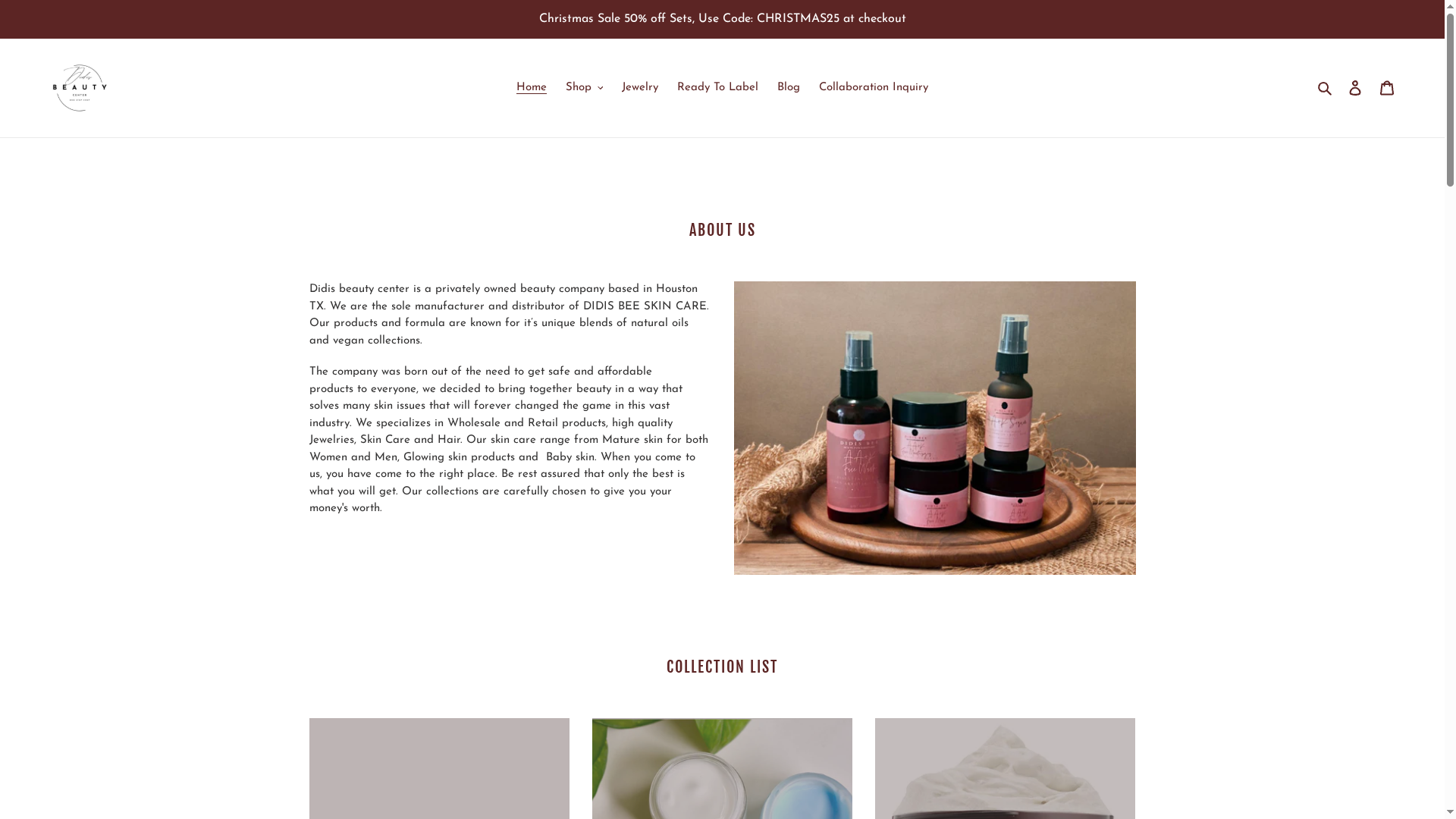
At Didis Beauty Center, we work directly with aspiring founders and small business owners who want to launch their own vegan skincare brands with confidence. Our private label services give you access to ready-to-label, vegan-formulated products with low minimum order quantities so you can enter the market quickly without sacrificing quality or compliance. From face soaps and toners to brightening lines, our catalog is built for founders who want to skip the formulation phase and start building their brand today.
Frequently asked questions
What is the difference between vegan and cruelty-free in skincare?
Vegan means no animal-derived ingredients are used in the formula, while cruelty-free means no animal testing occurred at any stage. Brands must validate both claims independently because a product can qualify as one without qualifying as the other.
How much does it cost to start a vegan skincare brand?
Smaller vegan beauty startups typically require $10,000 to $50,000 for small-batch DTC operations, while broader multi-channel launches often run $100,000 to $250,000 or more depending on formulation complexity and target markets.
What documentation is needed for vegan skincare certification?
Certification bodies require ingredient traceability records, verified supplier declarations, proof of no animal testing, and controls covering processing aids and cross-contamination risks, not just the finished product INCI list.
What is the most important step for scaling a vegan skincare brand?
Successful scaling requires building commercial foundations: retail readiness, logistics, pricing margins, and independent vegan certification that gives retailers and consumers a verifiable reason to trust your brand.
Discourse (0)