


TL;DR:
- Truly eco-conscious packaging involves considering the entire lifecycle, including sourcing, manufacturing, use, and disposal.
- Material choices like recycled plastics, FSC paper, and mono-materials need to balance performance and recyclability.
- Consumer trust relies on verified certifications and transparent, system-based sustainability efforts beyond just labeling.
Slapping a “recycled” label on a product box doesn’t automatically make it sustainable. Real eco-conscious packaging is far more layered than choosing a material and moving on, and that misconception costs both consumers and small beauty entrepreneurs dearly. From sourcing raw materials to what happens after you toss the container, every single step has an environmental footprint worth examining. This guide walks you through what eco-conscious packaging actually means, which materials hold up under scrutiny, how smart design compounds your impact, and how to spot the difference between authentic sustainability claims and polished greenwashing.
Table of Contents
- Defining eco-conscious packaging: More than a buzzword
- Materials that make a difference: Options for sustainable packaging
- Design strategies: How brands and entrepreneurs improve packaging sustainability
- Eco claims, consumer trends, and the reality check
- Beyond the label: What most guides miss about eco-conscious packaging
- Next steps: Beauty solutions that align with your eco-conscious values
- Frequently asked questions
Key Takeaways
| Point | Details |
|---|---|
| Systems thinking matters | True eco-conscious packaging requires considering the entire lifecycle, not just the materials used. |
| Material choice impacts | Each material option offers unique benefits and tradeoffs—no single solution is perfect for all needs. |
| Smart design reduces waste | Right-sizing, lightweighting, and thoughtful design often lower environmental impact more than switching materials alone. |
| Certifications build trust | Third-party labels like FSC and How2Recycle help consumers verify authentic sustainability claims. |
| Consumer demand accelerates change | With more shoppers valuing sustainability, eco-conscious packaging now shapes market trends and brand success. |
Defining eco-conscious packaging: More than a buzzword
With misconceptions clarified, let’s cut through the buzzwords and define what genuinely makes packaging eco-conscious.
Most people assume sustainable packaging means cardboard boxes or brown paper tape. But the real definition is broader and more demanding. Eco-conscious packaging, also known as sustainable or eco-friendly packaging, refers to packaging solutions designed to minimize environmental impact throughout their lifecycle, from sourcing to end-of-life disposal. That last phrase, “lifecycle,” is where most conversations go wrong.
Think of packaging as having five chapters: raw material sourcing, manufacturing, transport, consumer use, and disposal or recovery. A glass jar might feel virtuous in your hand, but if it shipped across three continents in a fossil-fuel-powered cargo ship, was manufactured in a factory with zero renewable energy, and ends up in a landfill because your local facility doesn’t accept that glass type, then its eco credentials start looking shaky. This is why sustainability professionals talk about lifecycle assessment, a method for measuring total environmental cost across every chapter.
“The most sustainable package isn’t the one made from the best material. It’s the one designed with the entire system in mind.”
For the beauty and skincare industry specifically, this matters even more. Consumers are paying closer attention to eco labels in beauty and demanding transparency. Regulatory pressure is also building, with the European Union’s packaging and packaging waste regulations pushing global brands to rethink their choices. And brand trust? It’s on the line every time a product hits a shelf or lands at someone’s door.
Here’s what a truly eco-conscious approach covers:
- Material sourcing: Is the raw material renewable, recycled, or resource-intensive?
- Manufacturing: What emissions, water, and energy does production require?
- Transport and logistics: How far does it travel, and how much does weight add to shipping emissions?
- Consumer experience: Is it reusable? Easy to recycle? Does it keep the product safe long enough to be used fully?
- End-of-life: Where does it go? Can it be composted, recycled, or does it end up in a landfill?
Understanding sustainable beauty impact means accepting that no single material wins every category. Every choice involves trade-offs, and the honest conversation starts there.
Materials that make a difference: Options for sustainable packaging
Once you understand the purpose, the next step is exploring what materials fit best with eco-conscious principles.
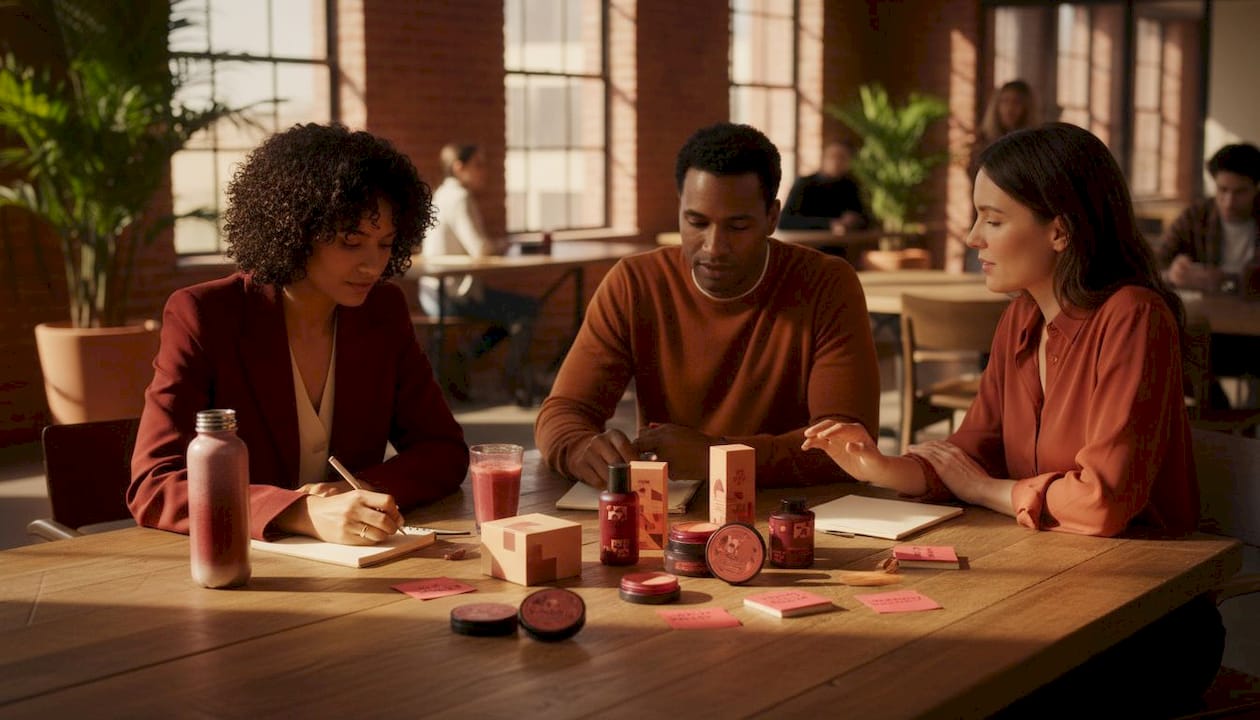
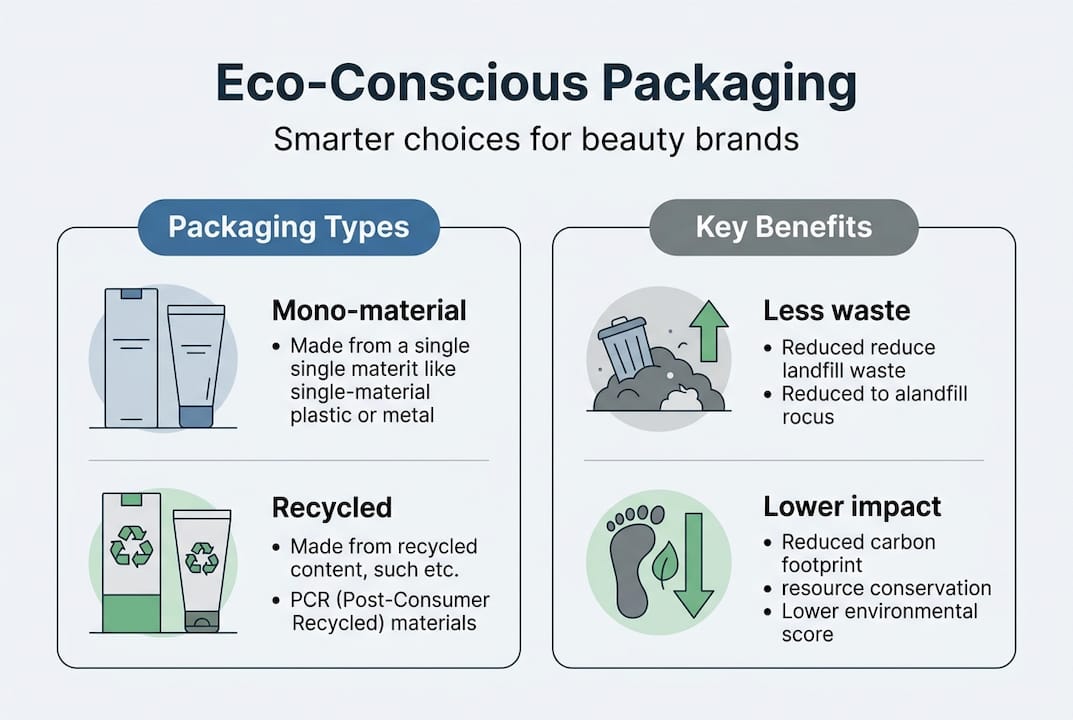
Common sustainable materials include recycled-content plastics like rPET and rHDPE, post-consumer recycled (PCR) paper, FSC-certified paper, bioplastics like PLA and PHA, mono-material structures built for recyclability, and specialty options like Miron glass jars, biodegradable paper tubes, and compostable paper pots. Each has its own profile of benefits and real-world limitations.
| Material | Key benefit | Main limitation |
|---|---|---|
| rPET plastic | Reduces virgin plastic demand | Requires clean sorting infrastructure |
| PCR paper | Widely recyclable | Poor moisture barrier |
| FSC-certified paper | Supports responsible forestry | Heavier, higher transport emissions |
| Miron glass | Reusable, premium feel | Heavy, higher shipping footprint |
| PLA bioplastic | Made from renewable crops | Needs industrial composting facilities |
| Compostable paper pots | Biodegradable, plastic-free | Short shelf life, moisture sensitive |
Take a real-world comparison between glass pots and compostable tubes for a face cream:
- Glass pots offer product protection, a premium unboxing experience, and potential reuse. Their downside is weight, which drives up shipping emissions, and breakage risk. Over time, a glass pot reused 20-plus times genuinely reduces its carbon footprint per use.
- Compostable tubes are lightweight and eliminate plastic entirely. However, they may not protect moisture-sensitive formulas as effectively, and they only break down properly in an industrial composting facility, not in a backyard compost bin.
Neither option is universally better. The right call depends on your product formula, your customer’s likely disposal behavior, and your shipping model. For small business owners launching their first skincare line, understanding these trade-offs early saves money and prevents packaging regrets. Check out natural beauty packaging ideas for more detailed guidance on matching material to product type.
Pro Tip: Choose mono-materials whenever possible. Packaging made from a single material type (like an all-paper box with no plastic window) is dramatically easier to recycle than multi-layer laminates, even if that laminate looks sleeker.
Design strategies: How brands and entrepreneurs improve packaging sustainability
Choosing materials is just the start. How you design and engineer the packaging makes a significant difference.
The gold standard framework used by packaging sustainability professionals is the Source Reduction Hierarchy: eliminate packaging entirely, then reduce what remains, then reuse, then recycle, then compost. Each step down the hierarchy represents less impact, but also more complexity in execution. The goal is always to move as high up the hierarchy as possible.
Here’s how that plays out in practical steps:
- Eliminate what isn’t necessary. Do you need an outer box for a product sold directly online? If it ships in a mailer, that secondary box creates waste with zero added value.
- Right-size your packaging. Match the box or container precisely to the product. Oversized packaging fills up with void fill material, adds weight, and signals excess to consumers.
- Lightweight your structures. Thinner walls, smaller caps, and reduced label coverage all trim material use without sacrificing protection.
- Use mono-materials. Design for recyclability from the start, not as an afterthought.
- Plan for the end of life. Label clearly with recycling or composting instructions using verified programs like How2Recycle.
The impact of right-sizing alone is staggering. Amazon eliminated 1.5 million tonnes of packaging material through a right-sizing program that matched box size to product dimensions. That’s not a small-brand trick. That’s a systems-level shift driven by intentional design.
| Strategy | Impact level | Complexity for small brands |
|---|---|---|
| Eliminate extra layers | Very high | Low to medium |
| Right-size containers | High | Medium |
| Lightweight structures | Medium to high | Medium |
| Mono-material design | High | Medium to high |
| How2Recycle labeling | Medium | Low |
| Refillable systems | Very high | High |
For beauty and skincare entrepreneurs, reviewing eco-friendly packaging case studies gives you real-world models to follow rather than guessing from scratch.
Pro Tip: Never sacrifice product protection for a sustainability win on paper. A broken, leaked, or spoiled product represents a total loss, not just of the item, but of all the energy and resources that went into making it. The packaging that keeps your product safe often has a smaller real-world footprint than the flimsy “eco” option that results in damaged goods.
Eco claims, consumer trends, and the reality check
Understanding options and strategies is essential, but what does this all mean for consumer trust and real-world outcomes?
Consumer attitudes have shifted decisively. According to McKinsey’s 2025 research, 39% of global consumers rank environmental impact as a top purchase priority, and 60% say they’re willing to pay more for sustainable packaging. Products with credible sustainability claims have grown 28% compared to 20% for products without them. This isn’t a niche trend. It’s a mainstream market signal.
“Sustainability claims that can’t be verified don’t build trust. They erode it.”
Certifications matter because they shift the trust burden from brand promise to third-party proof. The most recognized programs in the packaging space include:
- FSC (Forest Stewardship Council): Certifies that paper and wood-based materials come from responsibly managed forests.
- How2Recycle: A standardized label system that tells consumers exactly how to recycle a specific packaging component in their local area.
- APR (Association of Plastics Recyclers) Design Guide: A technical standard that helps brands design plastic packaging compatible with actual recycling streams.
Beyond certifications, here’s a reality check that most guides skip. Compostables require industrial facilities, not backyard bins, which many consumers don’t have access to. The FTC requires that a material labeled “recyclable” must be accessible to at least 60% of US consumers for the claim to be legally valid. Paper packaging, often seen as the safest option, is heavier than plastic, which drives up transport emissions and requires strong moisture barriers to protect beauty formulas. Flexible multi-layer packaging, despite being lightweight, is almost universally non-recyclable because separating its layers is economically impractical.
When you browse sustainable accessories trends in the beauty space, you’ll notice that the brands leading in authenticity aren’t the ones making the biggest claims. They’re the ones showing their work: publishing lifecycle data, displaying certifications prominently, and explaining disposal clearly on-pack.
Here’s a practical benchmark comparison to keep in mind:
- Reusable packaging reduces greenhouse gas emissions by 40 to 70% when used more than 20 times.
- Recycled-content packaging cuts emissions by 30 to 50% compared to virgin materials.
- Compostable packaging can match or beat plastic on carbon, but only when composted correctly, which often requires infrastructure your customer may not have.
For eco-conscious beauty shoppers building their own eco-conscious beauty routine, the smartest approach is to buy products from brands that show third-party proof, favor reusables and recycled-content options, and check local facilities before assuming compostable means problem-free.
Beyond the label: What most guides miss about eco-conscious packaging
Most conversations about eco-conscious packaging stall at materials. Pick glass over plastic. Choose paper over foam. Done. But that surface-level thinking misses the harder, more important question: does the entire system work?
At Didis Beauty Center, we’ve learned that systems-based sustainability frameworks, like those from the Sustainable Packaging Coalition and the Ellen MacArthur Foundation, consistently show there is no universally “best” material. The right choice depends on the product formula, the customer’s location, local infrastructure, shipping distance, and end-of-life options. A material that’s brilliant in one context can be a liability in another.
What we see most often overlooked? Product protection. If your packaging choice lets a formula oxidize, leak, or degrade before it’s used, you’ve created more environmental damage than the packaging itself would have caused. The carbon cost of manufacturing, shipping, and disposing of a ruined product far exceeds the cost of choosing a slightly less “pure” packaging material that actually keeps the product intact.
Third-party certifications are genuinely helpful, but they’re a floor, not a ceiling. They verify minimum standards. The most responsible brands go beyond compliance and share lifecycle data openly, so you can see the full picture rather than just a logo on a box. If a brand makes bold sustainability claims but can’t point to verified evidence, that’s a red flag worth taking seriously. Ask questions. Expect answers.
Next steps: Beauty solutions that align with your eco-conscious values
Looking to put your values into action? Here’s where Didis Beauty Center can help.
We’ve built our product range around vegan, natural formulations paired with thoughtful packaging choices that reflect real sustainability principles, not just marketing language. Our Daily Essential Bundle brings together carefully selected skincare favorites for eco-minded consumers who want quality without compromise. For nighttime skincare, our Detox Nightwear Face Cream delivers results in a formulation you can feel good about. And if you’re a small business owner ready to launch your own line, our eco-friendly private label program offers sustainable packaging solutions designed with entrepreneurs in mind. Start where you are, and build something better.
Frequently asked questions
What qualifies as eco-conscious packaging?
Eco-conscious packaging minimizes environmental impact across sourcing, production, use, and disposal, covering the full lifecycle rather than focusing on a single attribute like material type.
How can I tell if a beauty product’s packaging is sustainable?
Look for third-party certifications like FSC or How2Recycle labels, prioritize recycled or renewable materials, and check that the product includes clear instructions for recycling or composting.
Are compostable packaging options always better than plastic?
Not always. Compostables require industrial facilities and may not protect moisture-sensitive beauty products adequately, so they work best when your customer has reliable access to commercial composting programs.
Why is right-sizing important in eco-conscious packaging?
Right-sizing cuts excess material use, lowers shipping weight and emissions, and reduces the need for void fill. Amazon’s right-sizing program eliminated 1.5 million tonnes of packaging material, demonstrating the scale of impact this strategy can achieve.
Do consumers really care about sustainable packaging now?
Absolutely. 39% of consumers rank environmental impact as a top priority, and 60% are willing to pay more for sustainable packaging options, making it a measurable competitive advantage for beauty brands.
Discourse (0)