


Finding truly effective, vegan skincare that honors local roots can feel like a search with no map. For eco-conscious shoppers and future beauty founders alike, understanding what makes skincare genuinely “local” goes far beyond buzzwords on a label. Local skincare stands out with regional ingredient sourcing, small-batch production, and transparent practices that support both skin health and community sustainability. Discover how these values empower healthier choices for your skin and our planet while building trust in every product you use.
Table of Contents
- What Makes Skincare Products Local
- How Local Skincare Differs from Mass Brands
- Health and Environmental Benefits Explained
- Economic Impact: Supporting Local Entrepreneurs
- Choosing Ethical and Sustainable Local Brands
Key Takeaways
| Point | Details |
|---|---|
| Support Local Economies | Purchasing local skincare products directly benefits your community and supports local entrepreneurs. |
| Emphasize Quality and Freshness | Local brands offer smaller batches, ensuring better ingredient quality and product freshness. |
| Prioritize Sustainable Practices | Local skincare often utilizes eco-friendly ingredients and biodegradable packaging, reducing environmental impact. |
| Build Authentic Relationships | Local skincare companies foster personal connections with customers, enhancing trust and customer loyalty. |
What Makes Skincare Products Local
Local skincare products stand apart because they source ingredients from nearby regions and produce them in facilities that understand your specific environment. Unlike mass-market brands shipping products across continents, local skincare companies work with what grows in your climate.
Three core characteristics define local skincare:
- Regional ingredient sourcing – Formulations use plants, minerals, and botanicals harvested from local or nearby areas
- Small-batch production – Limited runs allow better quality control and freshness
- Transparent sourcing – You know where ingredients come from and who produced them
Local products often emphasize natural, organic ingredients while avoiding synthetic chemicals that mass producers rely on. This approach reflects both your local culture and environmental conditions, creating skincare tailored to regional skin concerns rather than one-size-fits-all formulas.

The production process matters too. Local skincare makers typically use environmentally friendly extraction methods for plant-based extracts, reducing chemical waste and environmental impact. Small-batch work means fewer preservatives and additives needed to maintain shelf life during long shipping.
Supporting local skincare also means supporting your community. Producers source from local farmers and suppliers, keeping money within your region’s economy. You’re not just buying a product—you’re investing in relationships and local agricultural practices.
Packaging tells another story. Local brands typically prioritize sustainable materials because they answer directly to their community. Plastic-heavy packaging raises eyebrows when your neighbors can see the waste.
Authenticity is built in. Local skincare makers can’t hide behind corporate marketing departments. Their reputation depends on actual results and word-of-mouth recommendations from people who know them.
Local skincare connects you directly to your region’s natural resources, farmers, and production practices in ways global brands simply cannot match.
Pro tip: Look for local skincare brands at farmers markets or through community networks—you’ll often find makers willing to customize formulas for your specific skin type, something mass-market retailers never offer.
How Local Skincare Differs from Mass Brands
Mass-market skincare companies prioritize profit margins and distribution scale. Local skincare makers prioritize your skin and your community. The difference shapes everything from ingredient selection to how they treat customer relationships.
Here’s what separates them:
- Production scale – Mass brands manufacture thousands of units; local brands produce smaller batches for quality control
- Ingredient transparency – Local makers disclose sourcing; mass brands hide supply chains behind corporate layers
- Customer connection – Local brands know their customers personally; mass brands sell to demographics
- Formulation approach – Local skincare adapts to regional needs; mass brands use one formula globally
Mass brands rely on massive marketing budgets and celebrity endorsements to create demand. Local skincare builds loyalty through brand authenticity and actual results. You trust them because you can verify their claims.
How they engage customers tells the real story. Mass brands broadcast the same message everywhere. Local skincare brands use personalized customer engagement through social media interactions, live responses, and community conversations. They answer your specific questions instead of directing you to FAQ pages.
Preservatives and fillers reveal another gap. Mass brands need extended shelf life for global shipping and warehouse storage. Local skincare often uses fewer preservatives because products reach you faster and fresher.
Cost structure differs too. Mass brands spend heavily on packaging, advertising, and distribution networks. Local brands invest more directly in ingredient quality, so you’re paying for effectiveness rather than marketing campaigns.
The relationship model changes everything. Mass brands sell products. Local skincare builds emotional connections with customers that encourage loyalty and trust.
Local brands respond to your specific skin concerns. Mass brands respond to quarterly earnings reports.
Pro tip: Message local skincare brands directly on social media with your skin concerns—most will discuss customization options or recommend specific products from their line rather than pushing everything they make.
Here’s a concise comparison of how local skincare brands differ from mass-market brands:
| Aspect | Local Skincare Brands | Mass-Market Brands |
|---|---|---|
| Customer Interaction | Direct, personal responses | Automated, generic outreach |
| Product Customization | Often available for individuals | Rarely offered globally |
| Shelf Life | Short, fresher products | Extended, preservatives added |
| Packaging | Minimal, eco-friendly options | Excessive plastic, disposable |
| Brand Trust | Built on authenticity and results | Driven by celebrity endorsements |
Health and Environmental Benefits Explained
Choosing local skincare delivers dual wins: your skin gets healthier while the planet recovers. These benefits connect directly because natural, locally-sourced ingredients work differently than mass-market formulations shipped across oceans.
Your skin experiences immediate improvements:
- Fewer synthetic chemicals – Local brands skip unnecessary preservatives and additives that irritate sensitive skin
- Reduced allergen exposure – Fewer ingredients mean fewer potential triggers for reactions
- Better barrier function – Natural botanicals support your skin’s natural protective layer
- Decreased irritation – Simpler formulations mean less inflammation and redness
Local skincare products contain reduced exposure to microplastics and synthetic chemicals commonly found in conventional brands. Your skin absorbs what you apply, so using products with natural, transparent ingredients directly impacts long-term skin health.
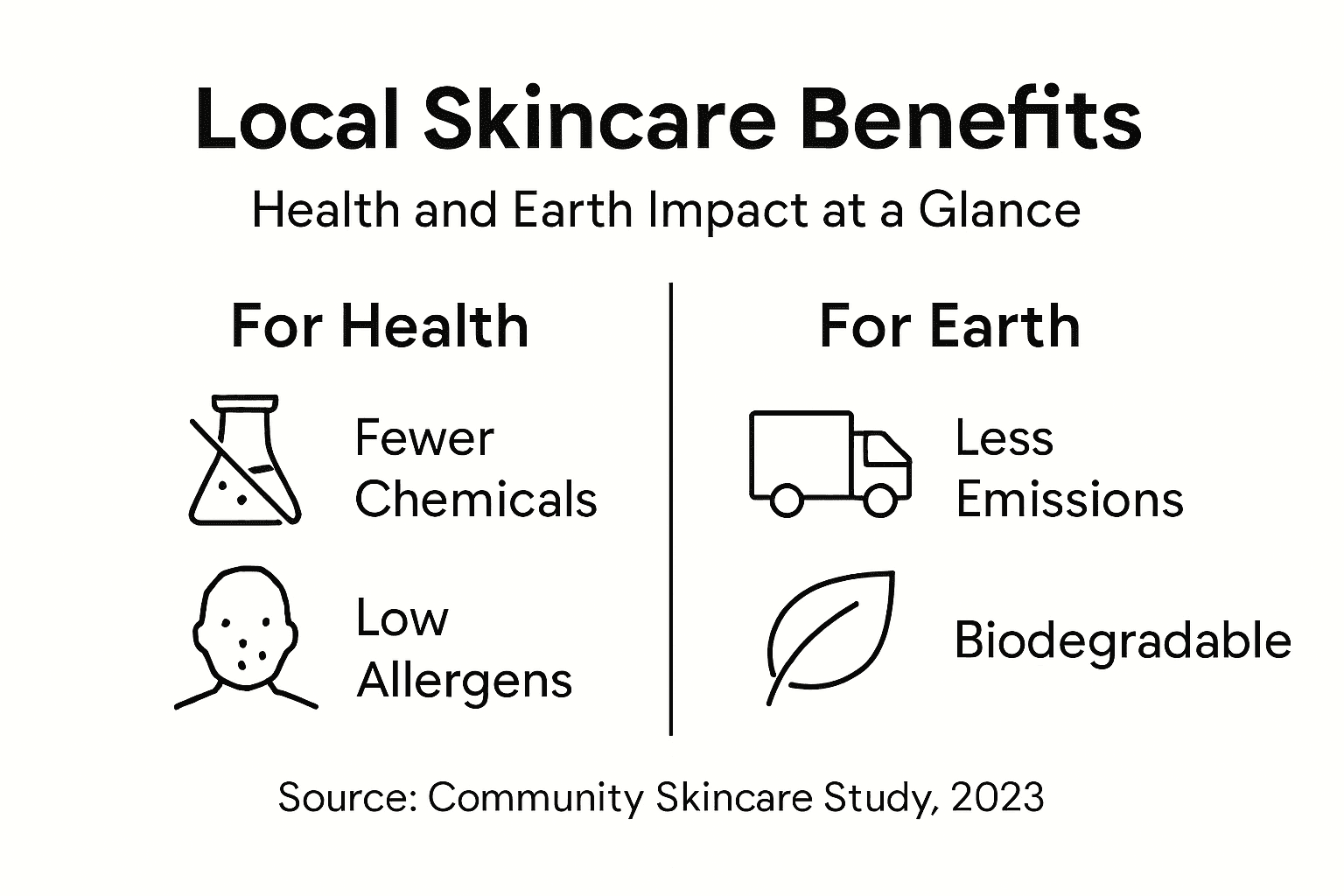
The environmental gains are equally significant. Local sourcing dramatically cuts transportation emissions. A product made across the street generates far fewer carbon emissions than one manufactured overseas and shipped through multiple distribution centers.
Organically sourced, biodegradable ingredients break down naturally instead of accumulating in waterways and soil. Conventional skincare chemicals persist in ecosystems, harming aquatic life and contaminating groundwater. Local brands using plant-based formulations prevent this damage.
Packaging waste shrinks dramatically too. Local brands typically use minimal, recyclable materials. Mass brands create excessive plastic waste through single-use packaging, shipping boxes, and protective layers that end up in landfills for centuries.
Large-scale ingredient harvesting depletes ecosystems and destroys habitats. Local sourcing supports sustainable farming practices that preserve biodiversity and protect soil health for future generations.
Buying local skincare means your personal wellness and planetary health move in the same direction, not opposite ones.
Pro tip: Check product labels for third-party certifications like organic or cruelty-free stamps—these verify the environmental and health claims brands make, helping you identify genuinely sustainable options versus greenwashing.
Economic Impact: Supporting Local Entrepreneurs
Every purchase of local skincare directly funds entrepreneurs in your community. This isn’t abstract charity—it’s concrete economic activity that creates jobs, builds businesses, and strengthens regional resilience.
Here’s how your spending works:
- Job creation – Local skincare businesses employ community members in production, packaging, and customer service roles
- Business growth – Increased sales fund expansion, equipment upgrades, and hiring
- Supply chain spending – Local brands purchase from regional farmers, manufacturers, and suppliers
- Tax revenue – Community infrastructure improves through local business tax contributions
- Skill preservation – Traditional knowledge and production techniques survive through local operations
Local skincare entrepreneurs face steep competition against global corporations with billion-dollar marketing budgets. Your support empowers small and medium enterprises to compete, innovate, and thrive in markets otherwise dominated by distant conglomerates.
When you buy from local makers, money circulates within your economy multiple times. A single purchase might fund a business owner who then pays employees who spend their wages locally, creating a multiplier effect that conventional retail can’t match.
Social media engagement and word-of-mouth marketing dramatically boost local skincare visibility and sales. As you share products with friends or follow brands online, you’re actively helping them reach new customers without expensive advertising campaigns.
Local entrepreneurship fosters innovation specific to regional needs. Small makers respond quickly to community preferences, developing products tailored to local climate, skin types, and cultural traditions. This diversity strengthens the entire skincare market.
Business sustainability improves dramatically with community support. Local brands reinvest profits into production capacity, research, and quality improvements rather than returning capital to distant shareholders.
Every dollar spent on local skincare stays in your community, supporting someone’s dream and building economic independence.
Pro tip: Follow local skincare brands on social media and engage with their content—likes, comments, and shares dramatically increase their algorithmic visibility, helping them reach new customers without paid advertising budgets.
Choosing Ethical and Sustainable Local Brands
Not every local skincare brand operates ethically. Location alone doesn’t guarantee sustainability or fair practices. You need specific signals to identify brands that genuinely align with your values.
Look for these key indicators:
- Transparent ingredient sourcing – Brands disclose where each component originates and why
- Fair trade certification – Third-party verification ensures suppliers receive fair compensation
- Cruelty-free testing – Products never tested on animals, with documented proof
- Biodegradable packaging – Materials break down naturally without harming ecosystems
- Clear supply chain documentation – You can trace how products move from source to shelf
Authentic ethical brands use transparent practices emphasizing fair trade and biodegradable packaging. They communicate these values clearly because they’re not hiding anything. If a brand won’t explain their practices, that’s a red flag.
Social media presence matters more than you’d think. Ethical local skincare makers actively engage with followers, answer questions honestly, and share behind-the-scenes production content. Mass brands rarely do this because they’d expose supply chain problems.
Natural, pesticide-free ingredients indicate commitment to both skin health and environmental stewardship. Avoid brands that claim to be local but import cheap synthetic ingredients from overseas.
Certifications matter, but verify them. Look for organic seals, cruelty-free stamps, and fair trade badges from recognized organizations. Fake certifications are increasingly common, so check official databases.
Ask direct questions. Contact brands about their waste management, water usage, and employee practices. Ethical companies answer thoroughly. Evasive responses suggest problems they’d rather hide.
Peer recommendations carry weight. Read reviews from other eco-conscious consumers who share your values. Their experience reveals whether brands actually deliver on sustainability promises.
Ethical skincare means every choice—from how plants are grown to how workers are treated—aligns with your principles.
Pro tip: Request product samples before committing to full sizes; ethical brands often provide them because they trust quality will convince you, while mass producers push bulk purchases to prevent returns.
Below is a summary of common signals to verify ethical and sustainable local skincare brands:
| Indicator | What It Reveals | Why It Matters |
|---|---|---|
| Transparent sourcing | Origin and producer details | Prevents hidden supply chains |
| Fair trade certification | Supplier compensation verified | Ensures ethical labor |
| Cruelty-free stamps | No animal testing involved | Supports animal welfare |
| Biodegradable packaging | Breaks down in nature | Reduces environmental impact |
| Social media engagement | Open conversation with consumers | Demonstrates honesty and care |
Discover the Power of Local Skincare with Didis Beauty Center
Are you ready to embrace skincare that truly supports your health and protects the earth? The article highlights key challenges like avoiding synthetic chemicals, reducing environmental impact, and fostering authentic connections with brands that care. If you want to experience fresher, natural formulations that honor your skin and community, explore our Cream Collection - Skincare & Moisturizers for Face & Beard – Didis Beauty Center and the carefully curated Oils Collection: Skincare Oils for Face & Body – Didis Beauty Center.

Take control of your skincare routine today with products crafted to nurture both your skin and the planet’s well-being. Visit Didis Beauty Center now to find clean, effective, and ethically made options. Feel good about what you put on your skin while supporting local entrepreneurs who prioritize transparency, sustainability, and quality. Shop smart. Shop local. Your skin and the earth will thank you.
Frequently Asked Questions
What are the health benefits of using local skincare products?
Local skincare products offer fewer synthetic chemicals, reduced allergen exposure, better barrier function, and decreased irritation, leading to healthier skin.
How do local skincare brands impact the environment?
Local skincare brands use sustainably sourced ingredients, produce less packaging waste, and reduce transportation emissions, contributing to a healthier planet.
What makes local skincare different from mass-market products?
Local skincare brands focus on small-batch production, ingredient transparency, and personalized customer relationships, while mass-market products prioritize scale and profit.
How can I identify ethical local skincare brands?
Look for transparent ingredient sourcing, fair trade certifications, cruelty-free testing, biodegradable packaging, and active social media engagement to gauge a brand’s ethical practices.
Recommended
- Eco-Friendly Skincare: Why It Matters for You – Didis Beauty Center
- Eco-Friendly Skincare: Why It Matters for You – Didis Beauty Center
- Eco-Friendly Skincare Guide: Achieve Sustainable Glow – Didis Beauty Center
- Eco-Friendly Skincare Guide: Achieve Sustainable Glow – Didis Beauty Center
- Nachhaltigkeit bei Parfüms: umweltfreundlich genießen im Alltag – Pure Parfüm
Discourse (0)