


TL;DR:
- An entrepreneur’s beauty kit combines products, tools, training materials, and marketing assets to support business operations, not just personal use. It serves functions such as client service, product demonstrations, and brand launches, shaping revenue and brand positioning. Building a focused, capacity-driven kit with proper sourcing and operational materials is essential for sustainable growth and brand validation.
If you’re serious about launching a beauty brand, you need to understand what is an entrepreneur’s beauty kit before you spend a dollar on inventory. Most people picture a cosmetics bag stuffed with foundations and serums. The reality is more purposeful than that. In industry terms, this is better described as a professional beauty starter kit or business launch bundle, and it functions as a strategic toolkit combining products, tools, client-facing materials, and operational essentials. Getting this distinction right from the start shapes every sourcing, pricing, and service decision you’ll make.
Table of Contents
- Key Takeaways
- What is an entrepreneur’s beauty kit, really?
- How beauty kits function as a business model
- How to assemble your own kit
- Examples of entrepreneur beauty kit types
- Integrating your kit into the bigger business picture
- My take on the kit as a business asset
- Build your kit with Didisbeautycenter
- FAQ
Key Takeaways
| Point | Details |
|---|---|
| More than products | An entrepreneur’s beauty kit includes training materials, samples, and marketing assets alongside physical products. |
| Built around capacity | Match your kit size to your expected client volume or sales goals, not personal preference. |
| Supports sales directly | Kits reduce friction in demonstrations and help customers understand multi-step routines faster. |
| Budget realistically | Startup kit costs typically range from $2,000 to $5,000 before accounting for licenses and insurance. |
| Private label accelerates growth | Ready-to-label kits let founders launch branded products without building formulas from scratch. |
What is an entrepreneur’s beauty kit, really?
A professional beauty starter kit is a curated package that combines products, tools, and training materials to help you deliver services, demonstrate your brand, or launch a skincare routine to customers. That last part is what separates an entrepreneur’s version from the kit a consumer buys at a department store. The consumer kit is about personal use. The entrepreneur’s kit is about business output.
Here’s what a well-assembled business launch bundle typically contains:
- Core products: Full-size or professional-grade skincare, makeup, or treatment items that represent your brand’s routine or service menu
- Sample sets: Smaller versions or trial sizes used for client education, product demos, or gifting
- Application tools: Brushes, spatulas, applicators, or treatment equipment specific to your service type
- Training materials: Step-by-step guides, how-to cards, or access to accredited training programs
- Marketing assets: Product descriptions, ingredient callouts, before-and-after imagery, and branded packaging inserts
- Compliance documentation: Safety data sheets, ingredient disclosures, and any required certifications for your market
These kits serve three distinct business purposes: client service delivery, product demonstrations for wholesale or retail buyers, and physical brand launches where founders need to present a complete lineup. Depending on your model, your kit might lean heavily toward one of these functions or blend all three.
Pro Tip: Before ordering any kit, write down which of those three purposes you’re solving for. A kit built for demos looks very different from one built to service 40 clients per month.
How beauty kits function as a business model
Think of your kit as a revenue architecture decision, not a shopping list. Beauty kits reduce sales friction by letting you walk a client through an entire skincare routine step by step, which builds confidence and dramatically improves conversion rates compared to pitching individual products.
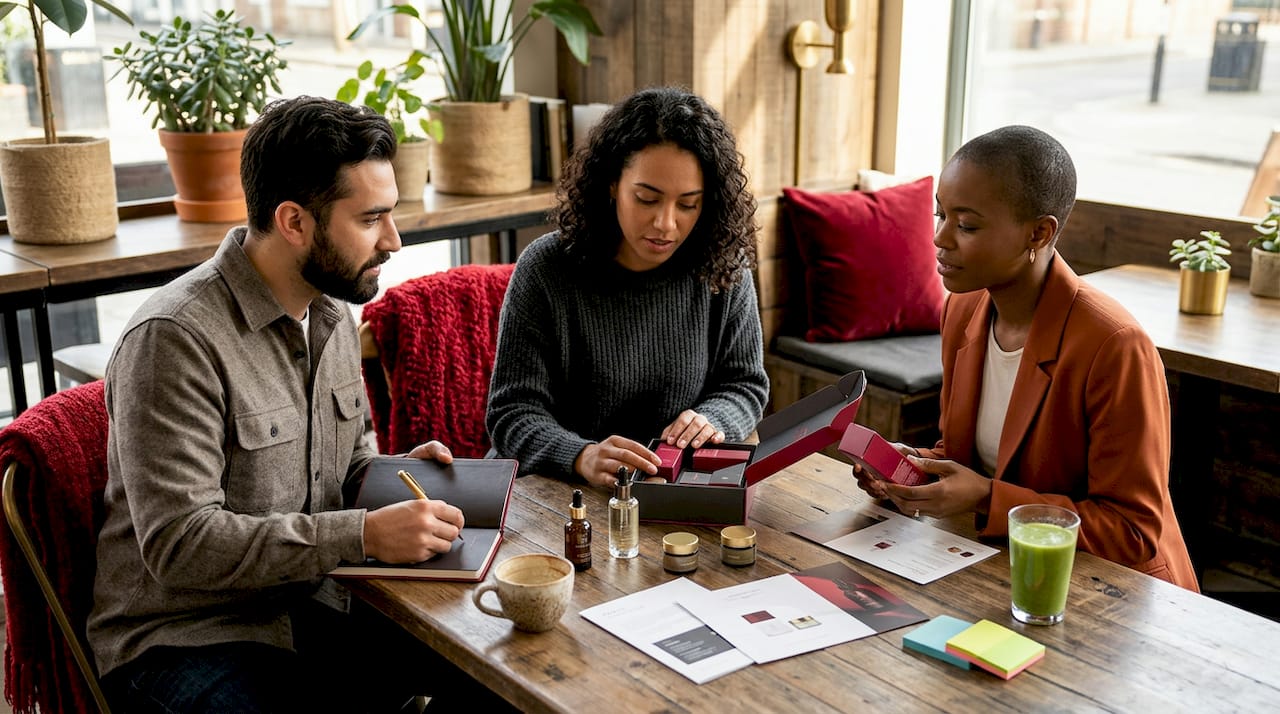
For service-based founders, this framing gets even more specific. A lash artist’s kit, for example, isn’t just product stock. It’s production capacity. A properly sized professional kit can contain inventory supporting 60+ clients, which at $50 per service translates to more than $3,000 in beginner revenue from a single kit purchase. That’s how service entrepreneurs should read their kit specs: not as a list of items, but as a client throughput number.
For product-based founders, kits serve a different but equally concrete function. They let you:
- Present a complete brand story without selling individual SKUs one at a time
- Test multiple price points through bundled versus individual pricing
- Create sellable products from the kit itself, such as at-home facial sets that customers purchase and use independently
- Build repeat purchase cycles by introducing customers to a full routine they want to maintain
“Your beauty kit isn’t a starter pack. It’s the first version of your product strategy. How you build it signals whether you’re thinking like a founder or a hobbyist.”
The kit also acts as a natural filter for your business model. If you find yourself struggling to fill a 10-product kit with items that all make sense together, that’s a sign your brand positioning needs work before you place an order.
How to assemble your own kit
Building a kit that actually serves your business requires some planning upfront. Here’s a structured approach:
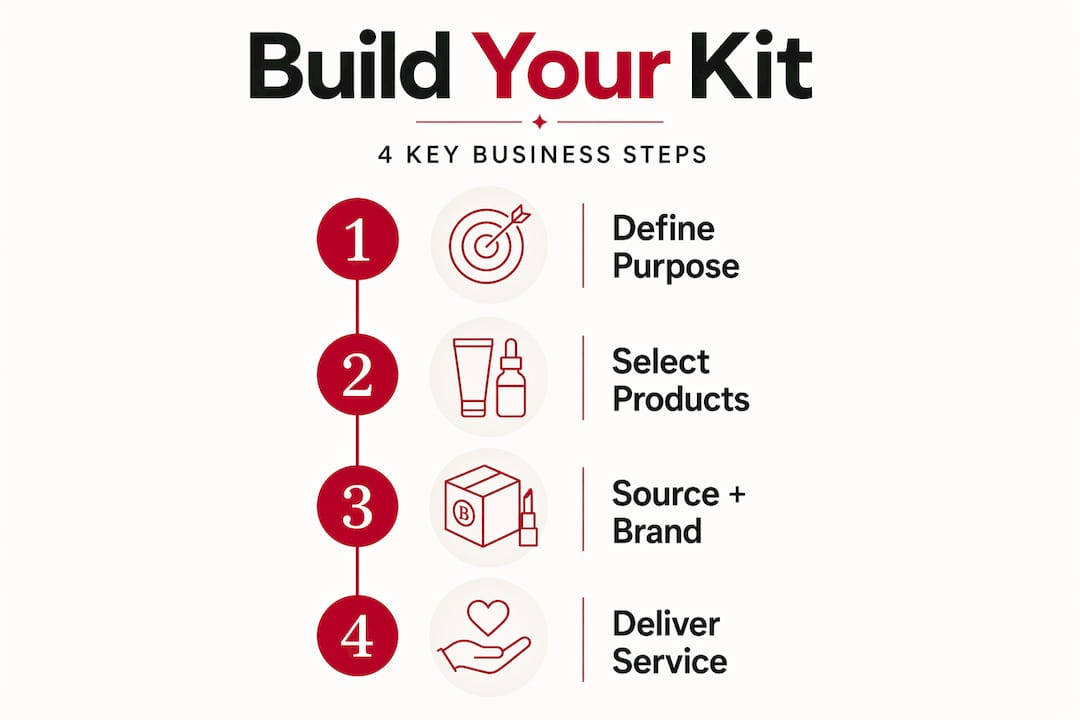
- Define your service or product model first. Are you a mobile beauty artist, a product brand founder, or both? Your answer determines kit size, product type, and whether training materials are a priority.
- Calculate your capacity needs. Match kit inventory to your client targets to avoid running out of product mid-rotation. Estimate how many clients or customers you plan to serve in the first 90 days and work backward from there.
- Prioritize brand coherence over variety. A kit with five products that tell a clear story outperforms a kit with fifteen products that confuse the customer. Stick to your core routine.
- Include operational materials. This means ingredient labels, safety documentation, and any licenses your products require for legal sale in your market. These are not optional.
- Decide on your sourcing path. You have three main options: buy wholesale and resell existing brands, source white-label products and add your branding, or develop private label formulas under your brand name.
Pro Tip: If you’re just starting out, private label is often the fastest path to a polished kit. You get professionally formulated products with your branding without the cost of custom formulation.
Here’s a quick comparison to help you choose your sourcing approach:
| Sourcing Model | Startup Cost | Brand Control | Time to Launch |
|---|---|---|---|
| Wholesale resale | Low ($500 to $2,000) | None | Fast (days) |
| White label | Medium ($1,000 to $3,000) | Partial (packaging only) | Moderate (weeks) |
| Private label | Higher ($2,000 to $5,000+) | Full (formula and brand) | Longer (weeks to months) |
For most aspiring founders, private label hits the right balance between brand ownership and launch speed, especially when platforms offer ready-to-label packs with vetted formulas already in place.
Examples of entrepreneur beauty kit types
Different business models call for different kit structures. Here’s a look at common kit categories and what makes each one work:
| Kit Type | Contents | Best For |
|---|---|---|
| Skincare discovery set | Full-size and sample serums, cleansers, toners, moisturizers | Product brand launches and retail demos |
| Lash service kit | Cluster inventory, adhesives, prep tools, client aftercare | Mobile lash artists and salon starters |
| Makeup starter bundle | Brush set, foundation range, education guide, marketing assets | Freelance MUAs or makeup brand founders |
| Private label launch pack | Ready-to-label SKUs, inserts, wholesale pricing sheet | Entrepreneurs building a named product line |
A professional-grade skincare kit can go beyond just bottles. Well-designed pro kits include doubled product inventory for consistent client delivery, dozens of sample containers for trials, accredited training, and marketing assets. That kind of support structure is what separates a kit designed for business from one designed for personal use.
The best beauty tools for entrepreneurs are rarely the flashiest. They’re the ones that serve a specific client need repeatedly without requiring constant restocking. Durability, consistent availability from your supplier, and products with clear ingredient stories all matter more than novelty.
Integrating your kit into the bigger business picture
A beauty kit for entrepreneurs is one piece of a larger operational setup. Starting a beauty business means validating your concept, securing the right licenses, acquiring inventory, and building reliable supplier relationships before you ever book a client or make a sale. Your kit sits in the middle of all of that.
Here’s where the kit connects to the broader launch stack:
- Legal setup: Your products need to meet labeling requirements, ingredient safety standards, and any local cosmetic regulations before they go into a kit
- Payment processing: Having a kit ready means nothing if you can’t take payment at a pop-up, event, or online store
- Branding: Your kit should visually reflect your brand. Packaging, inserts, and product naming all contribute to how customers perceive your business from the first touchpoint
- Marketing system: Natural brand identity built around your kit gives you content, story, and a reason for customers to return
Startup costs for the inventory and kit portion of a beauty business typically land between $3,000 and $10,000 for initial product stock, with professional kit expenses adding another $2,000 to $5,000. Knowing these numbers upfront helps you plan your sourcing strategy around a real budget rather than a hopeful one.
Pro Tip: Use your kit as a brand validation tool before scaling. Sell it to 10 real customers first. Their feedback will tell you more about what to keep, cut, or reorder than any spreadsheet will.
My take on the kit as a business asset
I’ve watched a lot of beauty founders make the same mistake. They treat the kit as the finish line when it’s actually the starting block.
In my experience, the founders who get results from their kits are the ones who think about it in terms of output. Not “how many products do I have?” but “how many clients can I serve, and what’s the revenue ceiling of this inventory?” That shift in framing changes everything about how you buy, store, and present your products.
I’ve also seen the opposite go badly. A founder orders a beautiful 20-product kit, uses six of them regularly, and the rest sit in a box aging out of their shelf life. Over-kitting is a real problem, and it’s usually caused by excitement rather than planning. The lean approach, starting with a focused four-to-six product routine and expanding based on actual demand, is almost always smarter than going big upfront.
What I find most underrated is the education layer. Kits that come with training materials, usage guides, or video content perform better in client retention than product-only bundles. Customers who understand why they’re using each step come back to repurchase. That’s the kind of long-term thinking that separates a side project from a real business. If you want to explore the broader context of what DIY beauty business models look like, that framing is worth understanding before you build your first kit.
— Gloria
Build your kit with Didisbeautycenter
If you’re ready to turn this knowledge into an actual launch, Didisbeautycenter is built specifically for founders at this stage.
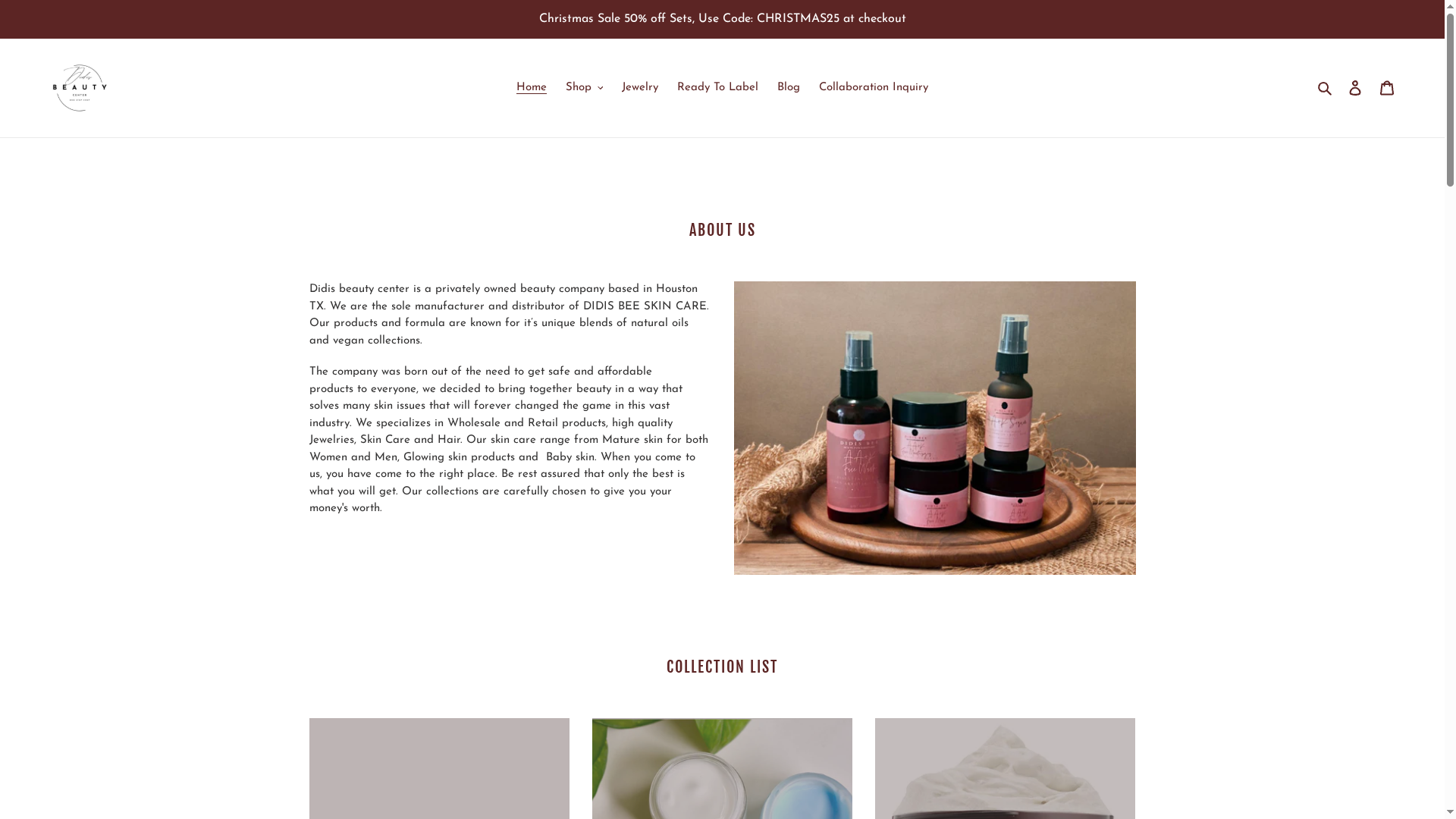
Didisbeautycenter offers a dedicated private label program with ready-to-label skincare SKUs, natural and vegan formulations, and wholesale pricing designed for small business budgets. You get products with real ingredient stories, packaging options that reflect your brand, and the flexibility to start with a focused kit before scaling up. Whether you want to launch a brightening line, a toner collection, or a complete skincare routine bundle, the platform has the product foundation ready. Explore the private label options and request your starter pack to see exactly what’s available at your price point.
FAQ
What does an entrepreneur’s beauty kit include?
An entrepreneur’s beauty kit typically includes core products, sample sets, application tools, training materials, marketing assets, and compliance documentation. The specific contents vary based on whether the kit is designed for service delivery, product demonstrations, or a brand launch.
How much does a startup beauty kit cost?
Startup kit expenses typically range from $2,000 to $5,000 for the professional kit portion, with initial inventory adding another $3,000 to $10,000 depending on your product range and order quantities.
What is the difference between a beauty kit and an entrepreneur’s kit?
A standard beauty kit is assembled for personal use. An entrepreneur’s version is designed around client capacity, brand presentation, and revenue generation, including business materials that a consumer kit never needs.
How do I choose the right kit size for my beauty business?
Size your kit based on the number of clients you plan to serve or products you plan to sell in your first 90 days. Start conservatively and reorder based on real demand rather than projected growth.
Can I use a private label kit to launch my own skincare brand?
Yes. Private label kits give you professionally formulated products under your own brand name, making them one of the fastest ways to launch a skincare line without developing formulas from scratch.
Discourse (0)