


TL;DR:
- Consumers increasingly require third-party certifications for natural and vegan skincare products.
- Effectiveness and honest sourcing are now prioritized over natural labels, with synthetics outperforming naturals in some cases.
- True sustainability involves packaging, lifecycle impact, and transparent supply chain practices, not just ingredient choice.
Top skincare trends: vegan, natural, and eco-conscious choices
Here’s a widely held belief worth questioning: if a skincare product is labeled “natural,” it must be safer and better for your skin. That assumption has driven billions in purchasing decisions, yet it’s only partially true at best. The natural and vegan skincare space is growing fast, with vegan cosmetics projected to reach $37.2B by 2035, and consumer expectations are evolving just as quickly. This article breaks down the real trends shaping 2025, which ingredients are worth your attention, where brands sometimes miss the mark, and how you can make smarter choices whether you’re building a skincare routine or launching your own product line.
Table of Contents
- Skincare trends driving the 2025 market
- The rise of plant-based and biotech skincare
- Performance vs. purity: New consumer priorities
- Eco-conscious beyond ingredients: Packaging, lifecycle, and real impact
- Why the ‘natural’ obsession misses better solutions
- Discover ethical and on-trend skincare solutions
- Frequently asked questions
Key Takeaways
| Point | Details |
|---|---|
| Vegan and eco labels are mainstream | Certified vegan and cruelty-free skincare is now a major market force rather than a niche. |
| Plant-based ingredients and biotech lead trends | Adaptogens and fermented botanicals offer both natural appeal and proven effectiveness in 2025. |
| Performance matters as much as purity | Consumers and brands increasingly prioritize results alongside ethical sourcing. |
| True sustainability covers lifecycle | Genuine eco-conscious skincare considers everything from ingredients to packaging and disposal. |
Skincare trends driving the 2025 market
The clean beauty conversation has matured. In 2025, consumers aren’t just asking “is this natural?” They’re asking for proof. Certifications like Leaping Bunny, PETA’s Beauty Without Bunnies, and The Vegan Society’s trademark have moved from niche differentiators to near-baseline expectations. If a brand can’t point to a verifiable third-party certification, skeptical shoppers scroll right past.
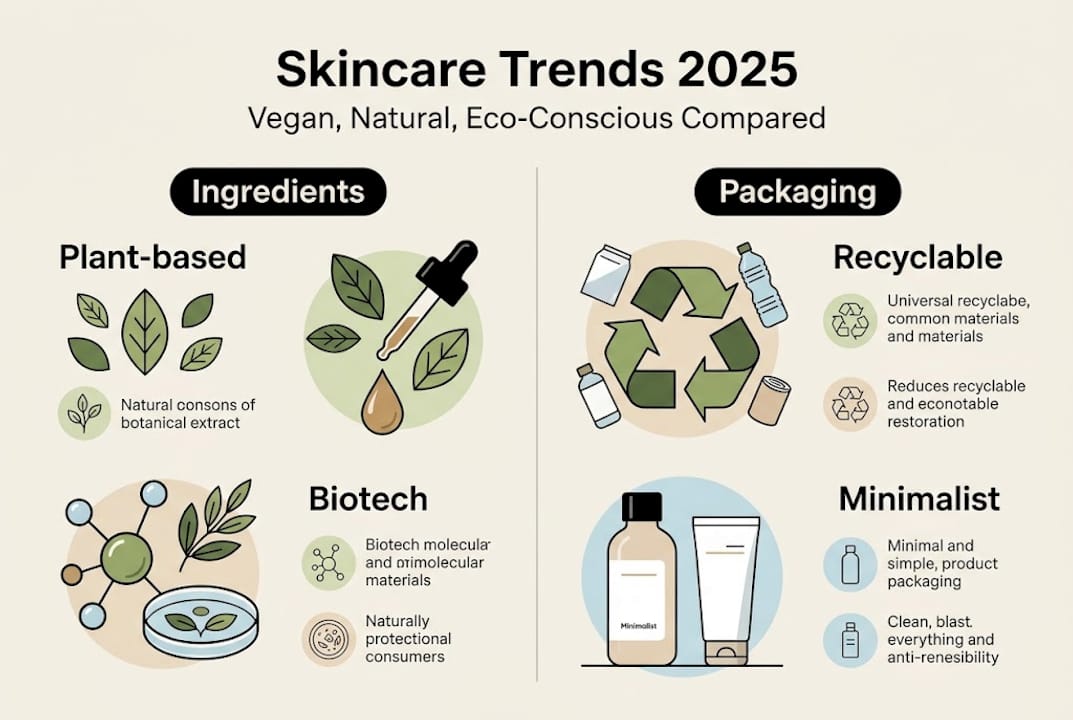
The numbers behind this shift are striking. Vegan cosmetics are valued at $18.8B in 2025, projected to reach $37.2B by 2035 at a CAGR of 6.9%. Plant-based skincare sits at $14.34B in 2025 and is forecast to hit $23.76B by 2030, growing at 8.78% annually. These aren’t fringe categories anymore. They represent a fundamental reorientation of where mainstream beauty spending goes.
Key drivers pushing this market forward include:
- Ethical sourcing claims backed by auditable supply chains
- Upcycled ingredients, like fruit byproducts from food manufacturing repurposed into serums
- Refillable packaging systems that reduce single-use plastic
- Increased accessibility through mass retail placement of vegan beauty certifications products
- Consumer demand for transparency in full ingredient disclosure
| Feature | Traditional formulations | Cruelty-free formulations | Vegan formulations |
|---|---|---|---|
| Animal-derived ingredients | Often included | May be included | Never included |
| Animal testing | May occur | Never occurs | Not guaranteed no testing |
| Sustainability focus | Variable | Variable | Often prioritized |
| Certification required | No | Yes (e.g., Leaping Bunny) | Yes (e.g., Vegan Society) |
| Price point | Broad range | Moderate to premium | Moderate to premium |
One important distinction this table highlights: vegan and cruelty-free are not interchangeable. A product can be vegan (no animal ingredients) but still be tested on animals in markets that require it by law. Conversely, a product can be cruelty-free but contain beeswax or lanolin. Understanding this distinction helps you shop with clarity rather than assumption. Reading up on cruelty-free ingredients makes that evaluation much easier.
The brands gaining real traction right now are those combining all three angles: ethical sourcing, certified cruelty-free status, and vegan formulations, all wrapped in genuinely sustainable packaging.
The rise of plant-based and biotech skincare
With these market forces in motion, let’s drill down into the hottest ingredients and technology fueling 2025’s skincare evolution.
Adaptogens are having a major moment. These are botanicals that help living organisms, including your skin, adapt to stress. Ashwagandha, well known in Ayurvedic medicine, is appearing in serums and moisturizers for its anti-inflammatory and antioxidant properties. Ginseng brings circulation-boosting and brightening effects that work well for dull, fatigued skin. Both are backed by meaningful research and are showing up in prestige lines as well as accessible price points.

Fermented botanicals are another standout category. Fermentation breaks down plant compounds into smaller molecules that penetrate the skin more effectively. Think of it as pre-digesting the ingredient so your skin absorbs more of what matters. Fermented green tea, fermented rice water, and fermented Centella asiatica are increasingly trending plant-based ingredients in 2025 formulas.
Biotechnology is quietly transforming what “natural” even means in skincare. Biotech-derived ingredients are produced through controlled biological processes, often using yeast or bacteria to synthesize plant compounds. The result is a highly consistent, stable ingredient that requires less agricultural land and water than traditional harvesting. Plant-derived growth factors, produced through biotech rather than animal or human sources, are making waves in the anti-aging segment.
| Ingredient | Source | Primary function | Effectiveness level |
|---|---|---|---|
| Ashwagandha | Root extract | Anti-inflammatory, antioxidant | High |
| Ginseng | Root extract | Brightening, circulation | High |
| Fermented green tea | Fermented leaf | Microbiome support, hydration | Moderate to high |
| Ectoin | Biotech derived | Barrier repair, anti-irritant | High |
| Bakuchiol | Seed extract | Retinol alternative, anti-aging | Moderate |
| Plant-derived growth factors | Biotech process | Cell renewal, anti-aging | Emerging, promising |
Exploring effective vegan ingredients like these can help you make purposeful additions to your routine rather than chasing every new launch. If you want to integrate these into a full regimen, following eco-friendly skincare routines gives you a practical structure.
Pro Tip: Before committing to a new natural active, such as an adaptogen serum or a fermented botanical toner, apply a small amount to the inside of your wrist for 24 hours. Natural does not equal universally gentle, and a simple patch test catches incompatibilities before they become a problem for your face.
For entrepreneurs building product lines, these plant-based routine steps offer a solid framework for sequencing actives in a way that maximizes efficacy for end users.
Performance vs. purity: New consumer priorities
Trends rarely stay clean and simple in real practice. Let’s untangle what happens when performance and ethics collide in real-world purchasing decisions.
In 2025, efficacy has quietly become the top priority for a large portion of consumers who once identified primarily as “clean beauty” shoppers. Research and candid market analysis reveal something surprising: some vegan brands are actually walking back strict vegan commitments, reintroducing ingredients like beeswax into formulas because consumers kept returning to products that worked better. This doesn’t signal a failure of the vegan movement. It signals that consumers are becoming more nuanced.
The idea that “natural” automatically means safer also deserves serious pushback. Essential oils, for example, are 100% natural and can cause contact dermatitis, photodermatitis, and hormonal disruption in concentrated amounts. Poison ivy is natural. That framing isn’t meant to scare you off plant-based ingredients. It’s meant to encourage you to evaluate products based on evidence rather than label aesthetics. Natural ingredients safety concerns are real, and ignoring them can lead to preventable skin reactions.
“Natural” on a label is a marketing term, not a safety certification. The ingredient list is where the real story lives.
Here’s how to evaluate any skincare product for both ethics and results:
- Check for third-party certifications, not just brand claims. Look for Leaping Bunny, PETA, or The Vegan Society logos.
- Read the full ingredient list. If you don’t recognize something, look it up. Tools like INCI Decoder are free and accessible.
- Research the concentration of active ingredients. A product with ashwagandha listed last on the label delivers very little of its benefit.
- Check for potential irritants specific to your skin type. Common offenders include citrus essential oils, cinnamon, and high-concentration vitamin C.
- Look for clinical or consumer testing data. Ethical brands increasingly publish transparency reports.
- Ask about the supply chain. Where do the plant ingredients come from? Are they harvested sustainably?
Pro Tip: If a product lists “fragrance” or “parfum” without specifying the source, that term can legally cover dozens of undisclosed ingredients. For sensitive skin, fragrance-free is nearly always the safer path, whether the product is natural or not.
Understanding the realities of vegan beauty helps both consumers and entrepreneurs make decisions grounded in reality rather than marketing language. And connecting those decisions to real sustainable beauty impact creates a more consistent, integrity-driven brand or routine.
Eco-conscious beyond ingredients: Packaging, lifecycle, and real impact
Performance isn’t the whole story. True eco-consciousness goes far beyond what’s inside the bottle.
A product formulated with every trendy botanical but packaged in multi-layered, non-recyclable plastic is not a sustainable product. That’s greenwashing, and it’s widespread. Real sustainability requires looking at full lifecycle impact, from where raw materials are grown and harvested, through manufacturing and transportation, to how the packaging is disposed of or reused by the consumer.
The industry is making real progress in a few specific areas. Refillable systems, where consumers purchase a durable outer container and buy only the inner refill pod, are expanding rapidly. Brands using post-consumer recycled (PCR) materials for packaging are becoming more mainstream. And upcycled ingredients, like using grape seed extract from winemaking waste or oat extract from food processing byproducts, reduce the agricultural footprint of skincare dramatically.
For individual consumers, here are practical ways to deepen your eco-commitment:
- Choose brands that offer a take-back or refill program rather than single-use packaging.
- Buy concentrated formats like solid bars or powder-to-foam cleansers that use less water and less packaging.
- Look for aluminum or glass containers, which have higher recycling rates than most plastics.
- Research whether your product’s key ingredients are certified organic or sustainably harvested.
- Reduce your overall routine complexity. Fewer products with better ingredients creates less waste overall.
For small business owners building their own lines, consider:
- Selecting a supplier that offers eco-certified packaging options from the start
- Prioritizing upcycled or byproduct-sourced ingredients where they match your formulation goals
- Being transparent about your packaging material’s recyclability on the label itself
- Communicating your sourcing story clearly, because today’s consumers reward honesty more than perfection
The Byrdie analysis of trending sustainable ingredients reinforces that eco-nuance matters. Consumers and regulators alike are beginning to expect full lifecycle accountability, not just a “plant-based” sticker on the front. Dig deeper into what sustainable beauty truly requires to sharpen your thinking in this space.
Ingredients like ectoin, which is produced via fermentation from desert microorganisms, offer a perfect example of how biotech and sustainability can merge. High efficacy, low agricultural footprint, and vegan by nature. That combination is what the best of 2025’s skincare innovation looks like.
Why the ‘natural’ obsession misses better solutions
Here’s the uncomfortable truth: the word “natural” has become more of a feeling than a fact. And chasing that feeling has led a lot of consumers and brands into poor decisions.
Some of the most effective and environmentally responsible ingredients in modern skincare are synthetics. Niacinamide, for instance, is synthesized rather than extracted from plants, yet it outperforms many naturals for brightening and barrier function. Hyaluronic acid produced through biotechnology is structurally identical to what your skin produces and carries a far lower environmental cost than alternatives requiring animal sources. Synthetics can outperform naturals in stability and efficacy, and that’s a fact the industry increasingly acknowledges.
True sustainability, the kind that actually reduces harm to ecosystems and communities, requires regenerative sourcing practices and honest supply chain evaluation. It is not satisfied by slapping a leaf icon on a bottle.
Our perspective at Didis Beauty Center is that the smartest consumers and entrepreneurs in 2025 blend healthy skepticism with genuine curiosity. Read beyond the buzzwords. Ask who certified this product and what that certification actually covers. Trust efficacy data over aesthetic packaging. And recognize that a well-formulated product, whether plant-based or biotech-assisted, aligned with ethical production and honest claims, is always more valuable than a purely “natural” one that underdelivers.
Discover ethical and on-trend skincare solutions
If this breakdown has sparked ideas, whether for your own skincare routine or for a product line you’ve been thinking about, Didis Beauty Center is built to help you act on them.
We carry natural, vegan, and cruelty-free skincare options designed for both everyday consumers and entrepreneurs ready to build their own brands. Our private label natural skincare program gives you a clear path to launching trend-aligned, eco-conscious products without starting from scratch. From ready-to-label packs to full formula customization, we connect your vision to products that perform and sell. Browse our catalog and see how ethical innovation and real efficacy can work together.
Frequently asked questions
Are vegan skincare products always cruelty-free?
No. Vegan means no animal-derived ingredients, but cruelty-free certification is a separate guarantee that no animal testing occurred at any stage of production.
What are the most popular natural ingredients in 2025 skincare?
Adaptogens like ashwagandha and ginseng, along with fermented botanicals and biotech-derived growth factors, lead the trending ingredient lists this year.
Can natural skincare cause skin irritation?
Yes. Essential oils and other naturals can trigger irritation or allergic reactions, especially for sensitive skin types, which is why patch testing matters regardless of how clean a label looks.
Is sustainable skincare just about the ingredients?
Not at all. True sustainability covers packaging and full lifecycle impact, including how ingredients are sourced, how products are manufactured, and how packaging is eventually disposed of or reused.
Discourse (0)