


TL;DR:
- Modern toners are now hydrating, pH-balancing treatments made from natural ingredients. Reading ingredient lists and understanding INCI names helps ensure products meet your skin needs and ethical values. Choosing toners with proper pH and avoiding potentially irritating ingredients enhances skin health and transparency.
Toners have a reputation problem. For years, people associated them with that sharp, alcohol-heavy sting that left skin tight and irritated. But that old formula is largely a relic. Modern toners, especially those built on natural and vegan principles, have evolved into hydrating, pH-balancing treatments that use plant extracts to genuinely support your skin. The catch? Not every bottle labeled “natural” or “vegan” lives up to the claim. Learning to read ingredient lists gives you real power over what goes on your skin and what aligns with your values.
Table of Contents
- What is a toner and why do ingredients matter?
- Breaking down common toner ingredients (and what they do)
- How ingredient transparency and pH influence toner performance
- How to choose the best toner for your skin type and values
- A fresh look: Why ingredient labels are your skincare superpower
- Explore your next step with natural and vegan skincare
- Frequently asked questions
Key Takeaways
| Point | Details |
|---|---|
| Know your ingredients | Reading ingredient labels is key to choosing effective and ethical toners. |
| Match toner to skin type | Use soothing botanicals for sensitive skin, actives like tea tree for oily skin, and hydrating agents for dryness. |
| Prioritize pH and transparency | A pH between 4.5 and 5.5 with a clear INCI list ensures better results and safer skincare. |
| Vegan doesn’t mean simple | Even vegan and natural claims require label scrutiny to avoid hidden synthetics. |
What is a toner and why do ingredients matter?
A toner is a water-based liquid applied to the face after cleansing and before serums or moisturizers. It sounds simple, but its job is surprisingly layered. A well-formulated toner restores skin pH, removes residual impurities, hydrates, and preps skin for everything you apply afterward. Think of it as the reset button between cleansing and treatment.
Where things get interesting is in the ingredients. The formula determines whether a toner soothes or strips, hydrates or irritates, and whether it genuinely earns a “vegan” or “natural” label. Two toners can look identical on the shelf and perform completely differently based on what is inside.
Here is what a quality toner should do for your skin:
- Balance skin pH to the ideal range of 4.5 to 5.5
- Remove leftover makeup, cleanser residue, and pollutants
- Deliver a first layer of hydration or active ingredients
- Improve absorption of serums and moisturizers applied after
- Calm redness or support the skin barrier
For those choosing the right toner, ingredient literacy is the single most useful skill you can develop. Marketing language like “clean,” “green,” or “botanical” means nothing without the INCI list to back it up.
INCI stands for International Nomenclature of Cosmetic Ingredients. It is the standardized system used globally to name every ingredient in a cosmetic product. Ingredients are listed in descending order by concentration, so the first few items make up the bulk of the formula. If water is first and aloe vera is near the bottom, you are mostly buying water with a trace of aloe.
“The ingredient list is the only honest part of a skincare label. Everything else is marketing.”
Understanding INCI is especially important for vegan and natural claims. Animal-derived ingredients like carmine (from beetles), lanolin (from wool), or hydrolyzed silk can hide behind scientific names that look completely unfamiliar. Knowing what to look for, and what to avoid, is how you make purchases that actually reflect your values. You can also explore the natural benefits of toners to see how plant-based formulas compare to conventional ones.
Breaking down common toner ingredients (and what they do)
Most toners share a predictable structure. Water (listed as Aqua) is almost always the base. From there, the formula branches into humectants, actives, preservatives, and sometimes alcohols. Each category plays a specific role, and each carries implications for your skin type and your ethics.
| Ingredient type | Examples | What it does |
|---|---|---|
| Humectants | Glycerin, Hyaluronic Acid | Draws moisture into the skin |
| Botanicals | Aloe Vera, Chamomile, Green Tea | Soothes, antioxidant protection |
| Acids (actives) | Salicylic Acid, Lactic Acid | Exfoliates, unclogs pores |
| Preservatives | Phenoxyethanol, Sodium Benzoate | Prevents microbial growth |
| Alcohols | Denatured Alcohol, Cetyl Alcohol | Varies: drying vs. emollient |
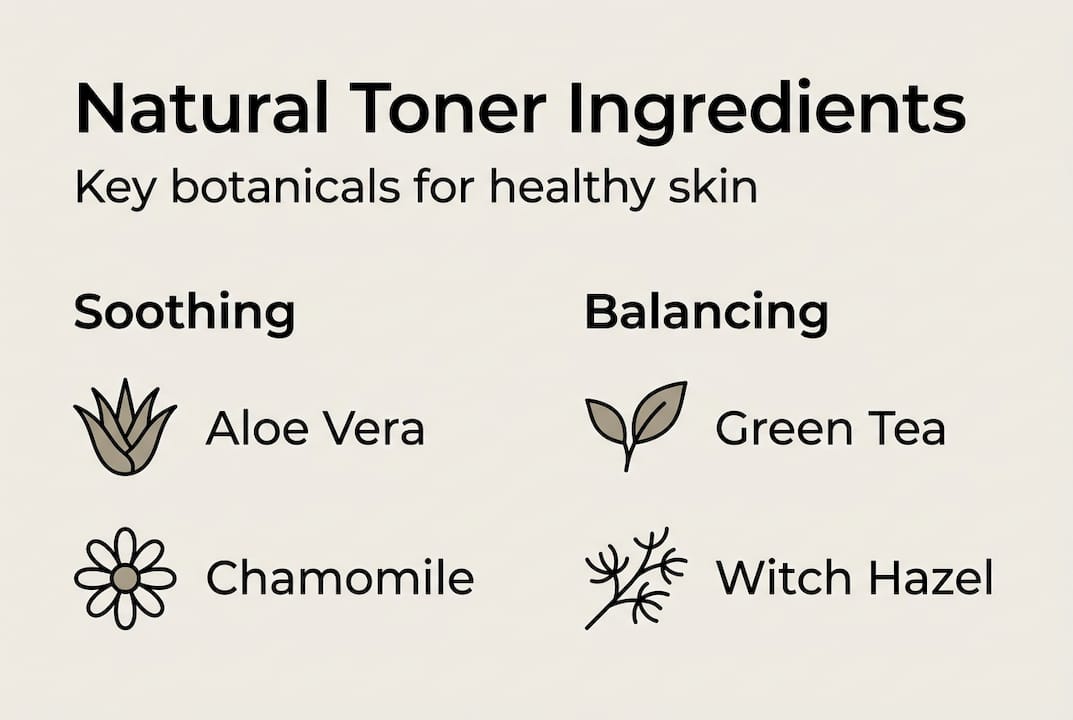
Natural and vegan actives are where the real story lives. Aloe vera calms inflammation and delivers lightweight hydration. Green tea is rich in polyphenols that fight oxidative stress. Chamomile reduces redness and is especially gentle for reactive skin. Rosemary acts as a natural antioxidant and can also serve as a mild preservative alternative.

A research-backed herbal toner combining aloe vera (15 ml), green tea (12 ml), and rosemary achieved a stable pH of 5.0 with confirmed non-irritation. That is not just a nice story. It is proof that plant-based formulas can perform with scientific rigor.
Now, the ingredients worth watching out for:
- Denatured alcohol (Alcohol Denat.): Evaporates quickly, feels refreshing, but disrupts the skin barrier over time
- Synthetic fragrance (Parfum or Fragrance): A catch-all term that can hide dozens of undisclosed chemicals, many of which are allergens
- Parabens (Methylparaben, Propylparaben): Preservatives linked to hormone disruption concerns, though debate continues
- PEGs (Polyethylene Glycols): Penetration enhancers that may carry other ingredients deeper than intended
For sensitive skin, soothing botanicals like aloe and chamomile are far safer than alcohol or synthetic fragrance. Oily or acne-prone skin can benefit from salicylic acid or tea tree, but even those need to be used at appropriate concentrations.
Pro Tip: If you see “Fragrance” or “Parfum” on a vegan toner label, ask the brand for a full disclosure. Truly transparent companies will tell you exactly what their fragrance blend contains.
When using natural toners, pairing the right botanical actives to your skin concern makes a measurable difference. It is not about using more ingredients. It is about using the right ones.
How ingredient transparency and pH influence toner performance
Knowing individual ingredients is useful. Understanding how they work together, and how pH shapes the entire formula, takes you to another level.
The INCI list is your transparency tool. By law in most markets, every ingredient must be disclosed in descending order of concentration. But loopholes exist. “Fragrance” is legally allowed to represent a blend of undisclosed compounds. “Natural” has no regulated definition in cosmetics. This is why reading the full INCI list matters more than trusting front-label claims.
For vegan shoppers, the key is knowing which INCI names signal animal origins. Here is a quick reference:
| INCI name | Animal source | Vegan alternative |
|---|---|---|
| Carmine (CI 75470) | Beetles | Synthetic dyes or plant pigments |
| Lanolin | Sheep wool | Plant-based emollients |
| Hydrolyzed Silk | Silkworm cocoons | Hydrolyzed Wheat Protein |
| Beeswax (Cera Alba) | Bees | Candelilla Wax |
Now, pH. Skin naturally sits around 4.5 to 5.5, which is mildly acidic. This acidity is not random. It supports the acid mantle, a protective film that keeps moisture in and bacteria out. When a toner’s pH is too high (alkaline), it weakens this barrier, leading to dryness, sensitivity, and breakouts.
The science of pH-balanced skincare shows that matching your toner’s pH to your skin’s natural range reduces irritation and dramatically improves how well subsequent products absorb.
The numbers back this up. Clinical herbal toner studies showed an 85% reduction in acne lesions and a 70% improvement in hydration over four weeks, with low irritation scores. These were not synthetic formulas. They were plant-based, pH-optimized, and transparently formulated.
That is a meaningful benchmark. When you see a toner claiming to be soothing but its pH is 7 or above, the formula is working against your skin biology, regardless of how many botanical names appear on the label.
How to choose the best toner for your skin type and values
Understanding labels is only half the work. The real payoff comes when you match the right ingredients to your skin and your values. Here is a practical approach:
- Identify your skin type first. Is it oily, dry, combination, sensitive, or acne-prone? Your skin type narrows the field of useful ingredients significantly.
- Check the first five INCI ingredients. These make up the majority of the formula. If the first five are water, glycerin, and recognizable botanicals, that is a good sign.
- Look for your target actives. Sensitive skin benefits from soothing botanicals; oily skin does well with salicylic acid or tea tree; dry skin needs hyaluronic acid or glycerin; pH mismatch at any skin type can trigger irritation.
- Verify vegan and cruelty-free status. Look for third-party certifications like Leaping Bunny or PETA’s Beauty Without Bunnies. Cross-check INCI names against known animal-derived ingredients.
- Confirm pH compatibility. Many brands now list pH on their packaging or website. Aim for 4.5 to 5.5 for daily use toners.
- Avoid red-flag ingredients. Denatured alcohol, synthetic fragrance, and parabens are worth skipping, especially for sensitive or reactive skin.
Pro Tip: Patch test any new toner on your inner arm for 24 hours before applying it to your face. Even the most natural formula can trigger a reaction in specific skin types.
For a deeper look at formulas that check all these boxes, explore how to choose toners by skin type and concern. And if you want a curated shortlist, the best cruelty-free toners guide is a strong starting point.
A fresh look: Why ingredient labels are your skincare superpower
Here is something most skincare guides will not tell you: the beauty industry is built on the gap between what brands say and what labels actually show. “Natural” is not a regulated term. Neither is “clean” or “green.” A product can legally call itself natural while containing synthetic preservatives, undisclosed fragrance blends, and PEGs.
Ingredient literacy closes that gap. When you know how to read an INCI list, no marketing claim can mislead you. You stop buying the story on the front of the bottle and start evaluating what is actually inside.
We have seen this play out with customers who switched to genuinely transparent formulas and noticed real differences in skin behavior. Not because the new products were more expensive or more “premium,” but because the ingredients were actually doing what the label promised.
The most empowering shift is learning to spot the real heroes in a formula versus the filler. Aloe vera at position two means something. Aloe vera at position seventeen means almost nothing. That one skill, reading ingredient order, changes how you shop forever. Explore unpacking toner benefits to see how this plays out across different formula types.
Explore your next step with natural and vegan skincare
Ready to take the guesswork out of ingredient lists? At Didis Beauty Center, we built our entire approach around transparency and plant-based formulations that actually deliver.
Whether you are looking for a toner that fits your skin type, or you are an entrepreneur ready to launch your own line with full ingredient visibility, we have options designed for both. Our discover custom vegan skincare private label program lets you create products with clean, verifiable INCI lists from the ground up. For everyday shoppers, the Didis Beauty Center home is your starting point for browsing toners and skincare built on honest, vegan-friendly formulas. No guesswork. Just ingredients you can trust.
Frequently asked questions
What are the best natural ingredients to look for in a toner?
Aloe vera, green tea, chamomile, and rosemary are top natural ingredients known for soothing, hydrating, and balancing the skin without harshness. Research confirms that toners combining these botanicals achieve stable pH and low irritation scores.
Why does toner pH matter for skin health?
A toner with pH 4.5 to 5.5 supports the skin’s acid mantle, preventing irritation and improving absorption of serums and moisturizers applied after. Using a toner outside this range can weaken your skin barrier over time.
How do I avoid irritating or synthetic ingredients in toners?
Read the full INCI list and avoid Alcohol Denat., Parfum or Fragrance, and parabens. INCI transparency is the most reliable way to verify that a vegan or natural claim is backed by the actual formula.
Discourse (0)