


TL;DR:
- Clean beauty is a marketing term without a legal standard, making it essential to review ingredients and certifications yourself. Reading INCI ingredient lists, understanding the concentration order, and checking third-party seals like MADE SAFE and EWG Verified help verify product safety. Using digital tools such as EWG Skin Deep and SkinGuard allows for quick, informed evaluations beyond marketing claims.
Clean beauty is a marketing term, not a regulated category. The FDA has no legal definition for “clean” on cosmetic labels as of 2026, which means any brand can print the word on packaging without meeting a single safety standard. That gap between marketing and reality is exactly why knowing how to spot clean beauty products yourself matters. This guide walks you through reading INCI ingredient lists, evaluating third-party certifications like MADE SAFE and EWG Verified, and using databases like EWG Skin Deep to verify what you are actually putting on your skin.
How to spot clean beauty by reading INCI ingredient lists
The INCI list, short for International Nomenclature of Cosmetic Ingredients, is the standardized ingredient list printed on every cosmetic product sold in the U.S. Learning to read it is the single most reliable skill for identifying genuinely clean formulations. Didisbeautycenter covers this in depth in their guide on reading skincare labels for safer choices.

How concentration order works
Ingredients are listed in descending order by concentration. The first five to seven ingredients typically make up the bulk of the formula. This means a moisturizer with “shea butter” listed tenth contains far less of it than the packaging implies.
The critical threshold is the 1% line. Ingredients at or below 1% concentration can appear in any order after that point, so a brand can legally list a trendy active like bakuchiol near the top of the trace ingredients without it being present in a meaningful dose. Phenoxyethanol, a common preservative, often signals where the 1% line falls. Anything listed after it is almost certainly present in trace amounts only.
Red flags to watch for on any label
Not every ingredient name signals a problem, but several patterns consistently appear in products that fall short of clean beauty standards:
- Fragrance or parfum: Listed as a single ingredient, this term can legally hide dozens of chemical components due to trade secret protections. Fragrance is one of the leading causes of contact dermatitis and allergic reactions in skincare.
- PEGs (polyethylene glycols): Penetration enhancers that may carry contaminants depending on manufacturing quality.
- Formaldehyde-releasing preservatives: Ingredients like DMDM hydantoin or quaternium-15 slowly release formaldehyde over time.
- Synthetic dyes: Listed as FD&C or D&C followed by a color and number, these serve no functional skincare purpose.
| Ingredient term | What it signals | Clean concern level |
|---|---|---|
| Fragrance / Parfum | Undisclosed chemical blend | High |
| Phenoxyethanol | Marks the 1% threshold | Moderate |
| DMDM Hydantoin | Formaldehyde releaser | High |
| PEG compounds | Penetration enhancer | Moderate |
| Aqua / Water | Base ingredient, no concern | None |
Pro Tip: When a brand highlights an ingredient on the front of the packaging, find it on the INCI list. If it appears after phenoxyethanol, it is present in trace amounts and the marketing claim is largely cosmetic, not functional.
What certifications actually tell you about clean beauty products
Third-party certifications exist precisely because the word “clean” carries no legal weight. A certification means an independent organization has reviewed the formula against a defined set of criteria. The key is understanding what each program actually covers.
Comparing the major certification programs
MADE SAFE screens products against thousands of substances for human health and environmental hazards. It covers the entire formula, not just individual ingredients in isolation. This makes it one of the most thorough certifications available for clean beauty products.
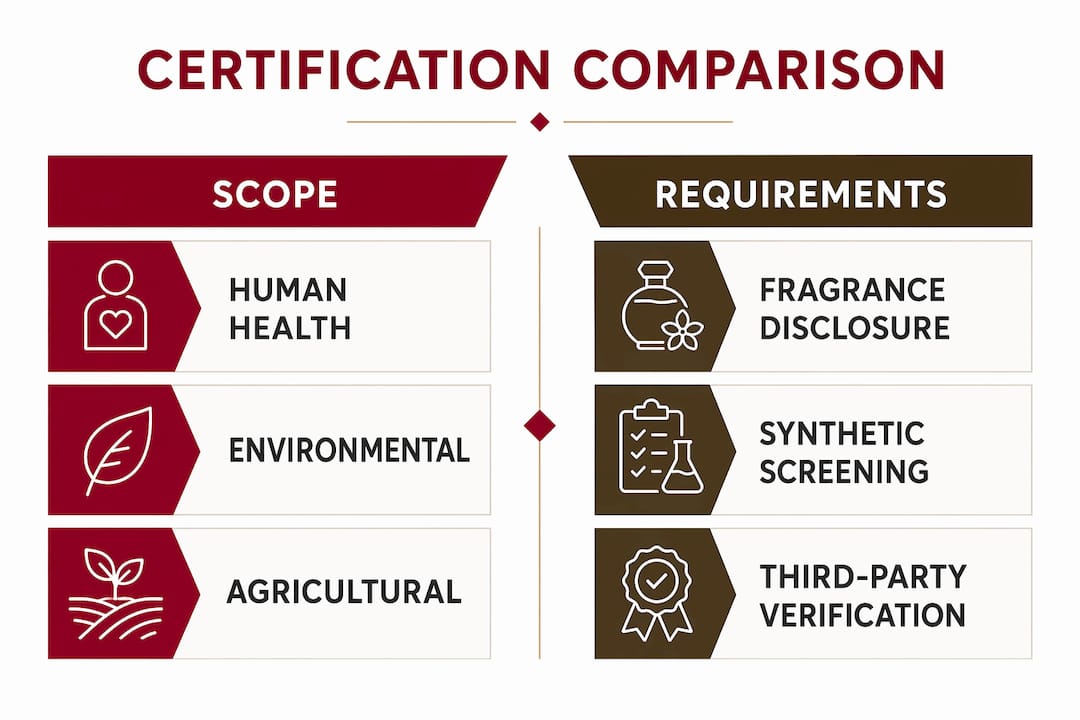
EWG Verified uses the Environmental Working Group’s ingredient safety database to confirm that a product meets their standards for transparency and ingredient safety. Products must disclose all ingredients, including fragrance components, to earn this seal.
USDA Organic is frequently misunderstood in beauty contexts. It covers only agricultural ingredients and does not screen synthetic chemicals in the formula. A product can be USDA Organic certified and still contain synthetic preservatives or fragrance compounds.
| Certification | Scope | Fragrance disclosure required | Synthetic chemical screening |
|---|---|---|---|
| MADE SAFE | Full formula, human and environmental health | Yes | Yes |
| EWG Verified | Ingredient safety and transparency | Yes | Yes |
| USDA Organic | Agricultural ingredients only | No | No |
| Leaping Bunny | Cruelty-free testing only | No | No |
Because not all certifications cover the same scope, relying on a single seal leaves gaps. A product with both EWG Verified and Leaping Bunny seals tells you more than either seal alone.
Pro Tip: Verify any certification seal by searching the certifying organization’s official directory. Brands occasionally display outdated or lapsed seals. MADE SAFE and EWG both maintain searchable product databases on their websites.
You can also cross-reference certifications with external wellness resources. Professionals at Rituel Salon & Med Spa in Phoenix, for example, use third-party verified products as part of their skin treatment protocols, which reflects how certification credibility extends beyond retail into professional settings.
Practical tools and databases for verifying clean beauty ingredients
Label reading and certification checks are your foundation. Digital tools make the verification process faster and more accessible, especially when you encounter an unfamiliar ingredient name.
EWG Skin Deep Cosmetics Database
The EWG Skin Deep database lets you search individual ingredients or full products and receive a safety score based on available research. It does not replace reading the label yourself, but it provides a fast second opinion on ingredients you cannot immediately identify. The database is free to use and covers tens of thousands of products and ingredients.
SkinGuard and similar ingredient apps
SkinGuard is a mobile app that scans product barcodes and analyzes the INCI list against a curated ingredient safety database. It flags potential irritants, allergens, and high-hazard chemicals in plain language. Apps like this are particularly useful when shopping in-store, where you have limited time to research each ingredient manually.
Here is a practical workflow for verifying any product before purchase:
- Read the INCI list and locate the 1% line using phenoxyethanol as your marker.
- Identify any fragrance, parfum, or undisclosed blend terms and treat them as unknowns.
- Search the product or its key ingredients in EWG Skin Deep for a safety score.
- Scan the barcode with SkinGuard or a similar app to catch flagged ingredients.
- Check whether the product carries a MADE SAFE, EWG Verified, or equivalent certification.
- Verify the certification is current using the certifying organization’s official directory.
This layered approach takes under five minutes per product and gives you far more confidence than relying on front-of-package claims alone. Didisbeautycenter’s resource on clean beauty standards explains how this kind of ingredient transparency applies to formulation choices at the brand level.
How to avoid greenwashing when choosing clean beauty products
Greenwashing is the practice of using environmental or safety language to imply a product is cleaner or safer than it actually is. It is widespread in the beauty industry and often subtle enough to mislead even informed shoppers.
The most common greenwashing tactics include:
- Vague “free-from” claims: “Paraben-free” or “sulfate-free” tells you what is not in the product but says nothing about what is. A paraben-free formula may still contain synthetic fragrance, PEGs, or formaldehyde releasers.
- Natural-sounding ingredient names: Some synthetic ingredients are listed using their plant-derived source name to appear more natural than they are. Sodium lauryl sulfate derived from coconut oil is still sodium lauryl sulfate.
- Minimal ingredient transparency: Brands that do not publish their full INCI list online or refuse to disclose fragrance components are signaling a transparency problem, regardless of how “clean” their marketing reads.
- Unverified certifications: Logos that resemble official seals but link to no verifiable certifying body are a direct red flag.
A 2025 study found that women using fragrance-free products had significantly lower urine concentrations of certain harmful chemical metabolites. This finding matters because it confirms that ingredient choices produce measurable biological differences, not just theoretical ones.
Pro Tip: Before trusting any “clean” claim, ask three questions: Does the brand publish its full INCI list? Does it disclose fragrance components? Does it hold a certification from a named, verifiable organization? A brand that answers yes to all three is operating at a higher transparency standard than most.
“Treating ‘clean’ as an initial indicator rather than a final verdict is the most reliable approach. Combine marketing claims with direct ingredient review and certification checks for a trustworthy assessment.” — The Rooted People
One important nuance: removing preservatives or emulsifiers solely to meet “clean” standards can actually reduce product safety by creating conditions for microbial growth. Clean beauty is not about eliminating all synthetic ingredients. It is about choosing ingredients with strong safety profiles and full disclosure.
Key takeaways
Spotting genuinely clean beauty products requires combining INCI label reading, certification verification, and digital database tools rather than relying on any single signal.
| Point | Details |
|---|---|
| INCI list is your starting point | Read ingredients in concentration order and locate the 1% line to assess meaningful doses. |
| Certifications vary in scope | MADE SAFE and EWG Verified screen full formulas; USDA Organic covers only agricultural ingredients. |
| Fragrance is a transparency gap | “Fragrance” or “parfum” can hide dozens of undisclosed chemicals; prioritize fragrance-free or fully disclosed formulas. |
| Greenwashing is common | Free-from claims and natural-sounding names do not confirm safety; verify with databases and certifying directories. |
| Layered verification works best | Combining label reading, EWG Skin Deep, SkinGuard, and certification checks gives the most reliable result. |
Why clean beauty still requires your own critical eye
I have spent years watching the clean beauty category grow from a niche concern into a mainstream marketing strategy, and the honest truth is that the growth has made spotting genuinely safe products harder, not easier. More brands use the language. Fewer of them earn it.
What I keep coming back to is this: the tools exist. EWG Skin Deep, MADE SAFE’s product directory, SkinGuard, and a basic understanding of INCI order give any consumer the ability to evaluate a product more rigorously than most brands expect. The problem is that most shoppers do not know these tools exist, or they assume a “clean” label means someone else already did the work.
Nobody has done the work for you. The FDA does not regulate the term. Retailers set their own standards. Certifications vary in rigor. That sounds discouraging, but I find it clarifying. It means the power to identify a genuinely clean formulation sits entirely with the person reading the label. That is actually a good position to be in, because the skills are learnable and the resources are free.
My recommendation: start with one product you already use. Pull up its INCI list, find the 1% line, check EWG Skin Deep, and see what you find. That single exercise will change how you shop for every product after it. The ethical beauty checklist from Didisbeautycenter is a practical companion for exactly this kind of product-by-product evaluation.
— Gloria
Clean beauty you can actually verify at Didisbeautycenter
Didisbeautycenter takes ingredient transparency seriously because the team knows how hard it is to find clean beauty products you can actually trust. Every formulation in the Didisbeautycenter line is built around full INCI disclosure, natural and vegan ingredients, and adherence to stricter clean beauty standards than U.S. law requires. For entrepreneurs and consumers alike, that transparency is not a marketing claim. It is built into the product development process. If you are ready to explore verified clean formulations or build your own brand on a foundation of ingredient integrity, the Didis Bee Private Label program gives you access to clean, fully disclosed formulations with the documentation to back them up.
FAQ
What does “clean beauty” actually mean?
Clean beauty has no legal definition in the U.S. It is a marketing term used to suggest a product is safer or more natural than conventional alternatives. Evaluating the INCI list and third-party certifications is the only reliable way to assess whether a product meets real safety standards.
How do I find the 1% line on an ingredient list?
Look for phenoxyethanol on the INCI list. This preservative is almost always used at or near the 1% concentration threshold, so ingredients listed after it are present in trace amounts only. Any active ingredient appearing after this point is unlikely to deliver a meaningful benefit.
Are USDA Organic beauty products automatically clean?
No. USDA Organic certification covers only agricultural ingredients and does not screen synthetic chemicals in the formula. A product can carry the USDA Organic seal and still contain synthetic fragrance, preservatives, or other ingredients that clean beauty standards would flag.
Is fragrance always a problem in skincare?
Fragrance listed as “fragrance” or “parfum” is a transparency concern because it can legally represent dozens of undisclosed chemical components. Research shows that switching to fragrance-free products measurably reduces exposure to certain harmful chemicals. Brands that fully disclose fragrance components are the safer alternative.
What is the fastest way to check if a product is clean?
Search the product in the EWG Skin Deep Cosmetics Database for a safety score, then scan the barcode with SkinGuard to flag any high-hazard ingredients. Cross-check whether the product holds a MADE SAFE or EWG Verified certification by searching the certifying organization’s official directory.
Discourse (0)