


TL;DR:
- A single mislabeled product can lead to costly recalls, regulatory actions, and damage to customer trust, especially for small natural and vegan skincare brands. Compliance with strict FDA and EU labeling laws, proper documentation, and thorough final reviews are essential to avoid violations and build consumer confidence. Investing in mockup testing and certification verification safeguards your brand’s reputation and supports long-term growth.
A single mislabeled product can trigger a costly recall, draw regulatory action, or destroy the customer trust you spent months building. For small brands selling natural and vegan skincare, the stakes are even higher because shoppers buy specifically for what’s on the label, whether that’s a vegan certification or an organic claim. This guide walks you through every layer of compliant, compelling label design: what the law requires, how to organize your information, how to execute the actual design, and what to verify before you ever press print.
Table of Contents
- Know the labeling requirements
- Prepare: Gather your information and certifications
- Design your skincare label step-by-step
- Double-check and approve your label
- What most guides miss about skincare label success
- Ready to launch your skincare brand?
- Frequently asked questions
Key Takeaways
| Point | Details |
|---|---|
| Start with compliance | Meet all legal requirements before making design choices to avoid costly mistakes later. |
| Gather info first | Have every ingredient, claim, and certification documented before starting your label. |
| Follow a proven process | Use checklists and mockups at each step to ensure accuracy and spot errors. |
| Avoid vague claims | Only use certified terms like ‘organic’ or ‘vegan’ with proper proof to build genuine consumer trust. |
| Get a final review | Have at least one compliance expert or mockup review before printing any label in bulk. |
Know the labeling requirements
Now that you know what’s at stake, let’s break down exactly what information your skincare label needs to display.
Legal requirements are not optional starting points you revisit after launch. They are the foundation everything else rests on. In the US, the FDA governs cosmetic labeling, and the rules are specific. According to FDA labeling requirements, your label’s Principal Display Panel (PDP) must include a clear statement of identity (for example, “Hydrating Face Cream”) and the net quantity of contents displayed in both US and metric units, positioned at the bottom of the panel with font size calculated according to the panel area. These are not suggestions. Missing either element puts your product out of compliance before a customer even opens the box.
For brands selling into the European Union, the requirements expand considerably. EU Cosmetics Regulation (EC) No 1223/2009 mandates the name and address of the Responsible Person, nominal content, a period after opening (PAO) symbol or expiry date, a batch number, the product’s function, and a full INCI ingredient list with nano-ingredients flagged specifically. Every element must be indelible and legible, and the language must match the Member State where the product is sold. If you plan to launch in both markets, design for both from day one rather than retrofitting.
Natural and vegan claims come with their own layer of complexity. Using certified claims only, such as the Vegan Society trademark or COSMOS Organic, is the only safe path. COSMOS Organic certification, for instance, requires at least 95% natural or organic ingredients and prohibits animal testing, GMOs, and parabens. A blanket statement like “100% natural” without certification behind it is legally risky and increasingly flagged by consumer watchdogs. Your customers are also savvier than ever. If you want to understand how buyers read skincare labels, you’ll see just how quickly informed shoppers spot unsubstantiated claims.
Key differences between US and EU labeling requirements:
| Element | US (FDA) | EU (EC No 1223/2009) |
|---|---|---|
| Statement of identity | Required on PDP | Required |
| Net quantity | US and metric units on PDP | Nominal content required |
| INCI ingredient list | Required, descending order | Required, nano-ingredients flagged |
| Responsible Person | Not required | Mandatory |
| Batch number | Recommended | Mandatory |
| PAO or expiry date | Not mandated | Mandatory |
| Language requirement | English | Language of Member State |
- Statement of identity and net quantity belong on the PDP
- Ingredient list goes on the information panel
- Warnings and directions must be in English (US) or the required language (EU)
- Certified claims must be backed by documentation you can produce on request
- Nano-ingredients require specific disclosure in EU markets
Pro Tip: Lock in your compliance checklist before you open any design software. Aesthetic decisions are easy to revise; legally required elements are not.
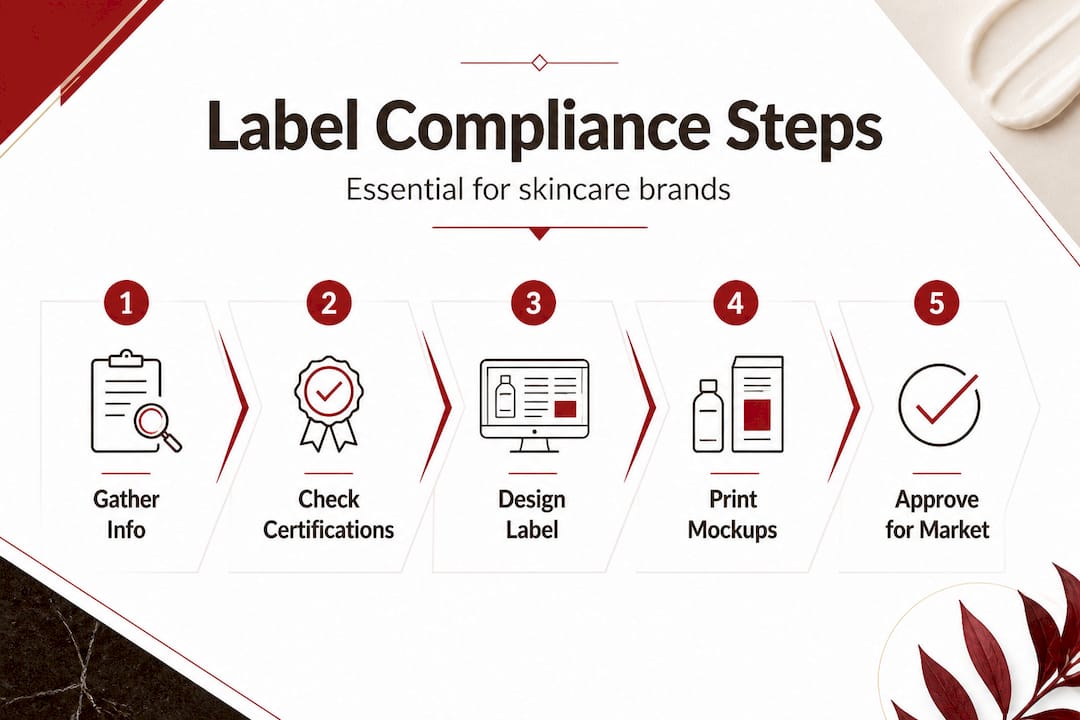
Prepare: Gather your information and certifications
With the importance of compliance clear, your next step is to organize and confirm all details before actually designing the label.
Rushing into design without all your information in hand is one of the most common and expensive mistakes small brand owners make. You print 500 units, then realize the batch code is missing or the manufacturer address is wrong. Starting with a complete documentation package prevents this entirely.
Your beauty product certifications are more than marketing assets. They are legal evidence that your claims hold up. Gather the actual logos, usage guidelines, and proof of certification for every claim on your label before you design anything. Certification bodies like the Vegan Society and COSMOS each have their own logo usage rules, and using their marks without authorization is its own legal problem.
The INCI ingredient list deserves special attention. FDA ingredient list rules require that all ingredients appear on the information panel in INCI format, listed in descending order by weight. Ingredients present at less than 1% concentration can appear in any order after the main list, and colorants always go last. The minimum font size is 1/16 inch, dropping to 1/32 inch only for small packages. Getting this wrong is one of the most common audit failure points for indie brands.
You also need the manufacturer and distributor information confirmed before design begins. If your business name is not listed in a standard directory, the street address must appear on the label. For private label brands, clarify early whether your name or your manufacturer’s name appears on the label, and whether you are the distributor of record.
Document checklist before you design:
| Document or data | Where it appears on label | Notes |
|---|---|---|
| INCI ingredient list | Information panel | Descending order by weight |
| Certifications and logos | PDP or information panel | Get logo usage rights in writing |
| Manufacturer/distributor name and address | Information panel | Street address if not in directory |
| Net quantity (US and metric) | PDP, bottom | Font size per panel area formula |
| Batch code system | Information panel or base | Consistent internal format |
| Warnings and directions | Information panel | Required in English for US market |
| PAO or expiry (EU) | PDP or shoulder | PAO symbol required for EU sales |
- Confirm your INCI names with your formulator, not just a generic ingredient lookup
- Collect digital copies of all certification logos in high resolution
- Decide on a batch coding system and document it before your first print run
- Check whether your product is also classified as an OTC drug (like SPF products), which adds additional FDA requirements
If you want to explore vegan skincare essentials and understand what goes into a compliant natural formulation, you’ll also get a clearer picture of how ingredients connect to what must appear on your label.
Pro Tip: Small packages with less than 12 square inches of label space qualify for the 1/32 inch minimum font and may list ingredients on an outer carton or package insert rather than directly on the product. Plan your packaging dimensions before finalizing your INCI list layout.
Design your skincare label step-by-step
With all your data and certifications at hand, let’s walk through each element of the label and how to create a compliant, attractive design.
Start with the PDP because it is what your customer sees first and what regulators examine first. The statement of identity (what your product is) and the net quantity (how much is in it) are non-negotiable on this panel. Everything else layers around them. Think of the PDP as prime real estate where every square inch competes between brand personality and legal obligation.
Here is a practical design sequence that works for most natural and vegan skincare products:
- Map your label panels first. Sketch the PDP, information panel, and any side panels on paper before opening design software. Decide where the INCI list, warnings, certifications, and contact details will physically live.
- Set font size minimums as hard constraints. Lock 1/16 inch as the minimum in your design file and do not allow any compliance text to fall below it. Use readable, clean fonts for regulatory text, and save decorative typography for the product name only.
- Build the information panel next. List the INCI ingredients, distributor information, warnings, directions, and batch code in a logical reading order. Keep text contrast high enough to read on the actual substrate (paper, recycled board, glass, etc.).
- Place certifications thoughtfully. Certification logos should be visible but not competing with the product name. The Vegan Society logo and COSMOS mark each have minimum size and clearance requirements. Follow them exactly.
- Add batch code and PAO. Batch codes are often printed separately at the end of a production run, but you need to reserve space for them in the design. PAO symbols (the open jar icon with a number) are required for EU markets.
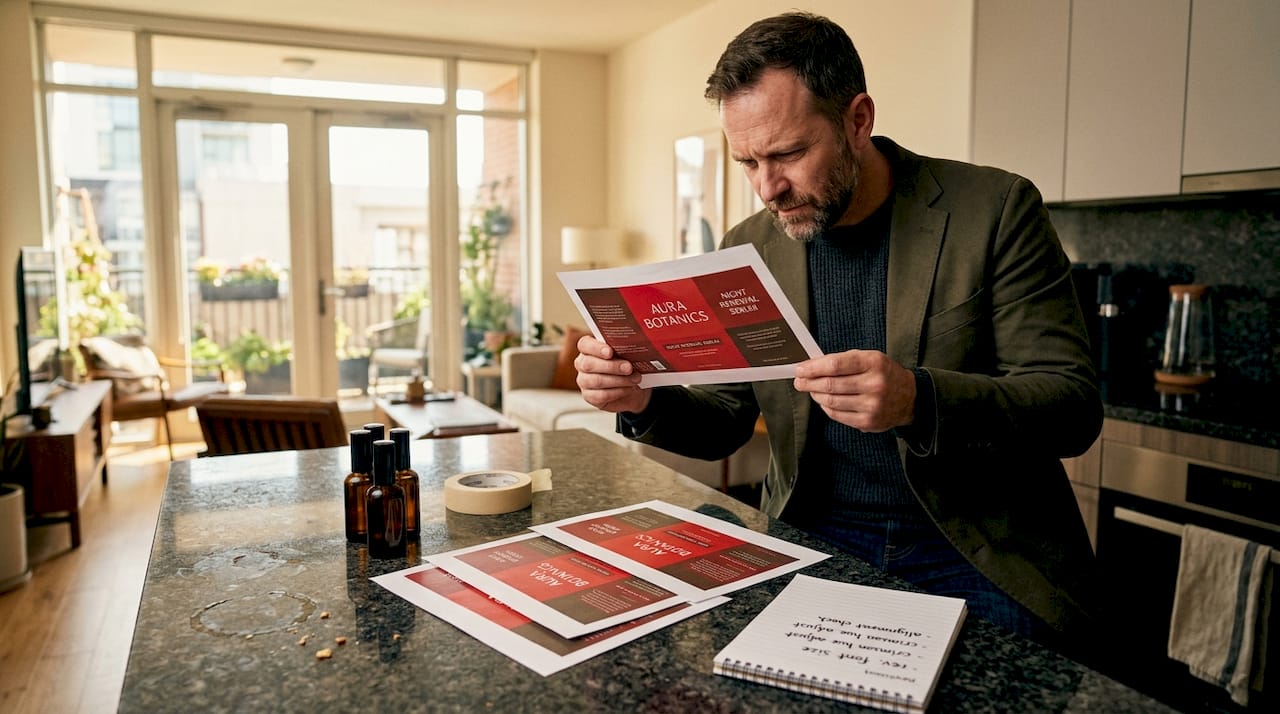
- Create a print mockup before finalizing. Print your label at actual size on plain paper and wrap it around the actual container. This catches font readability issues, color contrast problems, and proportion errors that screens hide.
Skincare product workflows tie directly into label design timing. Your label should be in development alongside your formulation, not after it.
Prioritizing FDA and EU compliance over aesthetics is the FDA’s own advice for small businesses. Use checklists and mockups before printing to avoid recalls. Many small brands learn this the hard way after a batch is already in customers’ hands.
Critical compliance note: All warnings, directions for use, and the batch code must appear in English (for US sales), be conspicuous and legible, and never be obscured by design elements, folds, or adhesive overlaps. This is a frequent audit failure point and a direct recall trigger.
Pro Tip: Print three physical mockups before approving any label. One for yourself, one for a person unfamiliar with the product (to check readability), and one to review under poor lighting, which simulates how products often look on retail shelves.
Double-check and approve your label
You’ve finished designing, but before hitting “print,” make sure your label is legally sound and ready for market.
Final review is where small brands either catch expensive mistakes or miss them. A structured checklist is significantly more reliable than a general read-through. Go panel by panel, element by element.
Final label review checklist:
- PDP: Statement of identity present and accurate
- PDP: Net quantity in both US and metric units, positioned at the bottom
- PDP: Font size meets FDA panel area formula
- Information panel: Full INCI list in descending order by weight, colorants last
- Information panel: Manufacturer or distributor name and full address
- Information panel: Warnings and directions in English, clearly legible
- Information panel: Batch code space reserved or printed
- EU compliance (if applicable): Responsible Person name and address, PAO symbol, batch number, language per Member State
- Certifications: All logos meet minimum size and clearance from certification body guidelines
- Claims: Every marketing claim (vegan, organic, cruelty-free) backed by current certification
Small package and multipack variations add specific rules. Small packages under 12 square inches can use 1/32 inch font and may move the ingredient list off-package. Multipacks require the PDP information to repeat on the outer packaging. If you’re selling globally, you’ll need multi-language labels and metric-only measurements in some markets, plus PAO symbols across all EU destinations.
Review a physical printed proof, not just a screen version. Colors shift between screen and print. Fonts that read clearly at 100% zoom can become blurry at actual label scale. If your label uses a dark or textured background, confirm that all regulatory text still passes basic contrast requirements.
The benefits of getting natural skincare labels right go far beyond compliance. Accurate, transparent labeling builds the kind of trust that turns a first-time buyer into a loyal customer.
Pro Tip: Create a label approval sign-off sheet that lists every compliance item, the person who verified it, and the date. This document becomes critical if you ever need to demonstrate due diligence during an audit or customer dispute.
What most guides miss about skincare label success
Most labeling guides hand you a checklist and call it done. What they rarely address is the mindset shift that separates brands that grow from brands that stagnate.
We’ve seen many small skincare entrepreneurs put enormous energy into brand identity, color palettes, and packaging photography, and almost none into compliance infrastructure, until a retailer rejects their product or a batch gets flagged. The real cost isn’t the reprint. It’s the delay in getting to market, the credibility hit with buyers, and the operational chaos of fixing a problem that could have been avoided in week one.
Here’s the contrarian view: your certifications and compliance documents are not administrative burdens. They are brand assets. A legitimate COSMOS Natural certification, a current Vegan Society trademark license, or a cruelty-free verification from Leaping Bunny tells a retailer and a customer that you have done the work. These signals build long-term vegan beauty impact that no amount of design polish can replicate.
Real-world label mockup testing also does something templates cannot: it surfaces problems you genuinely did not anticipate. We’ve seen brands discover that their ingredient list font was technically compliant but completely unreadable on amber glass. Others found that their certification logo disappeared against their chosen label color. A real mockup in a real consumer’s hands, before any commercial print run, is one of the highest-return investments a small brand can make.
The long-term math is simple. A $150 investment in proper mockup testing and a compliance review before your first print run can prevent a $3,000 reprint, a retailer delisting, or an FDA warning letter. Build the checklist habit now, and it becomes second nature by your third product launch.
Ready to launch your skincare brand?
Designing a compliant, compelling skincare label is a significant achievement, but it’s only one part of building a profitable beauty brand. The next step is getting your products market-ready with the right production and branding support behind you.
At Didis Beauty Center, we’ve built our private label skincare solutions specifically for entrepreneurs who want to launch natural and vegan products without starting from scratch. From ready-to-label formulations to full custom branding support, our team helps you move from compliant label design to products your customers will reorder. Whether you’re launching your first SKU or expanding an existing line, you get professional-grade products backed by clean formulations and transparent ingredients. Let us handle the production complexity so you can focus on building the brand.
Frequently asked questions
What must be on the front of a skincare label?
The front panel (PDP) must display the product’s identity and the net quantity in both US and metric units, positioned at the bottom with font size scaled to the panel area.
How should ingredients be listed on skincare labels?
List all ingredients using their INCI names in descending order by weight, with ingredients under 1% listed in any order after the main list and colorants always placed last.
Can I use the term ‘100% natural’ on my label?
No. Only use certified natural claims from recognized bodies like COSMOS or the Soil Association, since unsubstantiated claims like “100% natural” carry significant legal and reputational risk.
Are there different requirements for small packages?
Yes. Packages under 12 square inches allow a reduced font size of 1/32 inch and may place the ingredient list on outer packaging rather than directly on the product itself.
Recommended
- How to read skincare labels for smarter, safer choices – Didis Beauty Center
- How to design skincare branding that sells naturally & ethically – Didis Beauty Center
- Build a winning skincare product development workflow – Didis Beauty Center
- How to package sublimation products to impress customers – SubliBlanks Ltd
Discourse (0)