


Not all face soaps are created equal, and the difference between the right and wrong choice can show up on your skin faster than you’d expect. Many people assume that any bar or liquid soap will do the job, but the ingredients, pH level, and formulation type all shape how your skin looks and feels after every wash. For those of us drawn to natural and vegan skincare, the stakes are even higher because marketing claims don’t always match what’s actually in the formula. This guide breaks down the real science behind face soaps, explains what to look for on ingredient labels, and helps you find a cleanser that genuinely supports your skin health.
Table of Contents
- How face soaps cleanse: The science explained
- pH and your skin: Why it matters in cleansing
- Natural, vegan, and syndet face soaps: Which is best?
- Choosing for your skin type: Oily, dry, sensitive, and more
- Evidence-based routines for healthy, clean skin
- Find your perfect face soap and routine
- Frequently asked questions
Key Takeaways
| Point | Details |
|---|---|
| Soap ingredients cleanse differently | The surfactants and pH in face soaps determine how well they cleanse and how your skin feels afterward. |
| Low-pH and syndet cleansers are gentler | Face cleansers with balanced pH and mild surfactants protect your skin’s barrier and prevent dryness. |
| Choose cleanser for your skin type | Some soaps work better for oily skin, while dry or sensitive types need milder, barrier-friendly options. |
| Label reading matters | Always check ingredients and pH—not just marketing claims—to pick the best vegan or natural face soap. |
How face soaps cleanse: The science explained
Every time you wash your face, a chemical process is doing the heavy lifting. Face soaps work through surfactants, which are molecules with two distinct ends: one that attracts water (hydrophilic) and one that attracts oil (lipophilic). These molecules surround dirt, oil, and impurities, forming tiny structures called micelles that trap the grime so water can rinse it away. Facial skin cleansers work via surfactants from saponification that emulsify oils, dirt, and impurities using hydrophilic-lipophilic properties, forming micelles for rinsing.
Saponification is the chemical reaction that creates traditional natural soaps. It happens when fats or oils react with an alkali like sodium hydroxide, producing soap and glycerin. The glycerin byproduct is actually a natural moisturizer, which is one of the benefits for skin health that cold-process natural soaps can offer.
Not all surfactants behave the same way, though. Synthetic surfactants used in modern cleansers can be engineered to be gentler or more targeted. Here’s a quick comparison:
| Cleanser type | Surfactant source | Cleansing action | Skin feel after use |
|---|---|---|---|
| Natural soap | Saponified plant oils | Strong, broad-spectrum | Can feel tight or dry |
| Synthetic surfactant cleanser | Lab-derived compounds | Moderate, customizable | Varies widely |
| Syndet bar | Mild synthetic blend | Gentle, targeted | Softer, less stripping |
“The type of surfactant in your cleanser determines not just how clean your skin gets, but how your barrier holds up afterward.”
This distinction matters enormously when you’re choosing between a handcrafted natural bar and a formulated syndet (synthetic detergent) cleanser.
pH and your skin: Why it matters in cleansing
Your skin has a natural protective layer called the acid mantle, and it thrives at a pH between 4.5 and 5.5. Traditional soaps sit at a pH of 9 to 10, which is dramatically higher than your skin’s natural state. That gap causes real problems.
High-pH cleansers disrupt the acid mantle, strip natural oils, and increase transepidermal water loss (TEWL), which is the rate at which moisture evaporates through your skin. The result is dryness, tightness, and irritation, especially for dry or sensitive skin types. You can learn more about this in our pH-balanced skincare guide, and how pH affects cleansers is also well-documented in dermatology resources.
Here’s what high-pH cleansing can trigger:
- Dryness and flaking as the skin loses its natural lipid barrier
- Redness and irritation, particularly around the cheeks and forehead
- Increased TEWL, leaving skin dehydrated even after moisturizing
- Disrupted microbiome, since the acid mantle also protects against harmful bacteria
- Worsened sensitivity over time with repeated use
| Cleanser type | Typical pH | Impact on skin barrier |
|---|---|---|
| Traditional soap | 9 to 11 | High disruption, strips oils |
| Syndet bar | 5.5 to 7 | Low disruption, barrier-friendly |
| Gel or foam cleanser | 4.5 to 6.5 | Minimal disruption, hydration-supportive |
For anyone shopping for vegan or natural face soaps, reading the pH on the label or checking the brand’s formulation notes is a smart habit. A product can be 100% plant-based and still be too alkaline for daily use.
Natural, vegan, and syndet face soaps: Which is best?
These three categories overlap more than most people realize, and understanding the differences helps you shop smarter.
Natural soaps are made from plant-based oils and butters through saponification. They’re often free from synthetic additives, but their pH tends to run high. Vegan soaps simply exclude animal-derived ingredients like tallow or honey, but they can be either traditionally saponified or syndet-based. Syndet cleansers are soap-free bars or liquids formulated with mild synthetic surfactants, often at a skin-friendly pH.

Clinical research shows that syndet cleansers with mild surfactants like sodium cocoyl apple amino acids can preserve the skin barrier, improve hydration by up to 46%, and reduce porphyrins (a marker of acne-causing bacteria) and TEWL. That’s a meaningful result for anyone dealing with dryness or breakouts.
Here’s how to assess any cleanser before adding it to your routine:
- Check the surfactant list. Look for sodium cocoyl isethionate, sodium cocoyl glycinate, or amino acid-based surfactants for gentleness.
- Find the pH. Anything above 7 is worth questioning for daily facial use.
- Look for the vegan label. Confirm it’s certified or clearly states no animal byproducts.
- Scan for fragrance. Synthetic fragrance is a common irritant, even in natural-labeled products.
- Research the brand’s formulation philosophy. Brands that publish their pH and surfactant choices are usually more transparent overall.
You can also explore our vegan facial cleanser definition for a deeper breakdown of what these labels actually mean.
Pro Tip: Don’t let “natural” or “plant-based” on the front of a label be your only filter. Flip the product over and check the INCI (International Nomenclature of Cosmetic Ingredients) list. The first three to five ingredients tell you the most about how the formula will behave on your skin.
Choosing for your skin type: Oily, dry, sensitive, and more
Your skin type is the most practical filter when choosing a face soap. What works beautifully for oily skin can be a disaster for dry or sensitive skin, and vice versa.
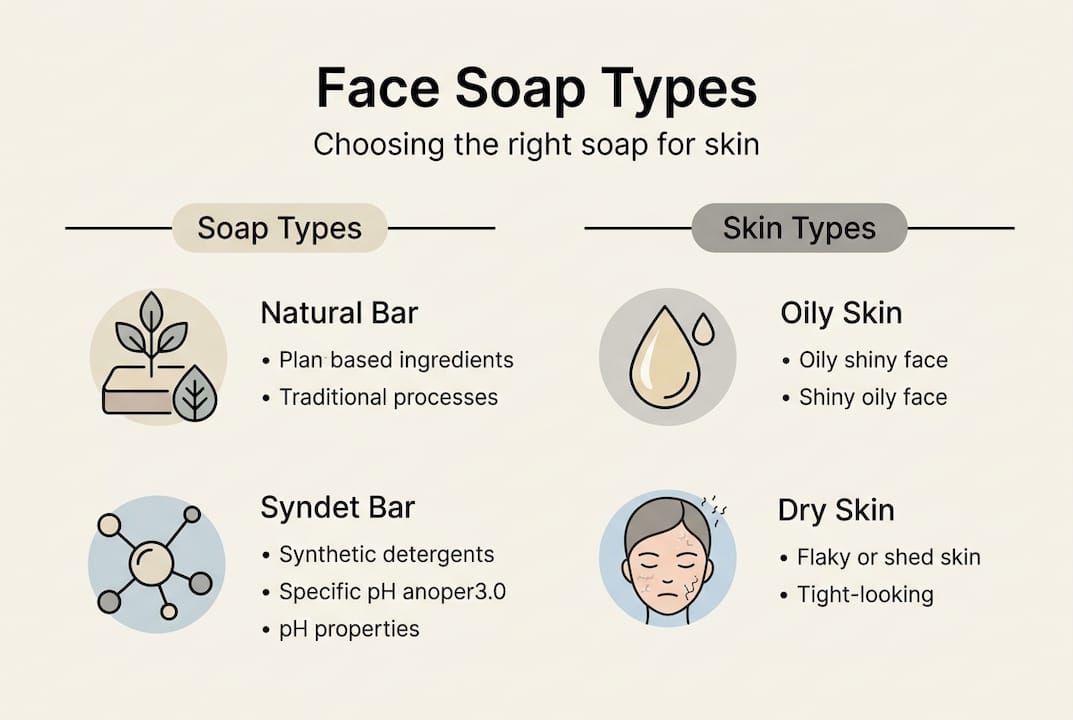
Salicylic acid soaps can be effective for oily and acne-prone skin, but they’re too harsh for dry or sensitive types. Natural soaps may suit oily skin better than synthetic options, but they still carry a risk of irritation due to their higher pH.
Here’s a quick guide by skin type:
- Oily or acne-prone: Look for mild syndet bars or natural soaps with salicylic acid or tea tree. Our Kojic face soap is a popular choice for brightening while managing excess oil.
- Dry skin: Prioritize syndet bars with humectants like glycerin or hyaluronic acid. Avoid anything with a pH above 7.
- Sensitive skin: Go fragrance-free and choose amino acid-based surfactants. Patch-test every new product before full use.
- Combination skin: A gentle syndet cleanser used twice daily usually works well without over-drying the cheeks.
- Normal skin: You have the most flexibility, but a pH-balanced cleanser still protects your barrier long-term.
For those who want a nourishing, gentle option, our Manuka face soap uses honey-derived ingredients known for their soothing and antibacterial properties.
Pro Tip: Always patch-test a new face soap on your inner arm or jawline for 24 to 48 hours before using it on your full face. Even gentle, vegan formulas can trigger reactions in highly sensitive skin.
Evidence-based routines for healthy, clean skin
Knowing which soap to choose is only half the equation. How and when you use it matters just as much. Syndets outperform traditional soaps in barrier preservation, with clinical data showing less TEWL and dryness across diverse skin types.
Here’s a simple, evidence-backed routine to follow:
- Morning cleanse: Use a gentle, pH-balanced face soap to remove overnight sebum and prep skin for serums or moisturizer.
- Evening cleanse: Double cleanse if you wear SPF or makeup. Start with a cleansing oil or micellar water, then follow with your face soap.
- Frequency: Twice daily is the standard recommendation. Over-cleansing strips the barrier just as much as using the wrong soap.
- Water temperature: Lukewarm water is best. Hot water increases TEWL and can trigger redness.
- Pat dry: Always pat, never rub, to avoid mechanical irritation.
| Step | Do | Don’t |
|---|---|---|
| Cleanser choice | Use pH-balanced, mild surfactants | Use high-pH traditional soaps daily |
| Frequency | Cleanse twice daily | Over-cleanse or skip entirely |
| Water temp | Lukewarm | Hot or ice-cold |
| Drying | Pat gently with a clean towel | Rub vigorously |
| Follow-up | Apply toner and moisturizer immediately | Leave skin bare after cleansing |
For more on the face soap benefits that come from consistent use, and to review skin pH best practices in your full routine, our blog has detailed guides to support every step.
Find your perfect face soap and routine
If this guide has helped you see your cleanser in a new light, the next step is finding products that actually match what your skin needs. At Didis Beauty Center, every face soap in our lineup is formulated with natural and vegan ingredients, transparent labeling, and your skin barrier in mind.
Our Daily Essential Bundle is a great starting point if you want a complete, curated routine without the guesswork. For a more structured approach, the Daily Routine Bundle pairs cleansing with toning and moisturizing steps that work together. And if brightening is your goal, the Kojic Brightening Face Soap delivers visible results while staying gentle on your barrier. Everything is vegan, cruelty-free, and backed by real customer results.
Frequently asked questions
How do face soaps differ from regular body soaps?
Face soaps are typically formulated with milder surfactants and a lower pH to protect the more delicate facial skin barrier. Body soaps often have a higher pH that can strip oils and cause dryness or irritation when used on your face.
Are natural or vegan face soaps always better for sensitive skin?
Not always. Some natural soaps are highly alkaline and can irritate sensitive skin just as much as conventional options. Always look for a low pH and mild surfactants, regardless of whether the label says natural or vegan.
Can face soaps help with acne or oily skin?
Yes, mild face soaps including certain syndet formulas and salicylic acid-based options can reduce excess oil and clear impurities without over-drying. The key is choosing a formula that targets oil without disrupting your skin barrier.
Why should I care about my cleanser’s pH level?
A cleanser with a pH above 7 disrupts your skin’s acid mantle, increasing moisture loss and making your skin more vulnerable to irritation and breakouts. Keeping your cleanser close to your skin’s natural pH of 4.5 to 5.5 helps maintain a healthy, resilient barrier.
Discourse (0)