


TL;DR:
- Building a sustainable beauty brand requires certified ingredients, transparent supply chains, and eco-friendly packaging choices. Establishing documentation, audits, and clear claims safeguards credibility and supports long-term growth. A holistic operating system ensures consistent sustainability practices as the brand scales and evolves.
Starting a beauty brand is one thing. Building one that stays genuinely sustainable as it scales is where most founders quietly run into trouble. The green beauty industry growth of recent years has created enormous opportunity, but it has also raised the bar for what “sustainable” actually means in practice. Vague labels, inconsistent sourcing, and recycling theater can erode trust fast. This guide covers the real architecture behind building a sustainable beauty brand: certifications, supply chain discipline, packaging decisions, claims compliance, and the systems that hold it all together when demand picks up.
Table of Contents
- Building a sustainable beauty brand: certifications and what they actually mean
- Mapping your supply chain for scalable sustainable sourcing
- Choosing and validating sustainable packaging
- Crafting transparent and substantiated sustainability claims
- Implementing systems for sustainable brand growth
- Why founders often get sustainability wrong — and how to do it right
- Launch your sustainable beauty brand with Didis Beauty Center
- Frequently asked questions
Key Takeaways
| Point | Details |
|---|---|
| Certify to build trust | Use recognized certifications like USDA Organic or COSMOS to substantiate organic and ethical claims authentically. |
| Map and monitor sourcing | Create detailed supply maps and regularly audit suppliers to maintain ingredient integrity and ethical standards as you grow. |
| Validate packaging realistically | Choose packaging that protects products and fits actual recycling practices, not just idealized eco-labels. |
| Separate clean from sustainable | Understand that clean ingredient lists differ from sustainability measures, and document both thoroughly. |
| Build sustainability systems | Treat sustainability as a business system with audits, controls, and policies integrated into your growth strategy. |
Building a sustainable beauty brand: certifications and what they actually mean
Before you can make credible claims, you need to understand what the rules actually say. The word “natural” has no legal definition in cosmetics. Neither does “clean.” Neither does “eco-friendly.” That means any brand can print those words on a box without consequence, which is exactly why consumers are increasingly skeptical and why third-party verification matters so much.
Start with the USDA Organic program. It operates on a tier-based system that determines what language you can legally use based on how much of your formula is certified organic. Products with 95% or more certified organic ingredients can use the “USDA Organic” seal. Products between 70% and 94% organic can say “made with organic [ingredient]” but cannot display the seal. Anything below 70% can only list organic ingredients in the ingredient panel. Knowing exactly which tier your formulas fall into is the first step in avoiding a costly labeling mistake.
Beyond USDA, certifications like COSMOS, Soil Association, and NATRUE set specific ingredient standards and ethical production criteria that go further than ambiguous “natural” claims. COSMOS, for example, restricts certain synthetic ingredients even when they are derived from natural sources, and it requires that processing methods be environmentally responsible.
Key certification tiers and their labeling implications:
| Label claim | Organic content required | Seal allowed? |
|---|---|---|
| “USDA Organic” | 95%+ certified organic | Yes |
| “Made with organic [X]” | 70 to 94% organic | No |
| No organic claim | Less than 70% | Organic ingredients listed only |
| COSMOS Organic | Variable, strict sourcing rules | Yes |
| NATRUE Natural | 0% petrochemicals, natural origin | Yes |
What third-party verification protects you from:
- Greenwashing accusations that damage brand reputation
- Regulatory action as laws tighten globally
- Retailer rejection during vetting processes
- Consumer chargebacks and review backlash
Pro Tip: Build your certification roadmap before you finalize formulas. Changing ingredients after launch to chase a certification is expensive and time-consuming. Work backward from the label you want to the formula you need.
For more on how certifications fit into your overall brand positioning, the sustainable skincare branding guide from our blog is a practical starting point.
With a clear foundation on certifications, you can now map out the sourcing systems your brand needs to scale ethically.
Mapping your supply chain for scalable sustainable sourcing
Most early-stage beauty founders know where their hero ingredients come from. Fewer know where those ingredients were processed, how they were transported, or what labor conditions look like at the farm level. That gap becomes a serious risk as your volume grows and your brand becomes visible enough to attract scrutiny.
A sourcing map that documents origins, certifications, and processing methods is not optional if you plan to grow without sacrificing your values. This is a living document, not a one-time exercise. It should name every supplier, their location, what they supply, and what certifications or standards they hold.
Here is a practical sequence for building your sourcing map:
- List every ingredient in each formula, including carriers, preservatives, and fragrance components.
- Identify the primary supplier for each ingredient and document their location and certification status.
- Trace one level deeper by finding out where your supplier sources their raw materials from.
- Record processing methods used between raw material and finished ingredient, including any solvents or refining steps.
- Note transport routes and flag any high-carbon or ethically ambiguous pathways.
- Assign a risk rating to each ingredient based on how much you know versus how much is unknown.
Once the map exists, supplier audits are what keep it honest. Annual audits focused on hygiene, labor standards, and capacity tell you whether a supplier can actually support your growth without cutting corners. Think of audits not as a compliance checkbox but as your earliest warning system. A supplier who struggles to meet hygiene standards at your current volume will absolutely fail when your orders double.
Pro Tip: Use the eco-friendly beauty checklist as a starting template for your supplier evaluation criteria. It gives you a concrete list of what to look for before you build a formal audit scorecard.
You can also reference this sustainability supplier audits guide for structuring audit frameworks as your supplier network expands.
Once your sourcing is mapped and audited, the next step is selecting and validating sustainable packaging.
Choosing and validating sustainable packaging
Packaging is where many brands confuse aesthetics with sustainability. A gorgeous amber glass bottle feels premium and eco-conscious. But if it contains a pump mechanism made from three different plastic types that cannot be separated at recycling facilities, the bottle is less sustainable in practice than a simple mono-material alternative.

Sustainable packaging must fit municipal recycling realities, not just look good on a shelf. That means fewer components, single-material designs where possible, and a realistic understanding of what your target customer’s curbside program actually accepts.
Packaging material comparison:
| Material | Recyclability | Formula compatibility | Cost tier |
|---|---|---|---|
| Glass | High (mono-material) | Excellent, all formulas | High |
| Aluminum | Very high | Good for anhydrous products | Medium to high |
| PET plastic | High in most systems | Excellent | Low |
| PCR plastic | Medium (depends on color) | Good | Medium |
| Refill systems | Very high when adopted | Good | High upfront |
| Multi-material pumps | Very low | Excellent | Low to medium |
What to evaluate before committing to a packaging format:
- Formula stability testing in your chosen container over 6 to 12 months
- Compatibility with your preservative system (some plastics leach or interact)
- Ease of separation for the end consumer at disposal
- Whether your supplier can source the same format at larger MOQs as you grow
Note that “recyclable” and “recycled” are two different claims with very different implications. Recyclable means the material can theoretically be processed. Recycled means the material contains post-consumer or post-industrial content. Both require substantiation if you use them in marketing.
Pro Tip: Request a “recyclability assessment” from your packaging supplier before finalizing any component. Ask them specifically which municipal systems accept it and whether it meets FTC Green Guide standards if you’re selling in the US.
Our guide on packaging beauty products naturally walks through real examples of format choices and how to communicate them honestly to consumers.
With packaging aligned, it is vital to sharpen your brand’s claims and marketing language to stay on the right side of consumer trust and the law.
Crafting transparent and substantiated sustainability claims
Here is a distinction that trips up almost every early-stage founder: clean beauty and sustainable beauty are not the same thing, and conflating them is one of the fastest ways to lose credibility with educated consumers.
Clean beauty is about ingredient safety, specifically the exclusion of compounds considered potentially harmful to human health. Sustainable beauty is about environmental impact: how ingredients are grown, how packaging is disposed of, and how far ingredients travel. A formula can be perfectly “clean” while being environmentally destructive, and vice versa.
When your marketing mixes these two concepts without distinction, you signal to informed buyers that you do not fully understand what you are claiming. Separate your claims clearly, and your credibility immediately increases.
The EU’s ECGT directive is already requiring brands to back up environmental marketing with verifiable, specific data. Similar scrutiny is growing in the US. Words like “eco-friendly,” “green,” “natural,” or “net-zero” without accompanying evidence are becoming legal liabilities in multiple markets.
How to build a substantiation file for each sustainability claim:
- Write down the exact claim as it will appear on the product, website, or advertisement.
- Identify what category it falls into: ingredient safety, environmental impact, packaging, or supply chain ethics.
- Gather specific data supporting it, such as lifecycle assessments, certifications, or supplier documentation.
- Document what the claim does NOT cover to avoid over-broad language.
- Review annually as formulas, suppliers, or packaging change.
The green claims marketing psychology behind sustainability messaging also matters. Transparency without substance triggers skepticism. Specificity builds trust far faster than sweeping statements.
For a deeper look at what sustainable impact actually means in practice, visit our guide on defining sustainable beauty impact.
Once your claims are verified, the next priority is building systems that keep everything consistent as you grow.
Implementing systems for sustainable brand growth
Good intentions do not scale. Systems do. The brands that sustain their ethics through growth are not the ones with the best values on paper. They are the ones that turned those values into documented, repeatable processes.
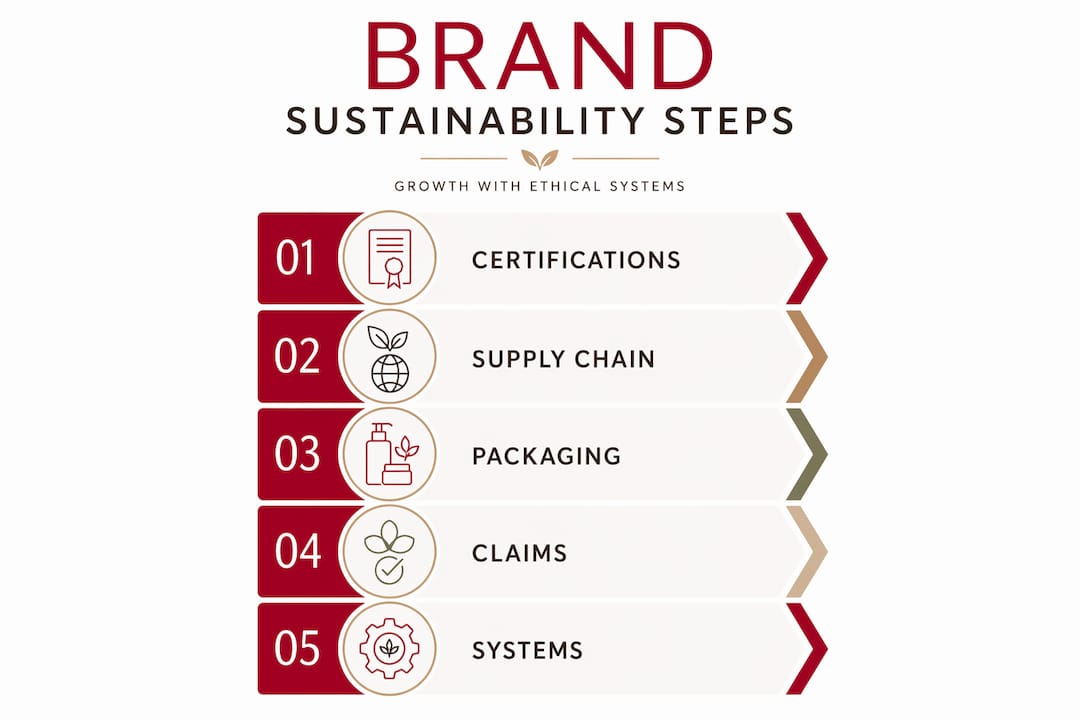
Sustainable scalability requires traceability, testing, packaging validation, and audit discipline to grow in parallel, not sequentially. Waiting until something breaks to formalize a system almost always means a shortcut has already become a habit.
Here is a sequenced approach to building your operating system:
- Audit your current state. Grade every supplier and packaging component against your stated standards. Identify gaps honestly.
- Create scorecards. Standardized evaluation criteria for all suppliers reduce subjectivity and make it easier to onboard new vendors at scale.
- Set change-control policies. Any formula, supplier, or packaging change must go through a documented review process before it is implemented.
- Align your contract manufacturers. If you outsource production, your quality and sustainability standards must be written into the contract, not assumed.
- Enforce non-negotiables. Define three to five absolute limits that cannot be waived regardless of pressure, cost, or timelines.
Pro Tip: The phrase “just this once” is the most dangerous phrase in a growing beauty business. One exception in sourcing, packaging, or labeling creates a precedent. Precedents become patterns. Patterns become your actual brand, regardless of what your website says.
The step-by-step sustainable beauty guide on our blog gives you a practical framework for implementing each of these systems at different growth stages.
Why founders often get sustainability wrong — and how to do it right
The most common mistake is treating sustainability as a marketing layer applied after the product is built. A recycled box here, a “cruelty-free” badge there. It looks the part. But it does not hold up when a retailer requests your sourcing documentation, when a journalist asks pointed questions, or when a supplier changes their practices mid-contract.
Documentation and audit culture are underestimated because they are unglamorous. Nobody posts about their change-control policy on social media. But founders who build these habits early find that sustainability actually compounds brand trust rather than depleting resources. Every audit completed, every substantiation file built, every supplier standard enforced becomes an asset. It is evidence you can show rather than claims you have to defend.
The other trap is the “exception” mentality. A supplier ships late, so you accept a non-compliant substitute. A packaging order falls through, so you use a non-recyclable alternative “just this launch.” Each exception feels small in isolation. Collectively, they quietly hollow out everything your brand claims to stand for. True sustainability in cosmetics requires the same discipline as safety testing: it is not situational.
The brands that do this well tend to think of sustainability as an operating system rather than a label. It governs decisions at the ingredient level, the supplier level, the packaging level, and the marketing level simultaneously. It requires more work upfront. It returns significantly more trust, margin protection, and retailer access over time.
For more on how natural beauty branding intersects with long-term business credibility, our blog covers real-world examples from founders navigating exactly this challenge.
Launch your sustainable beauty brand with Didis Beauty Center
Building a genuinely sustainable beauty brand takes more than good ingredients and good intentions. It takes the right partner. At Didis Beauty Center, we have built our platform specifically for founders who want to launch or scale with natural, vegan formulations backed by transparent, eco-conscious practices.
Our private label program gives you access to customizable, pre-tested formulations built on ethical sourcing and responsible packaging, so you start from a compliant foundation rather than building one from scratch. For founders ready to launch with a curated product lineup, the Daily Essential Bundle and Daily Routine Bundle offer natural, vegan formulas ready to carry your brand. We take the sourcing and formulation complexity off your plate so you can focus on building the brand your customers will trust.
Frequently asked questions
What does “USDA Organic” certification mean for beauty products?
USDA Organic certification verifies that at least 95% of a product’s ingredients are certified organic, and compliance with strict production and handling standards must be met before the seal can be used on the label.
How can I ensure my sustainability claims are trustworthy and not misleading?
Build a detailed substantiation file for every environmental claim, keep clean beauty and sustainability claims separate, and avoid vague terms like “eco-friendly” without supporting data, especially as EU green claims regulation requires clear, verifiable proof tied to your product and supply chain.
Are “clean beauty” and “sustainable beauty” the same?
No. Clean beauty and sustainable beauty differ significantly in focus: clean relates to excluding potentially harmful ingredients from the formula, while sustainable addresses environmental impact and supply chain ethics, and each requires its own separate documentation and transparency.
What role do supplier audits play in building a sustainable beauty brand?
Supplier audits verify traceability, labor standards, hygiene, and capacity at scale, giving you an early warning system for risks that would otherwise surface as quality failures or credibility problems after they have already damaged your brand.
How can I choose sustainable packaging that works for my beauty products?
Prioritize mono-material designs that align with your customers’ local recycling systems, test for formula stability and compatibility before committing, and make sure you understand the legal difference between “recyclable” and “recycled” before using either claim in packaging or marketing copy.
Discourse (0)