


Creating effective, vegan, natural skincare products that are safe and eco-conscious presents unique challenges for consumers and small business owners. Many struggle with ingredient sourcing, formulation stability, and regulatory compliance while maintaining ethical standards. This guide provides clear, actionable steps to formulate cruelty-free skincare products in 2026, covering ingredient selection, preservation techniques, pH balancing, and safety testing to help you launch successful natural skincare lines.
Table of Contents
- Introduction To Natural Skincare Formulation
- Prerequisites: What You Need Before Starting
- Step-By-Step Formulation Process
- Ingredient Sourcing: Cruelty-Free And Eco-Friendly Options
- Common Mistakes And Troubleshooting In Natural Formulation
- Expected Timelines, Costs, And Success Metrics
- Conclusion And Next Steps
- Start Your Natural Skincare Journey With Didis Beauty Center
- FAQ
Key Takeaways
| Point | Details |
|---|---|
| Preparation essentials | Gather precision scales, mixers, pH meters, and certified vegan ingredients before starting formulation. |
| Stepwise formulation | Balance emollients, humectants, occlusives, and add broad-spectrum preservatives for stability. |
| Ethical sourcing | Choose certified cruelty-free, organic, Fair Trade ingredients and eco-conscious packaging. |
| Avoid common mistakes | Maintain pH 4.5-6.5, use proper preservative levels, conduct patch testing to reduce irritation. |
| Timeline expectations | Plan for 6-12 weeks from formulation to testing with measurable safety and efficacy outcomes. |
Introduction to Natural Skincare Formulation
Natural skincare products use plant-based, minimally processed ingredients free from synthetic chemicals, parabens, and artificial fragrances. These formulations offer gentler alternatives for sensitive skin while supporting environmental sustainability through biodegradable components and reduced chemical runoff.
Vegan skincare excludes all animal-derived ingredients like beeswax, lanolin, and collagen, relying instead on plant oils, butters, and extracts. Cruelty-free certification ensures no animal testing occurred during ingredient sourcing or product development. These ethical standards matter increasingly to consumers, with the US natural skincare market growing 8% annually as buyers prioritize transparency and environmental responsibility.
Consumer demand for eco-conscious products continues rising in 2026, driven by awareness of synthetic ingredient impacts on health and ecosystems. Small business owners entering this market must balance efficacy with safety, requiring knowledge of proper formulation techniques, preservation methods, and regulatory compliance.
The general formulation process involves five core steps:
- Research and select certified ingredients meeting vegan and cruelty-free standards
- Create balanced formulations with appropriate ratios of moisturizing components
- Add preservation systems to prevent microbial contamination
- Adjust pH levels for skin compatibility and product stability
- Conduct safety testing through patch tests and stability assessments
A common misconception suggests natural products are inherently safe and need no testing. Reality shows improper preservation or pH imbalance can cause irritation or spoilage regardless of ingredient origin. Safety testing validates product performance and protects customers from adverse reactions.
Prerequisites: What You Need Before Starting
Successful natural skincare formulation requires basic cosmetic chemistry knowledge or access to credible educational resources. Understanding emulsification, pH chemistry, and preservation principles prevents costly mistakes and ensures product safety.
Essential equipment includes precision digital scales accurate to 0.01 grams for measuring small quantities of active ingredients and preservatives. High-shear mixers or immersion blenders create stable emulsions by breaking down oil and water phases into uniform particles. pH meters or test strips validate formulation acidity, while heat-resistant glass beakers and containers prevent contamination during mixing and storage.

Ingredient selection criteria focus on certifications demonstrating ethical sourcing. Look for Leaping Bunny or PETA cruelty-free certification, USDA Organic or Ecocert organic labels, and Fair Trade verification when available. Purity matters too, with cosmetic-grade ingredients meeting safety standards for direct skin application.
Familiarity with FDA cosmetic safety regulations is important for US small manufacturers. While the FDA does not pre-approve cosmetics, manufacturers must ensure products are safe and properly labeled. Understanding Good Manufacturing Practices helps maintain quality control even for small batch production.
| Tool/Material | Purpose | Key Features |
|---|---|---|
| Precision Scale | Accurate ingredient measurement | 0.01g accuracy, 500g+ capacity |
| Immersion Blender | Emulsion creation | Variable speed, stainless steel |
| pH Meter/Strips | Acidity verification | Range 3-10, 0.1 accuracy |
| Glass Beakers | Heat-safe mixing | 100ml, 250ml, 500ml sizes |
| Plant Oils | Vegan emollients | Jojoba, sunflower, squalane |
| Natural Preservatives | Microbial protection | Leucidal, Geogard ECT |
Pro Tip: Start with building natural skincare routines to understand how different product types work together before formulating your first batch.
Step-by-Step Formulation Process
Following a logical sequence ensures your natural skincare products achieve stability, safety, and effectiveness. Each step builds on the previous, creating a systematic approach to formulation.
-
Research and select certified vegan and cruelty-free ingredients, focusing on plant-based oils like jojoba and sunflower that provide excellent emollient properties. Verify supplier certifications and request Certificates of Analysis confirming purity and absence of contaminants.
-
Create a balanced moisturizer formula by combining emollients that soften skin, humectants that attract moisture, and occlusives that seal hydration. A typical ratio uses 60% water phase, 30% oil phase, and 10% active and preservation phases. Balancing emollients, humectants, and occlusives ensures effective hydration and skin barrier function.
-
Add broad-spectrum preservatives within regulatory safety limits, typically 0.5% to 1.5% depending on the system chosen. Natural options like Leucidal Liquid or Geogard ECT protect against bacteria, yeast, and mold without synthetic parabens. Calculate preservative percentages precisely using your digital scale.
-
Adjust formulation pH to 4.5 to 6.5 for stability and skin compatibility. Most natural ingredients are slightly acidic, matching skin’s natural pH of approximately 5.5. Use citric acid to lower pH or sodium bicarbonate to raise it, testing after each small adjustment.
-
Perform patch tests on samples to confirm skin safety before full production. Apply small amounts to inner forearm skin of willing volunteers, checking for redness, itching, or irritation after 24 and 48 hours. Document results to establish safety profiles.
Pro Tip: Keep detailed batch records including ingredient sources, amounts, mixing temperatures, and pH readings. This documentation helps troubleshoot issues and ensures formula repeatability for consistent product quality.
Ingredient Sourcing: Cruelty-Free and Eco-Friendly Options
Authentic, certified sustainable ingredients form the foundation of ethical natural skincare. Verification labels provide assurance that products meet vegan and eco-conscious standards throughout supply chains.
Certified organic ingredients from USDA Organic or Ecocert programs guarantee cultivation without synthetic pesticides or GMOs. Fair Trade certification ensures farmers receive fair compensation and work under ethical conditions. Vegan certification from organizations like Vegan Action or The Vegan Society confirms no animal-derived ingredients or testing. Leaping Bunny or PETA cruelty-free labels verify no animal testing at any production stage.
Reliable US-based suppliers include Mountain Rose Herbs for organic botanical extracts and essential oils, Ingredients to Die For offering bulk natural ingredients with transparent sourcing, and Lotioncrafter specializing in natural preservatives and emulsifiers. These suppliers provide Certificates of Analysis and maintain strict quality control standards.
Plant-based oils like jojoba and sunflower provide vegan emollients with antioxidant benefits and sustainable sourcing. Jojoba technically is a liquid wax with composition similar to human sebum, making it exceptionally compatible with skin. Sunflower oil contains high levels of vitamin E and linoleic acid, supporting skin barrier repair.
Eco-conscious packaging choices significantly impact overall sustainability. Glass containers offer infinite recyclability and chemical inertness, though they add weight to shipping. Post-consumer recycled plastic reduces virgin material demand while maintaining lightweight convenience. Aluminum tubes and jars provide durability and high recycling rates. Explore eco-friendly packaging options that align with brand values and customer expectations.
| Preservative Type | Source | Spectrum | Typical Use Level | Notes |
|---|---|---|---|---|
| Leucidal Liquid | Fermented radish root | Broad | 2-4% | Natural, mild scent |
| Geogard ECT | Plant-derived | Broad | 0.6% | Ecocert approved |
| Potassium Sorbate | Synthetic nature-identical | Mold/yeast | 0.1-0.2% | Often combined |
| Sodium Benzoate | Synthetic nature-identical | Bacteria | 0.1-0.5% | pH dependent |
Common Mistakes and Troubleshooting in Natural Formulation
Beginners frequently encounter preventable issues that compromise product safety and effectiveness. Recognizing these pitfalls early saves time, money, and protects customer trust.
PH imbalance represents the most frequent formulation error. Products with pH above 7 feel harsh and disrupt skin’s acid mantle, while pH below 4 may cause stinging. Always measure pH after combining all ingredients and adjust carefully using small increments of pH modifiers.
Overuse of abrasive or scented additives irritates sensitive skin unnecessarily. Physical scrubs can cause irritation rates up to 20%, whereas enzyme exfoliants produce less than 5%. Choose gentle enzyme-based exfoliants from papaya or pineapple instead of harsh walnut shells or apricot kernels. Limit essential oils to under 1% total formula weight to prevent sensitization.
Insufficient preservative levels allow microbial growth, creating safety hazards and product spoilage. Calculate preservative percentages based on total formula weight, not just water phase. Test preservation efficacy through challenge testing if producing commercial quantities.
Lack of patch testing before market release risks customer adverse reactions and potential liability. Even natural ingredients cause allergies in susceptible individuals. Conduct systematic testing on diverse skin types to identify potential issues.
Safety testing reduces allergic reactions and irritation while building customer confidence in product quality and brand integrity.
Proper documentation enables troubleshooting when formulas behave unexpectedly. Record exact measurements, mixing sequences, temperatures, and timing for each batch. When issues arise, review records to identify variables that may have changed. Avoid formulation errors by maintaining consistent processes and ingredient sources.
Expected Timelines, Costs, and Success Metrics
Realistic planning helps small businesses allocate resources effectively and measure progress toward product launch goals. Understanding typical development cycles prevents frustration and premature market entry with undertested products.
Typical formulation and testing cycles span 6 to 12 weeks depending on formula complexity and testing thoroughness. Initial formulation takes 1 to 2 weeks including ingredient sourcing. Stability testing requires 4 to 8 weeks observing samples at room temperature and elevated temperatures. Patch testing adds 1 to 2 weeks for volunteer recruitment and observation periods.
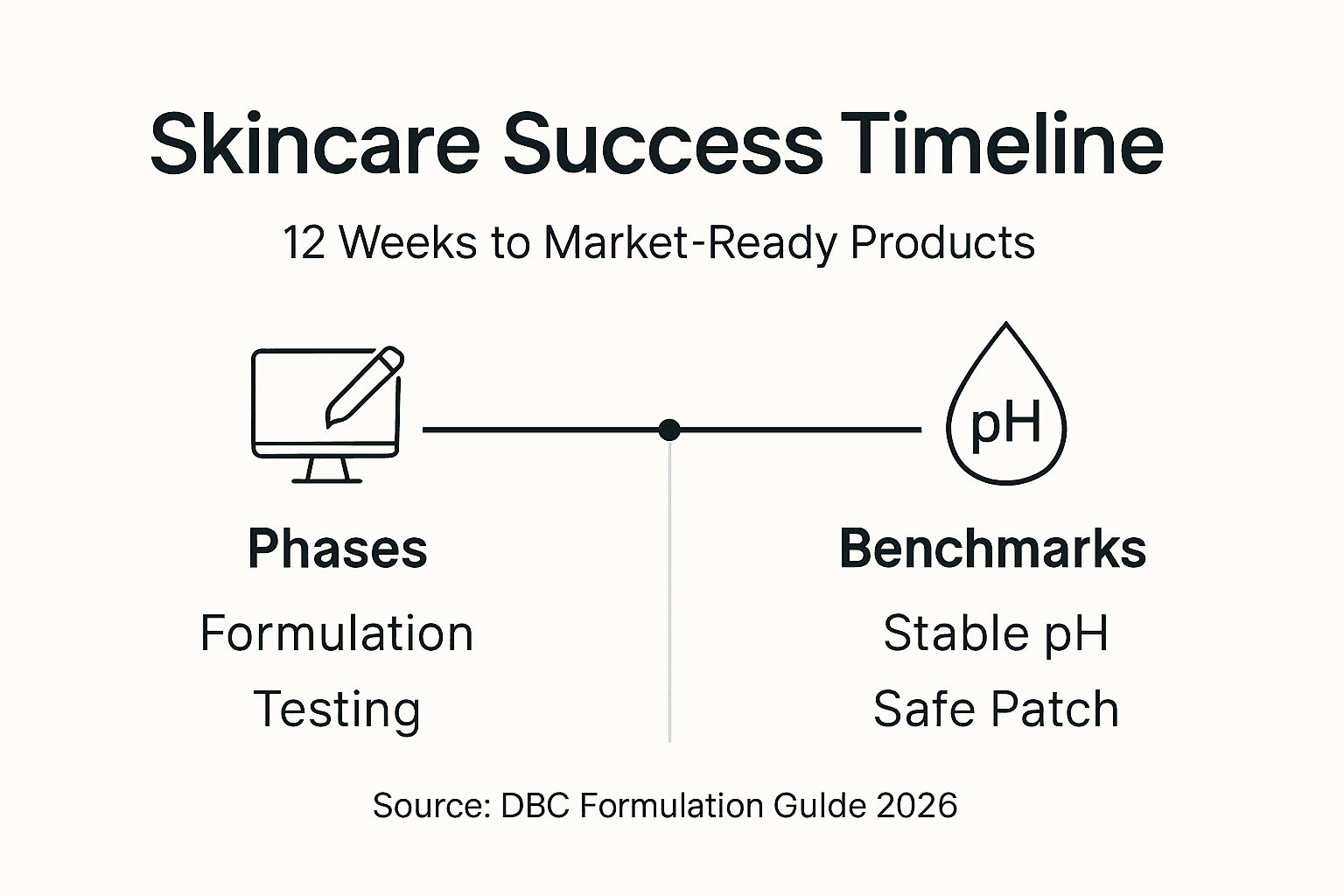
Patch testing protocols help validate product safety with target irritation rates below 5%. Recruit 20 to 30 volunteers representing your target demographic. Apply products to clean inner forearm skin, covering with hypoallergenic tape. Examine sites at 24 hours and 48 hours, documenting any redness, swelling, or itching. Products passing with less than 5% adverse reactions demonstrate acceptable safety profiles.
| Development Phase | Duration | Estimated Cost | Success Metrics |
|---|---|---|---|
| Formula Development | 1-2 weeks | $200-500 | Stable emulsion, target viscosity |
| Ingredient Sourcing | 1 week | $300-800 | Certified suppliers, COA received |
| Stability Testing | 4-8 weeks | $100-200 | pH stable ±0.3, no separation |
| Patch Testing | 1-2 weeks | $150-300 | <5% irritation rate |
| Packaging Selection | 1-2 weeks | $400-1000 | Eco-certified, product compatible |
Cost-saving strategies include starting with small 100g to 500g batches to minimize ingredient waste during formula optimization. Source ingredients from certified suppliers offering bulk discounts while maintaining quality standards. Consider cost-effective private label skincare partnerships that provide pre-tested formulations and regulatory support.
Benchmarks for success include maintaining stable pH within 0.3 units over 3+ months at room temperature. Microbial testing should show absence of bacteria, yeast, and mold after preservation challenge tests. User feedback should indicate moisturizing satisfaction above 80% and irritation reports below 5%. Texture and scent should remain consistent throughout shelf life.
Pro Tip: Invest in quality ingredients rather than cutting costs on core components. Premium plant oils and effective preservatives prevent product failures that damage brand reputation far more expensively than initial ingredient savings.
Conclusion and Next Steps
Formulating natural, vegan, cruelty-free skincare products requires systematic attention to safety, preservation, and ethical sourcing principles. Success comes from understanding cosmetic chemistry fundamentals, selecting certified ingredients, following stepwise formulation processes, and conducting thorough safety testing.
Begin your formulation journey by gathering essential equipment and researching credible ingredient suppliers with transparent certifications. Start with simple formulas like moisturizers or toners before advancing to complex emulsions or active-rich serums. Document every step to build repeatable processes and troubleshoot effectively.
Didis Beauty Center offers comprehensive support for natural skincare entrepreneurs through certified vegan ingredients, formulation guidance, and private label solutions that streamline product development. Our resources help small businesses navigate regulatory requirements, source ethical ingredients, and launch successful natural skincare brands aligned with sustainability values.
Take action today by exploring formulation education, connecting with certified suppliers, and building the foundation for your natural skincare brand.
Start Your Natural Skincare Journey with Didis Beauty Center
Transform your natural skincare vision into reality with expert support and quality ingredients. Didis Beauty Center specializes in private label skincare solutions designed for entrepreneurs launching vegan, cruelty-free brands.
Our platform provides certified vegan ingredients including plant-based oils, botanical extracts, and broad-spectrum natural preservatives meeting rigorous quality standards. Access pre-tested formulations that eliminate guesswork while maintaining customization flexibility for unique brand positioning.
Sustainability remains central to our mission. Explore eco-friendly packaging options including recycled materials, biodegradable containers, and minimal-waste designs that resonate with environmentally conscious consumers.
Leverage our formulation expertise to streamline your launch timeline and reduce development costs without compromising ingredient quality or ethical standards. Discover vegan skincare benefits and how plant-based formulations meet growing consumer demand for transparent, cruelty-free beauty products.
FAQ
What Are the Most Important Tools to Start Natural Skincare Formulation?
Essential tools include precision scales accurate to 0.01 grams for measuring ingredients, immersion blenders for creating stable emulsions, and pH meters for stability verification. Proper heat-resistant glass containers prevent contamination during mixing and storage. These tools ensure safety, consistency, and professional-quality results from your first batch.
How Can I Ensure My Natural Skincare Product Is Safe for Customers?
Conduct systematic patch testing on 20 to 30 volunteers representing your target demographic to evaluate skin reactions and minimize irritation risk. Use broad-spectrum natural preservatives within regulated limits, typically 0.5% to 1.5%, to prevent microbial growth. Maintain pH between 4.5 and 6.5 for skin compatibility and document all formulation details for quality control.
What Are the Best Cruelty-Free Ingredients for Vegan Skincare?
Plant-based oils like jojoba, sunflower, and squalane offer excellent hydration with antioxidant benefits and ethical sourcing. Botanical extracts from chamomile, green tea, and aloe provide soothing and anti-inflammatory properties. Certified organic and Fair Trade labels help verify sustainable cultivation practices and ethical supply chains throughout ingredient sourcing.
How Long Does It Typically Take to Develop a Natural Skincare Product?
Development including formulation, stability testing, and safety verification usually spans 6 to 12 weeks for thorough quality assurance. Initial formulation requires 1 to 2 weeks, while stability testing needs 4 to 8 weeks observing product performance under various conditions. Patience and systematic testing ensure stable, effective products that meet safety standards and customer expectations.
Discourse (0)