


TL;DR:
- Skin’s needs change with seasons due to temperature and humidity shifts.
- Use plant-based ingredients tailored to each season for optimal skin health.
- Adjust routines gradually, listening to signals like dryness, oiliness, or dullness.
You swap your coat for a lighter jacket when spring arrives, but your cleanser? Same bottle, same steps, same results — except your skin starts breaking out, flaking, or turning into an oil slick. Seasonal weather shifts change everything about how your skin behaves, and a routine built for July will actively work against you in January. The good news is that adjusting your vegan, natural routine doesn’t require a full overhaul every few months. A few smart swaps at the right time can keep your skin balanced, clear, and glowing year-round. This guide walks you through exactly what to change, when to change it, and which plant-based products to reach for.
Table of Contents
- Understanding your skin’s seasonal needs
- Essential products and tools for each season
- Step-by-step: Adapting your routine for each season
- Troubleshooting and common mistakes to avoid
- Our take: Why routine is about rhythm, not rules
- Upgrade your seasonal skincare with plant-based essentials
- Frequently asked questions
Key Takeaways
| Point | Details |
|---|---|
| Seasonal adaptation matters | Changing your skincare routine for each season prevents dryness, oiliness, and breakouts. |
| Go natural and vegan | Plant-based, gentle products offer safe, effective care all year long. |
| Layer and swap smart | Update textures, ingredients, and accessories with the weather for best results. |
| Watch and tweak | Monitor your skin and adjust your routine as soon as you notice changes or issues. |
Understanding your skin’s seasonal needs
Before diving into the specific steps, let’s understand why and how your routine must change with the seasons.
Your skin barrier, the outermost protective layer, responds directly to temperature and humidity. Cold, dry air pulls moisture out of skin cells. Hot, humid air triggers excess sebum (oil) production. These aren’t minor inconveniences — they’re measurable shifts in how your skin functions, and ignoring them leads to real problems like tightness, congestion, or breakouts. Seasonal changes alter skin’s hydration and oil levels, creating entirely new skincare needs every few months.
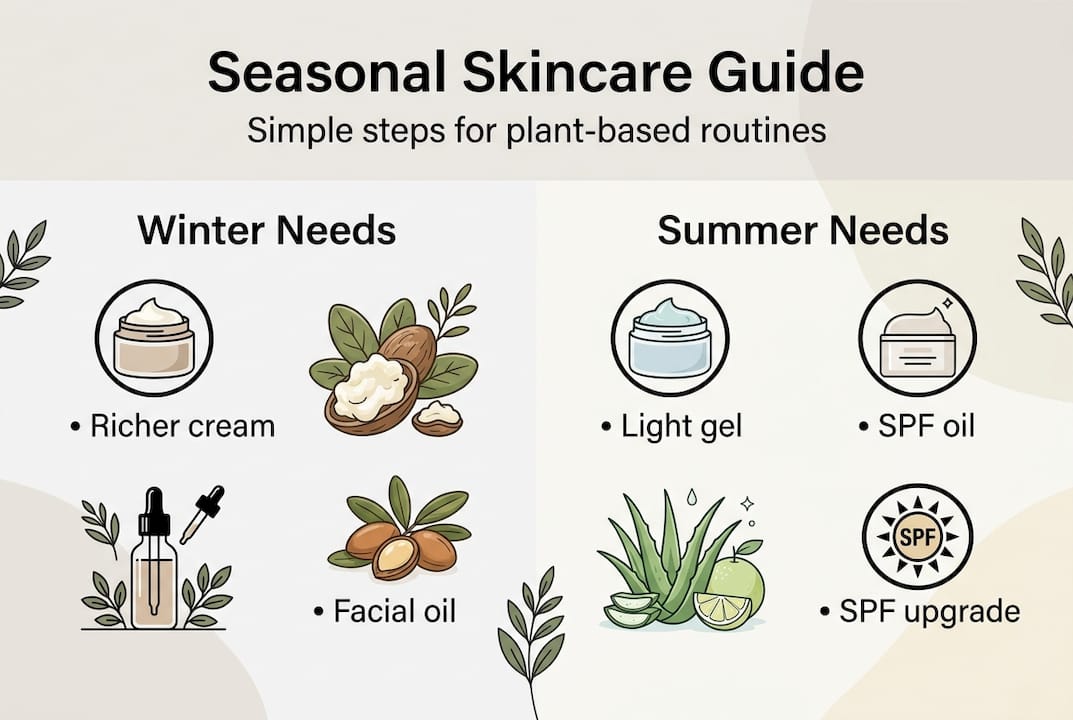
Here’s a quick breakdown of what your skin actually needs by season:
| Season | Main skin concern | Routine focus |
|---|---|---|
| Winter | Moisture loss, tightness | Deep hydration, barrier repair |
| Spring | Congestion, sensitivity | Gentle renewal, rebalancing |
| Summer | Excess oil, UV damage | Oil control, SPF, lightweight layers |
| Fall | Dullness, early dryness | Exfoliation, transition moisturizing |
The signs your current routine isn’t keeping up with the season are easy to spot if you know what to look for:
- Skin feels tight or flaky after cleansing (winter signal)
- Breakouts appear in new areas as temperatures rise
- Makeup sits unevenly or pores look enlarged
- Redness or sensitivity flares without a clear cause
- Skin looks dull or uneven in fall or early spring
Plant-based and vegan formulas tend to adapt better across seasons because they rely on ingredients that mimic the skin’s own lipids and hydration factors. Shea butter, aloe vera, jojoba oil, and green tea extract work with your skin rather than forcing a synthetic response. Following natural skincare routine tips gives you a strong foundation to build seasonal adjustments on top of.
Pro Tip: If you’re unsure whether a new skin issue is seasonal or product-related, stop one product at a time for a week before making bigger changes. Isolating variables saves time and skin stress.
Essential products and tools for each season
Now that you know what your skin needs, here’s what to stock (and when to swap) for every season.

Layering skincare products enhances their effect, especially when tailored seasonally. That means the order you apply products matters just as much as what you’re using. A lightweight serum under a rich cream in winter creates a moisture sandwich that locks hydration in. The same rich cream in summer clogs pores and triggers breakouts.
Here’s a season-by-season product guide with key ingredients to look for:
| Season | Core products | Star ingredients |
|---|---|---|
| Winter | Creamy cleanser, facial oil, thick moisturizer, gentle exfoliant | Shea butter, rosehip oil, hyaluronic acid |
| Spring | Balancing toner, light serum, SPF moisturizer | Niacinamide, green tea, aloe vera |
| Summer | Gel cleanser, lightweight SPF, clay mask | Salicylic acid (plant-derived), cucumber, tea tree |
| Fall | Brightening serum, medium moisturizer, exfoliating mask | Vitamin C (from kakadu plum), glycolic acid (sugarcane), jojoba |
Beyond products, your tools and accessories deserve a seasonal refresh too:
- Winter: Swap to soft muslin cloths for cleansing — they’re gentler on a compromised barrier
- Summer: Reusable cotton rounds work well for toner application without dragging dry skin
- All seasons: Biodegradable sheet masks and natural face mists are eco-friendly upgrades worth keeping in rotation
- Year-round: A clean, dry jade roller stored in the fridge adds a depuffing step that works in any season
For a full breakdown of how to layer these products for maximum impact, the vegan skincare layering guide is a practical resource. You can also explore a broader list of natural skincare routines to find structures that match your skin type and lifestyle.
Step-by-step: Adapting your routine for each season
With the right products at hand, here’s how to actually shift your routine as each season arrives.
A five-step vegan skincare routine can be customized as the seasons change without rebuilding from scratch. Think of your core routine as the skeleton and seasonal swaps as the muscle that makes it work.
Winter morning routine:
- Cleanse with a creamy, sulfate-free cleanser to avoid stripping oils
- Apply a hydrating toner with rose water or glycerin
- Layer a hyaluronic acid serum while skin is still damp
- Seal with a thick plant-based moisturizer containing shea or cocoa butter
- Finish with a mineral SPF (yes, even in winter)
Summer morning routine:
- Cleanse with a gentle gel formula to remove overnight oil buildup
- Use a balancing toner with witch hazel or green tea
- Apply a lightweight niacinamide serum for pore control
- Skip heavy moisturizer — use a tinted SPF 30 or higher instead
- Blotting papers in your bag replace midday powder touch-ups
Mid-season transition tips:
- Start swapping one product at a time, not your entire shelf at once
- Give each new product at least five to seven days before judging results
- If you’re between seasons, mix textures — a light moisturizer on top of a richer serum works well in spring and fall
“The biggest seasonal mistake isn’t using the wrong product. It’s using the right product at the wrong time of year.”
For your night routine, follow the same seasonal logic. Winter nights call for a facial oil pressed into damp skin before your moisturizer. Summer nights benefit from a lighter gel moisturizer or just a serum if your skin runs oily. Explore the full seasonal skincare routine steps for a more detailed walkthrough.
Pro Tip: Always patch test new seasonal products on your inner arm or behind your ear for 24 hours before applying to your face. Skin sensitivity often increases during weather transitions.
Troubleshooting and common mistakes to avoid
Even the best plans can go wrong. Here’s how to tweak your routine and avoid the biggest pitfalls as seasons shift.
The most common seasonal skincare mistakes are surprisingly consistent across skin types. Simple routine swaps can help you save money and boost results without starting over completely.
Common mistakes and what to do instead:
- Skipping SPF in winter or on cloudy days: UV rays penetrate clouds and reflect off snow. SPF is a year-round non-negotiable, not a summer accessory.
- Not switching product textures: Keeping a heavy cream through summer or a thin gel through winter is the fastest route to breakouts or dryness.
- Over-exfoliating during transitions: Skin is more sensitive when adjusting to new temperatures. Limit exfoliation to once or twice a week in spring and fall.
- Adding too many new products at once: Seasonal switches are tempting moments to try everything new. Introduce one product per week maximum.
- Ignoring your neck and chest: These areas show seasonal stress just as much as your face, but they’re almost always skipped.
Troubleshooting by symptom:
- Sudden dryness: Add a hydrating serum before your moisturizer; check if your cleanser is too stripping
- New breakouts in winter: Your moisturizer may be too heavy; try a lighter formula with non-comedogenic plant oils
- Dullness in fall: Increase exfoliation gently and add a vitamin C serum to your morning routine
- Redness or sensitivity: Simplify your routine to three steps — cleanse, moisturize, SPF — and reintroduce actives slowly
Pro Tip: Keep a simple skin diary during seasonal transitions. Note the date, weather, products used, and how your skin feels. After two weeks, patterns become obvious and adjustments become easy.
Knowing when to see a professional matters too. If your skin doesn’t respond to routine adjustments within three to four weeks, or if you’re dealing with persistent cystic acne, rosacea flares, or eczema, a dermatologist can help you rule out underlying causes. Explore affordable skincare swaps that make these transitions easier on your budget as well.
Our take: Why routine is about rhythm, not rules
After covering common mistakes and fixes, let’s share a new philosophy on what consistency and self-care really mean in seasonal routines.
Most skincare advice is written like a rulebook. Use this in the morning. Never mix that. Always apply in this order. We think that framing sets people up to feel like they’re failing whenever life gets in the way.
Real seasonal skincare is more like listening to weather forecasts than following a rigid script. Your skin gives you signals. Tightness, oiliness, dullness — these are messages, not failures. The goal isn’t a perfect routine. It’s a responsive one.
If you miss a night, skip a step, or run out of your favorite serum mid-season, that’s fine. What matters is that you check in with your skin regularly and realign when needed. Browsing a natural skincare routines list can remind you of options when you feel stuck. Seasonal skincare should feel empowering, not like another obligation to fail at. Give yourself permission to adapt, experiment, and simplify whenever you need to.
Upgrade your seasonal skincare with plant-based essentials
Ready to simplify your seasonal switch-ups? Here’s how you can make it effortless with trusted vegan choices.
At Didis Beauty Center, we’ve built our product line around exactly this kind of flexible, season-aware skincare. Whether you’re heading into dry winter months or managing summer oiliness, our plant-based formulas are designed to layer well and work gently on all skin types.

The Daily Essential Bundle gives you a complete starting point that transitions easily across seasons. Add the Detox Nightwear Face Cream for deeper overnight repair in colder months, and keep the Fresh Tea Face Mist on hand year-round for a quick hydration and balance reset. All products come in eco-conscious packaging, so your routine stays kind to your skin and the planet.
Frequently asked questions
How often should I change my skincare routine for each season?
Update your routine at the start of every season, but adjust sooner if your skin feels dry, oily, or sensitive due to weather changes. Modifying your routine as weather shifts throughout the year delivers the best results.
Which ingredients are best to add or remove in different seasons?
In winter, add richer moisturizers and facial oils; in summer, use lighter moisturizers and increase your SPF. Switching to seasonally appropriate plant-based ingredients always gives the best outcome.
Is it safe to use the same cleanser or SPF all year round?
Gentle vegan cleansers may be safe year-round, but your SPF needs may shift if you spend more time outdoors or face stronger sun exposure. Adjusting your routine as weather changes is key for skin health.
What signs show I need to update my seasonal skincare steps?
Watch for new dryness, oiliness, breakouts, or dullness — these often signal it’s time to swap products or modify steps. Skin issues often arise from failing to adapt routines to seasonal changes.
Discourse (0)